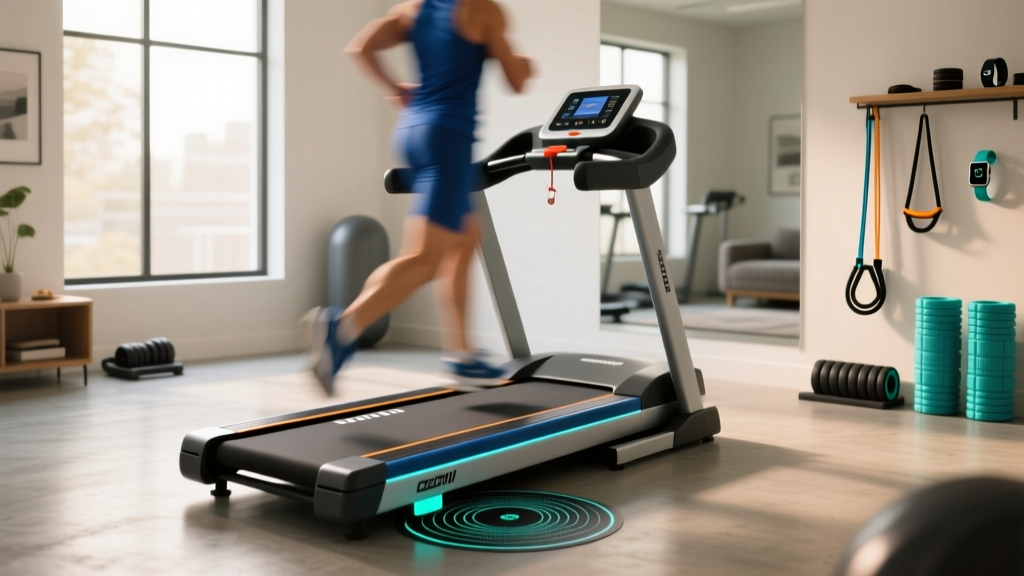
Force Plate Treadmill Installation & Noise Level Comparison Guide
Master your force plate treadmill installation with our walkthrough. Compare cardio machine noise levels and optimize acoustic dampening.

The Dual Challenge: Acoustic vs. Signal Noise in Biomechanics Labs
Installing a force plate treadmill—such as the Bertec FIT, AMTI Tandem, or an h/p/cosmos system integrated with Kistler piezoelectric sensors—is a masterclass in precision engineering. These systems, which typically range from $65,000 to over $150,000 depending on sensor density and belt width, are the gold standard for gait analysis, sports science, and clinical rehabilitation. However, facility managers and lab directors frequently overlook a critical variable during setup: noise.
When we discuss noise in the context of advanced cardio machines, we must differentiate between two distinct phenomena:
- Acoustic Noise: The airborne sound pressure level (measured in decibels, dB) generated by the motor, belt friction, and footstrike impacts. This affects researcher comfort and patient focus.
- Signal Noise (Electromagnetic Interference): The electrical 'hum' or transient spikes generated by the treadmill's high-torque motor and variable frequency drive (VFD) that bleeds into the sensitive strain gauges or piezoelectric crystals of the force plates, corrupting ground reaction force (GRF) data.
As of 2026, modern biomechanics labs demand rigorous isolation protocols for both. Below is a comprehensive setup and installation walkthrough designed to mitigate both acoustic and signal noise, ensuring pristine data capture and a compliant facility environment.
Cardio Machine Noise Level Comparison Matrix
To contextualize the acoustic footprint of a force plate treadmill, it is essential to compare it against standard commercial and residential cardio equipment. The following matrix outlines average acoustic outputs and impact vibrations at a standard operational pace (e.g., 6.0 mph or equivalent resistance).
| Machine Type | Average Acoustic Output (dB) | Peak Impact Transients | Primary Noise & Vibration Source |
|---|---|---|---|
| Standard Commercial Treadmill (e.g., Woodway 4Front) | 72 - 78 dB | High (Heel Strike) | Motor whine, belt slapping, deck impact |
| Force Plate Treadmill (e.g., Bertec FIT) | 65 - 71 dB (Belt) | Extreme (Sensor Coupled) | Drive motor VFD, structural resonance through chassis |
| Elliptical Cross-Trainer | 55 - 62 dB | Low | Drive belt, flywheel bearings |
| Air Bike (e.g., Assault Fitness) | 75 - 85 dB | Moderate (Air Displacement) | Wind resistance fan, chain drive |
| Rowing Ergometer (e.g., Concept2 Model D) | 68 - 74 dB | Low | Air baffle, seat rollers on rail |
Note: While the continuous belt noise of a force plate treadmill is often quieter than a standard commercial treadmill due to specialized dampening decks, the localized footstrike transients are directly transferred into the chassis and floor, requiring specialized acoustic isolation.
Expert Insight: According to guidelines from the CDC NIOSH Occupational Noise Exposure standards, prolonged exposure to noise above 85 dB requires hearing protection. While cardio machines rarely exceed this threshold continuously, the cumulative low-frequency rumble of multiple treadmills in a sports science facility can cause fatigue and interfere with sensitive audio-based motion capture markers.Phase 1: Structural Prep and Acoustic Isolation
You cannot simply uncrate a 1,500 lb force plate treadmill and place it on standard commercial carpet or luxury vinyl plank. The structural coupling between the treadmill chassis and the building's foundation will transmit low-frequency vibrations throughout the facility, potentially disrupting sensitive MRI equipment or microscope arrays in adjacent clinical rooms.
Subfloor Requirements
- Concrete Slab: A minimum 6-inch thick, reinforced concrete slab on grade is required. Suspended floors (wood joists or steel pan decking) will flex under the dynamic loading of a running athlete, introducing catastrophic artifacts into the vertical GRF (Fz) data.
- Levelness Tolerance: The installation footprint must be level to within 1/8th of an inch over a 10-foot radius. Use a laser level to map the floor before the machine arrives.
Acoustic Decoupling Materials
To manage the cardio machine noise level and prevent structural vibration transfer, install a floating floor pad beneath the treadmill. We recommend Regupol 4512 or a high-density recycled rubber acoustic underlayment (minimum 3/8-inch thick, 60 durometer). This material absorbs the high-amplitude, low-frequency transients generated by heel strikes, preventing them from traveling through the concrete.
Phase 2: Positioning, Leveling, and Vibration Dampening
Once the site is prepped, the physical installation begins. This phase is critical for ensuring the force measurement systems operate within their calibrated tolerances.
- Rigging and Placement: Use specialized machinery skates. Never drag the treadmill, as this will destroy the internal leveling feet and potentially misalign the split-belt gap (which must remain exactly 4mm to 6mm to prevent sensor cross-talk).
- Precision Leveling: Place a precision machinist level (accurate to 0.02mm/m) on the lateral and longitudinal axes of the treadmill deck. Adjust the heavy-duty leveling feet. Failure Mode: If the treadmill is pitched forward by even 1 degree, the constant gravitational vector will skew the anterior-posterior shear force (Fy) readings, requiring complex software offsets that degrade data integrity.
- Anti-Vibration Mounting: Place Mason Industries neoprene-in-shear isolator pads under each leveling foot. This provides a secondary layer of high-frequency vibration dampening, isolating the motor's 60Hz hum from the force plate chassis.
Phase 3: Electrical Routing to Eliminate Signal Noise
Acoustic noise is a comfort issue; signal noise is a data-destroyer. The variable frequency drives (VFDs) used to control the massive 3HP to 5HP motors on instrumented treadmills generate severe electromagnetic interference (EMI).
'Ground loops are the silent killer of biomechanical data. If your force plates share a ground path with the treadmill's drive motor, every footstrike will be accompanied by a 60Hz electrical sine wave that renders shear force calculations useless.' — Senior Biomechanics Lab Director
Electrical Installation Checklist
- Dedicated Circuit: The treadmill must be on a dedicated 20-Amp (or 30-Amp, depending on the model) circuit. It cannot share a breaker with the data acquisition (DAQ) computer or lab lighting.
- Isolated Ground (IG): Ensure the receptacle features an Isolated Ground (orange triangle), wired directly back to the main building ground bus, bypassing any intermediate conduit grounds that might carry stray voltage.
- Cable Separation: Route the analog/digital sensor cables (from the force plates to the DAQ) at least 18 inches away from the treadmill's main power supply cable. If they must cross, they must do so at a strict 90-degree angle to minimize inductive coupling.
Phase 4: Calibration and Baseline Noise Floor Testing
With the machine physically secured and electrically isolated, you must establish the baseline noise floor. This verifies that your acoustic and electrical dampening efforts were successful.
Step 1: Static Zeroing and Crosstalk Verification
Power on the DAQ system and the treadmill belt (set to 0.5 mph to engage the motor without dynamic loading). Zero the force plates. Observe the raw voltage output. If you see a rhythmic oscillation matching the belt rotation speed, you have motor-induced signal noise. Re-check your isolated ground and cable separation.
Step 2: Acoustic Baseline Measurement
Using a calibrated Class 1 Sound Level Meter (set to A-weighting, slow response), measure the ambient room noise. Then, increase the treadmill speed to 8.0 mph with no user on the belt.
Target Metrics: The acoustic output should not exceed 72 dB at a distance of 1 meter from the motor housing. If it does, inspect the belt tension and deck lubrication (most modern force plate treadmills use wax-impregnated decks; applying liquid silicone will destroy the friction coefficients and void the warranty).
Step 3: Dynamic Impact Testing
Have a test subject (approx. 75 kg) run at a self-selected pace. Monitor the vertical force (Fz) peaks. Clean data should show smooth loading and unloading curves. 'Fuzzy' or jagged lines indicate high-frequency structural resonance bouncing back from the floor into the chassis—requiring thicker acoustic underlayment.
Troubleshooting Common Installation Failures
Warning: Edge Cases in Facility Setup
- HVAC Interference: Do not install the treadmill directly beneath a high-velocity HVAC return vent. The acoustic noise of the air handler will mask verbal cues during gait retraining, and the vibration can transfer down the wall into the treadmill frame.
- Split-Belt Synchronization Artifacts: If using a dual-belt force plate treadmill for asymmetry analysis, ensure the software synchronization cable is shielded. A 2-millisecond latency between the left and right belt motor controllers will create false asymmetries in braking and propulsive shear forces.
- Thermal Drift: Piezoelectric force plates are sensitive to temperature changes. Maintain the lab at a constant 68°F - 72°F (20°C - 22°C). A sudden spike in room temperature from afternoon sun hitting the chassis can cause thermal drift, mimicking low-frequency signal noise.
Conclusion
Setting up a force plate treadmill is not merely a matter of assembly; it is an exercise in environmental control. By understanding the distinct differences between acoustic noise and signal interference, and by rigorously applying structural decoupling and electrical isolation techniques, you protect your six-figure investment. Referencing standards from organizations like the Acoustical Society of America and adhering to manufacturer-specific tolerances will ensure your facility yields pristine, publication-grade biomechanical data for years to come.
More gear to consider
All reviews
Xterra Treadmill Motor Guide: Horsepower Explained for Beginners

Walking Pads vs. Traditional Types of Treadmills (2026)

Curved vs Motorized Setup & ProForm Crosswalk Treadmill Reviews
Spin, Upright & Recumbent Bikes + True Treadmill Lubricant Guide

Rowing Machine Setup & Technique to Supplement Free Treadmill Workouts
