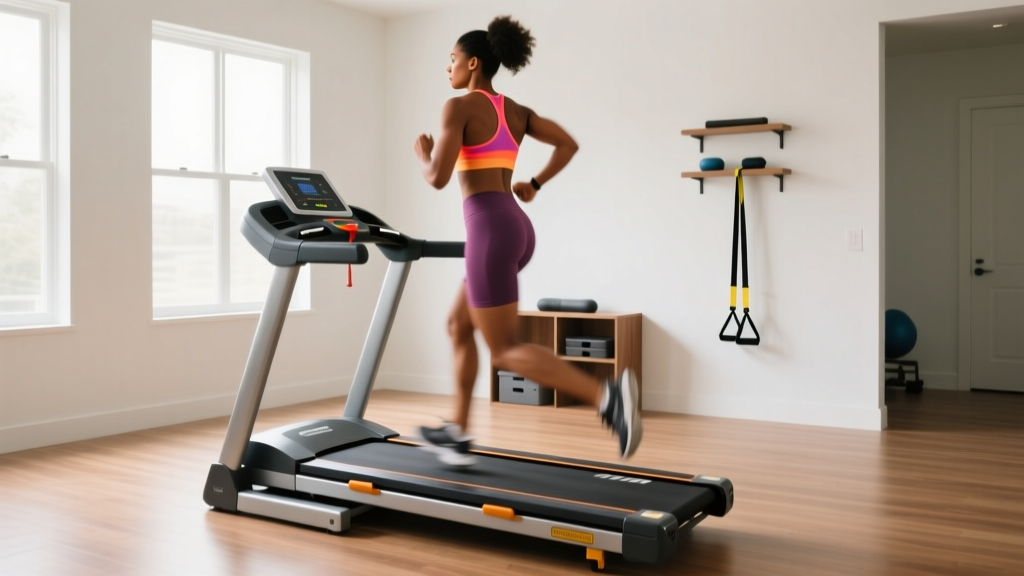
Budget Folding Treadmills: Treadmill Stress Test Target Heart Rate
We review budget folding treadmills for small spaces, analyzing if they safely sustain a treadmill stress test target heart rate protocol.

The Hidden Complexity of At-Home Cardiac Monitoring
In the 2026 compact fitness market, folding treadmills are the undisputed champions of small-space living. They slide under beds, fold into closets, and offer a convenient way to maintain cardiovascular health. However, a highly specific and often overlooked use case arises when users are prescribed at-home cardiac rehabilitation or monitored fitness evaluations. If your physical therapist or cardiologist requires you to perform a submaximal evaluation to reach your treadmill stress test target heart rate, the mechanical and electronic demands on the machine change drastically.
Most budget folding treadmills are engineered for steady-state walking or light jogging. Pushing a user to 85% of their age-predicted maximum heart rate—often required during clinical stress protocols—demands sustained motor torque, precise speed calibration, and accurate biometric feedback. When a machine fails under this specific load, it does not just ruin a workout; it compromises clinical data and introduces severe safety hazards like belt stuttering or sudden motor shutoffs.
Clinical Context: What is the Target?
According to the American Heart Association, target heart rates during moderate to vigorous stress testing generally fall between 64% and 85% of your maximum heart rate. To achieve this on a treadmill without running, clinical protocols (like the Bruce or Balke protocols) rely on steep inclines and specific speed ramps. If your folding treadmill cannot sustain these ramps, you cannot safely or accurately hit your treadmill stress test target heart rate.
Value Analysis: Can Sub-$800 Folding Treadmills Handle Stress Protocols?
To evaluate the true value of budget folding treadmills, we must look past the marketing claims of 'peak horsepower' and analyze continuous duty motors, belt ply construction, and incline mechanics under the duress of a stress test protocol.
1. Horizon Fitness T101 (Approx. $699)
The Horizon T101 is widely considered the gold standard for budget-friendly home cardio. It features a 2.5 Continuous Horsepower (CHP) motor and a 55-inch belt. Stress Test Viability: The 2.5 CHP motor is robust enough to handle the amperage draw of a 200-pound user walking at 3.5 mph without tripping the thermal breaker. However, the T101 maxes out at a 10% power incline. The standard Bruce Protocol requires a 14% incline by Stage 3. Therefore, while the T101 can help you reach your treadmill stress test target heart rate via a Modified Balke protocol (relying on speed rather than extreme incline), it cannot replicate a full clinical Bruce test. The value here is high for submaximal testing, but limited for advanced clinical replication.
2. Sunny Health & Fitness SF-T7516 (Approx. $349)
This ultra-budget folding model is a favorite for apartment dwellers. It boasts a 1.0 HP motor and manual incline settings. Stress Test Viability: Poor. A 1.0 HP motor is essentially a peak rating, delivering roughly 0.6 CHP under load. When you attempt to elevate your heart rate to the 150+ BPM range required for a stress test, you must walk briskly at an incline. The SF-T7516’s 1-ply belt will stretch under high-tension incline walking, causing the drive roller to slip. This results in a dangerous micro-stuttering effect. Furthermore, the manual incline pins are difficult to adjust mid-stride, making standardized protocol ramping impossible. We strongly advise against using this model for any form of targeted cardiac stress testing.
3. ProForm City L6 (Approx. $599)
Designed specifically for small spaces, the City L6 folds flat and features a minimalist console. Stress Test Viability: Moderate to Low. The 1.6 CHP motor is adequate for flat walking, but the City L6 features a 0% fixed incline. Because you cannot utilize grade resistance, reaching your treadmill stress test target heart rate requires walking at speeds exceeding 4.5 mph. For many cardiac rehab patients, fast walking or jogging introduces orthopedic joint stress that the test is specifically trying to avoid. The lack of incline severely limits the machine's utility for controlled, low-impact heart rate elevation.
Comparative Breakdown: Budget Models vs. Clinical Demands
| Model | Price (2026) | Motor (CHP) | Max Incline | Stress Test Rating |
|---|---|---|---|---|
| Horizon T101 | $699 | 2.5 CHP | 10% | Good (Modified) |
| ProForm City L6 | $599 | 1.6 CHP | 0% | Poor (No Grade) |
| Sunny SF-T7516 | $349 | ~0.6 CHP | Manual | Fail (Safety Risk) |
The Biometric Bottleneck: Console Sensors vs. Chest Straps
Reaching your treadmill stress test target heart rate is only half the equation; accurately measuring it is the other. Budget folding treadmills universally rely on dual-grip stainless steel pulse sensors embedded in the handrails. From a biomechanical and electrical engineering standpoint, these sensors are highly problematic during a stress test.
During a clinical evaluation, as outlined by the Mayo Clinic, continuous and precise ECG or heart rate monitoring is vital to detect arrhythmias or ischemic events. Budget grip sensors suffer from 'motion artifact'—the electrical noise generated by your muscles gripping the rails and the friction of your palms sweating. This can cause the console to display a heart rate that is 10 to 15 BPM lower than your actual physiological state, leading you to overexert yourself dangerously.
Expert Troubleshooting Tip: Never rely on a sub-$1,000 treadmill's built-in grip sensors to dictate the endpoint of a stress test. You must bypass the console entirely by wearing a medical-grade or high-fidelity consumer chest strap (such as the Polar H10 or Garmin HRM-Pro). These devices use electrical leads to read cardiac depolarization directly, eliminating the motion artifact inherent in budget treadmill handrails.Budget Allocation: Where Should You Spend Your Money?
If your primary goal is to conduct at-home submaximal stress testing in a small space, your budget breakdown must prioritize continuous torque and belt stability over smart screens or interactive programming.
- Motor Controller Board (PWM): Budget machines use cheap Pulse Width Modulation boards that overheat when asked to sustain 3.0+ mph at an incline for more than 15 minutes. Allocate at least $600-$750 to ensure the machine uses a heavy-duty heat sink on the motor controller.
- Belt Ply and Waxing: A 2-ply belt with a pre-waxed underside reduces friction coefficient by up to 40%. This means the motor draws fewer amps to maintain speed under your body weight, keeping the machine stable as you push toward your treadmill stress test target heart rate.
- Frame Welding vs. Bolting: Many ultra-compact folding treadmills use bolted hinges to save manufacturing costs. Under the heavy, asymmetrical foot strikes of a fatigued user at high heart rates, bolted hinges develop lateral play, causing the deck to sway. Look for welded steel uprights, even if it means sacrificing a few inches of folding clearance.
Final Verdict: The True Cost of Clinical Accuracy at Home
When evaluating folding treadmills for small spaces through the lens of cardiac stress testing, the definition of 'value' shifts. A $350 treadmill is a fantastic value for casual walking, but it is a severe liability and a poor investment for anyone needing to reliably hit a treadmill stress test target heart rate. The mechanical limitations—specifically the lack of continuous horsepower and inadequate incline ranges—make sub-$500 models fundamentally incompatible with standardized clinical protocols.
For small-space dwellers requiring at-home cardiac monitoring, the Horizon T101 represents the absolute floor for acceptable value, provided you pair it with a high-fidelity chest strap and utilize a modified, speed-based protocol rather than an incline-based one. If your physician requires strict adherence to a 14%+ incline Bruce Protocol, you must abandon the folding category entirely and allocate a budget north of $1,500 for a commercial-grade, non-folding chassis. In the realm of cardiovascular health, cutting corners on continuous torque and belt friction is a budget breakdown that ultimately costs too much.
More gear to consider
All reviews
Curved vs Motorized Treadmill Setup: How Long is 10,000 Steps?

How to Disassemble a NordicTrack Treadmill & Air Bike vs Assault Bike
Motor HP Guide: NordicTrack Treadmill Speed Sensor vs Sole F80 Motor
Curved vs Motorized: Top Brands of Treadmills for Beginners

Portable Cardio vs. The VO2 Max Treadmill Test: 2026 Market Trends
