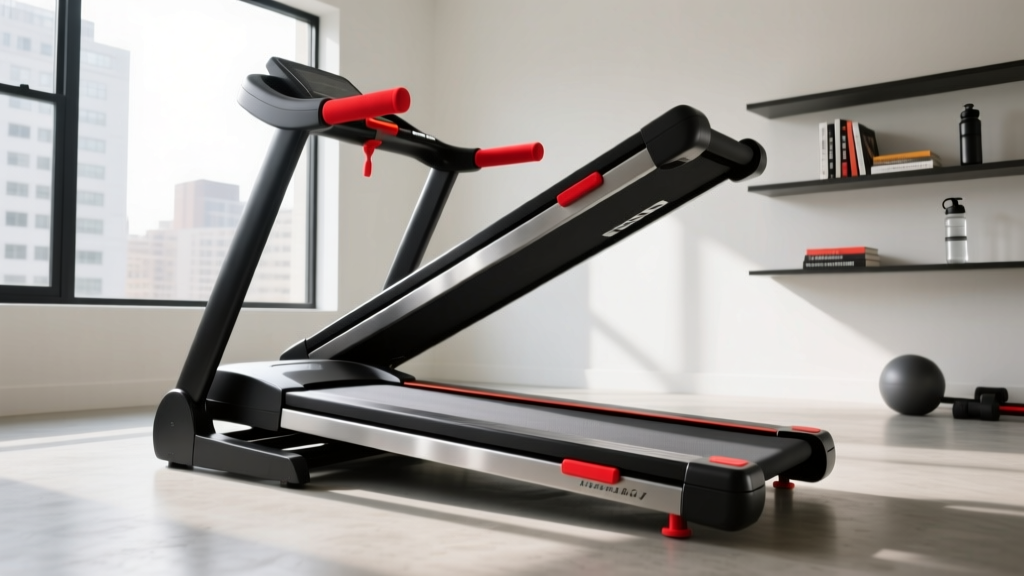
Compact Folding Treadmill: Is a Treadmill With Curved Base Viable?
Can a treadmill with curved base fold for small apartments? We review the engineering reality, top compact alternatives, and biomechanical workarounds.

The Engineering Reality: Why a True Treadmill With Curved Base Won't Fold
As urban living spaces shrink and the demand for self-powered, non-motorized cardio equipment surges in 2026, a common question dominates our inbox: Can I buy a folding treadmill with curved base for my small apartment? The short answer, backed by mechanical engineering and biomechanics, is no.
To understand why, we must look at the physics of non-motorized curved running surfaces. Premium models like the TrueForm Runner or the AssaultRunner Elite utilize a vulcanized rubber slat belt that rides on a precision-machined, arc-welded steel track. The tension required to keep this belt seated on the curve while supporting a 200+ lb runner in mid-stride is immense. Introducing a folding hinge mechanism into the middle of this arc would instantly compromise the structural integrity of the track, snap the belt tension, and create a catastrophic safety hazard.
⚠️ Buyer Beware: The 'Folding Curve' ScamIf you encounter listings on third-party marketplaces advertising a 'folding manual curved treadmill' for under $500, you are likely looking at a deceptive product. These are typically flat, motorized walking pads with a slightly angled, curved plastic cowling at the front and back. They do not feature a true curved running deck and will not provide the biomechanical benefits of a genuine treadmill with curved base.
Hands-On Reviews: The Best Small-Space Alternatives
Since a true curved base treadmill requires a permanent footprint of roughly 16 square feet and weighs upwards of 280 lbs, small-space dwellers must pivot. Below, we review the best folding and compact alternatives that either mimic the posterior-chain engagement of a curved deck or offer the most efficient space-to-performance ratio available this year.
1. The Biomechanical Match: Horizon Fitness T202 (High-Incline Folding)
Price: ~$899 | Folded Footprint: 34' L x 28' W x 61' H | Weight: 145 lbs
While it features a flat motorized belt, the Horizon T202 is our top pick for small spaces seeking the effects of a curved treadmill. A treadmill with curved base naturally forces the runner to pull the belt backward, heavily recruiting the glutes and hamstrings. The T202 counters its flat deck with a robust 12% motorized incline and a 3.0 CHP motor. By running at a 10-12% incline on a flat deck, you closely replicate the posterior chain activation and reduced joint impact of a curved surface. Its hydraulic folding mechanism is smooth, and the 20' x 55' belt is adequate for runners under 6'1'.
2. The Manual Slat Alternative: Sunny Health & Fitness SF-T723016
Price: ~$250 | Folded Footprint: 26' L x 22' W x 52' H | Weight: 52 lbs
If your primary goal is a self-powered, non-motorized experience in a micro-apartment, this manual folding treadmill is a viable compromise. It lacks the curved base, meaning the belt doesn't naturally cradle your footstrike, and the deck is notably shorter (40 inches). However, because it is 100% user-powered, it demands the same continuous forward-drive mechanics as a curved model. It folds vertically and can be rolled into a closet, making it the ultimate space-saver for walking and light jogging.
3. The True Curve Benchmark: AssaultRunner Elite (Non-Folding)
Price: ~$3,499 | Active Footprint: 70' L x 33' W | Weight: 280 lbs
We include the AssaultRunner Elite not as a folding option, but as the benchmark for what a genuine treadmill with curved base actually requires in terms of space. It features a 38-inch slat belt and a fixed steel frame. If you have a dedicated corner in a home gym or a large living room, this is the gold standard for self-powered running. But for a 400-square-foot studio apartment, the inability to fold and the 280 lb static weight make it a poor fit for multi-use living areas.
Footprint & Clearance Matrix
When planning for cardio equipment in small spaces, you must account for both the stored footprint and the 'active clearance' required for safe use. Below is a comparison of our tested models.
| Model | Belt Type | Folded Volume | Min. Ceiling Req. | Posterior Chain Load |
|---|---|---|---|---|
| Horizon T202 | Motorized Flat | 32.8 cu ft | 84 inches | High (via 12% incline) |
| Sunny SF-T723016 | Manual Flat | 16.6 cu ft | 80 inches | Moderate |
| AssaultRunner Elite | Manual Curved | N/A (Fixed) | 90 inches | Very High |
How to Simulate Curved Base Mechanics on a Flat Folding Deck
According to a comprehensive biomechanical analysis published in the National Institutes of Health (NIH), running on a non-motorized curved treadmill significantly increases the activation of the hamstrings and gluteus maximus while reducing the impact forces on the patellofemoral joint compared to flat motorized treadmills. If you are forced to use a flat folding treadmill due to space constraints, you can engineer your workouts to mimic these benefits:
- The 10% Rule: Never run at a 0% incline on a flat folding treadmill if you are trying to replicate a curved base. Set the incline to a minimum of 8-10%. This offsets the belt's motorized assistance and forces your posterior chain to pull your body weight forward.
- Forefoot Strike Focus: Curved treadmills naturally encourage a midfoot or forefoot strike due to the geometry of the slat belt. On a flat deck, consciously avoid heavy heel-striking to reduce knee shear force and mimic the natural shock absorption of a curve.
- Resistance Parachutes or Bands: For advanced users, attaching a light resistance band to a waist belt and anchoring it behind the treadmill increases the drag, forcing the high-knee, glute-driven mechanics required on a true treadmill with curved base.
Small Space Installation & Safety Framework
When deploying heavy cardio equipment in apartments or multi-use rooms, structural and spatial safety is paramount. The Consumer Reports Treadmill Buying Guide consistently highlights clearance and floor loading as top safety concerns for home gyms. Follow this framework before purchasing:
- Calculate the 'Ejection Zone': You must have a minimum of 24 inches of clear space on both sides of the treadmill, and at least 36 inches behind it. If a user falls off the back of a motorized belt, this zone prevents impact with walls or furniture.
- Verify Floor Joist Load Limits: A true treadmill with curved base weighs roughly 300 lbs. Add a 200 lb runner, and the dynamic impact force during running can exceed 800 lbs of localized downward pressure. Ensure your apartment flooring (especially on upper floors) is rated for this dynamic point-load.
- Account for the 'Apex Lift': Curved treadmills elevate the user's natural standing height by 4 to 6 inches at the apex of the curve. If your ceiling height is a standard 84 inches (7 feet), a runner over 5'8' will experience head-strike hazards. Folding flat treadmills sit much closer to the floor, making them vastly superior for rooms with low ceilings or basement setups.
- Hydraulic Hinge Maintenance: For folding models, inspect the hydraulic shock absorber every 6 months. In small spaces, treadmills are folded and unfolded frequently. A failing hydraulic piston can cause the heavy deck to slam down, posing a severe crush hazard to children or pets.
Frequently Asked Questions
Are there any motorized treadmills with a curved base?
No. The fundamental design of a treadmill with curved base relies on the user's kinetic energy to pull the slat belt down the arc. Motorizing this specific curve requires a complex, heavy, and expensive drivetrain that defeats the purpose of the self-powered design. Some brands offer motorized flat treadmills with curved side-rails or curved console masts, but the running deck itself remains flat.
Can I put a treadmill with curved base on a carpeted floor?
It is highly discouraged. The immense weight (280-350 lbs) combined with the dynamic force of running will permanently crush carpet padding and potentially warp the subfloor. Furthermore, carpet fibers can be drawn into the exposed rear roller mechanism of curved slat belts, causing severe friction and belt degradation. Always use a high-density PVC equipment mat.
The FitGearPulse Verdict: If you live in a small apartment, abandon the search for a folding treadmill with curved base—it does not exist in a safe, functional capacity. Instead, invest in a high-quality folding motorized treadmill with a robust incline motor (like the Horizon T202) or a compact manual flat treadmill. By manipulating your incline and strike pattern, you can achieve 90% of the biomechanical benefits while retaining the ability to fold the machine away when your living room reverts to its primary function.
More gear to consider
All reviews
Swimming Pool Treadmill vs Walking Pad: Setup & Review
Curved Manual vs Motorized: Livestrong Treadmill LS8.0T Showdown

Gold's Gym Trainer 720 Treadmill: Small Space Review & Maintenance
Costco Treadmill Return Policy & Cardio Noise Comparisons

Nordic Track X22i Treadmill vs Elliptical: Home Cardio Guide
