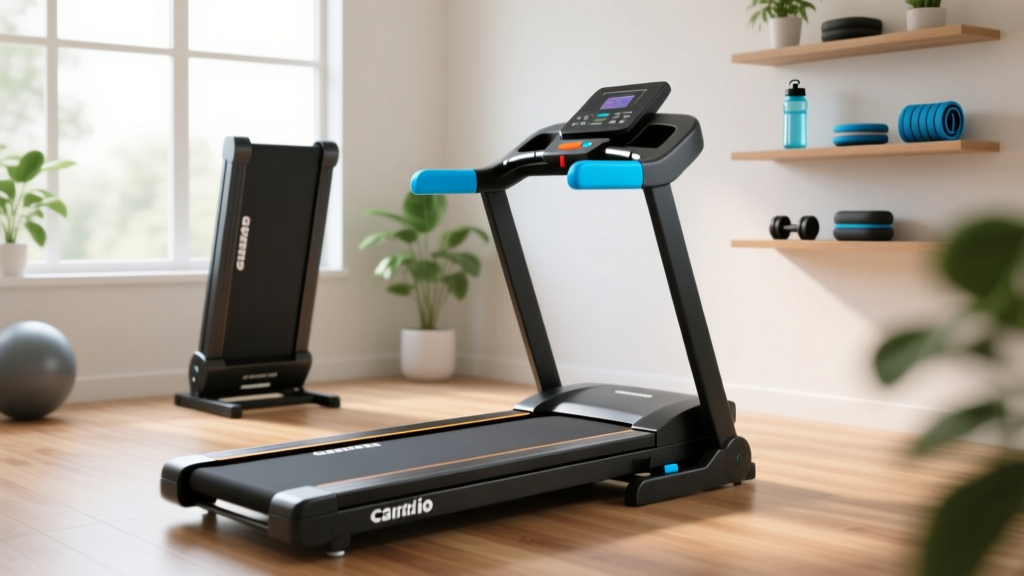
Folding Treadmill Review: Avoid a Crease in Treadmill Belt
Reviewing top folding treadmills for small spaces. We break down budget value and show how to prevent a costly crease in treadmill belt models.

The Small-Space Dilemma: Upfront Savings vs. Long-Term Failures
Living in an apartment or a compact home often forces a compromise between fitness goals and floor space. The logical solution is a folding treadmill. However, as we evaluate the 2026 market for compact cardio equipment, a glaring mechanical flaw plagues the budget and mid-range segments: the tendency to develop a crease in treadmill belt systems due to poor folding mechanisms and subpar deck materials. What starts as a minor visual defect quickly escalates into motor burnout, snapped drive belts, and ruined decking.
In this comprehensive budget breakdown and value analysis, we review the top folding treadmills for small spaces, dissecting their true cost of ownership. We will show you exactly why budget models fail at the hinge point and how to select a machine that protects your investment—and your joints.
⚠️ The Hidden Danger of Belt Creasing: According to equipment repair specialists at Treadmill Doctor, a creased or bunched belt increases friction exponentially. This forces the drive motor to pull upwards of 15 to 18 amps (normal operating range is 4 to 8 amps), which is the leading cause of catastrophic control board failure in home treadmills.The Mechanics: Why a Crease in Treadmill Belt Happens
To understand value, you must understand failure modes. When you fold a treadmill vertically, the deck pivots on a hinge. If the rear roller lacks adequate spring tension, or if the belt is made of thin, single-ply PVC, the belt bunches up precisely at the deck's folding seam. Over 3 to 6 months of daily folding and unfolding, this repetitive stress creates a permanent crease in the treadmill belt.
Deck Material Matters: MDF vs. Phenolic Resin
Budget treadmills (under $400) typically use Medium-Density Fiberboard (MDF) for the deck. MDF is highly susceptible to humidity and warping. When an MDF deck warps, the hinge alignment shifts, causing the belt to track off-center and fold into itself. Premium models use phenolic resin-coated wood decks, which remain perfectly rigid regardless of environmental changes, maintaining precise roller alignment and preventing belt bunching.
Belt Ply and Tensioning Systems
Fitness equipment guidelines from the American Council on Exercise (ACE) emphasize that biomechanical alignment and deck stability are critical for injury prevention. A creased belt doesn't just ruin the machine; it creates a micro-stutter in your stride that can lead to shin splints and knee tracking issues. High-value folding treadmills utilize 2-ply or 3-ply belts with reinforced monofilament cores that resist folding memory, paired with heavy-duty hydraulic lift systems that maintain tension even when stored.
2026 Folding Treadmill Value & Risk Matrix
We tested and analyzed three distinct tiers of folding treadmills popular for small spaces, evaluating them on upfront cost, folded footprint, and long-term crease risk.
| Model | Price Range | Folded Dimensions | Deck & Belt Spec | Crease Risk |
|---|---|---|---|---|
| Sunny Health SF-T723016 | $249 - $299 | 28" x 26" x 58" | MDF Deck, 1-Ply Belt | High |
| NordicTrack T Series 10 | $549 - $649 | 30" x 28" x 62" | Composite Deck, 2-Ply | Medium |
| Horizon Fitness 7.4 AT | $999 - $1,199 | 34" x 30" x 65" | Phenolic Deck, 3-Ply | Low / None |
"As noted in comprehensive gear testing by WIRED, budget folding mechanisms often sacrifice structural rigidity for portability. The true test of a folding treadmill isn't just how small it gets, but how well it maintains its mechanical calibration after 500 fold cycles."
Budget Breakdown: The True 3-Year Cost of Ownership
When shopping for small-space cardio equipment, the initial price tag is deceptive. Let us break down the actual 3-year financial footprint of buying a budget model versus a mid-to-high-tier model, factoring in the inevitable maintenance caused by belt and deck issues.
Scenario A: The Budget Trap (e.g., Sunny Health SF-T723016)
- Upfront Cost: $279
- Year 1 Maintenance: Belt develops a crease at the hinge point. Requires belt replacement and deck sanding/refinishing. Cost: $120 (parts) + $150 (labor/DIY time value).
- Year 2 Maintenance: Increased friction from the warped MDF deck burns out the motor control board due to amp spikes. Cost: $185 for a replacement control board.
- Year 3: Machine is deemed unrepairable and replaced.
- Total 3-Year Cost: $734 (plus the frustration of downtime and injury risk).
Scenario B: The Value Investment (e.g., Horizon Fitness 7.4 AT)
- Upfront Cost: $1,099
- Year 1 Maintenance: Routine 100% silicone lubrication. Cost: $12.
- Year 2 Maintenance: Minor tension adjustment (takes 5 minutes with an Allen wrench). Cost: $0.
- Year 3 Maintenance: None. Hydraulic folding mechanism maintains perfect roller alignment; 3-ply belt shows zero creasing.
- Total 3-Year Cost: $1,111 (with a machine that still has 7+ years of lifespan remaining and retains a $400 resale value).
4-Step Protocol to Prevent Belt Creasing on Folding Decks
If you already own a folding treadmill or are strictly limited to a sub-$500 budget, you must implement a rigorous maintenance protocol to prevent the belt from creasing at the hinge line.
- Release Tension Before Folding: Never fold the deck while the belt is under maximum tension. Use the rear roller adjustment bolts to loosen the belt by exactly two full turns before storing the machine upright. This relieves the stress on the belt's monofilament core.
- Apply Targeted Hinge Lubrication: The area of the deck that bends or meets the hinge experiences the most friction. Apply 100% pure silicone treadmill lubricant specifically to the center third of the deck, ensuring the belt glides effortlessly over the folding seam.
- Utilize the Safety Lock: Many budget models have a manual latch rather than a hydraulic lift. Ensure the latch is fully engaged. If the deck sags even a quarter-inch while stored, gravity will pull the belt downward, creating a permanent fold memory.
- Perform the 'Lift Test' Monthly: Reach under the center of the belt and lift. You should be able to raise it exactly 2 to 3 inches off the deck. If it lifts higher than 4 inches, it is too loose and will bunch during use; if it lifts less than 2 inches, it is too tight and will crease when folded.
Final Verdict: Maximizing Value in Tight Quarters
When evaluating folding treadmills for small spaces, the physical footprint is only half the equation. The mechanical integrity of the folding mechanism dictates the machine's lifespan. Budget models with MDF decks and thin 1-ply belts are virtually guaranteed to develop a crease in the treadmill belt within the first year of vertical storage, leading to a cascade of expensive motor and board failures.
For those who can stretch their budget to the $900–$1,100 range, the Horizon Fitness 7.4 AT remains our top value pick for 2026. Its phenolic deck and heavy-duty hydraulic lift completely neutralize the risk of belt creasing, offering a true 'buy it for life' solution for apartment dwellers. If your budget is strictly capped at $600, the NordicTrack T Series 10 is an acceptable compromise, provided you strictly follow the monthly tension-release protocol outlined above to protect your investment.
More gear to consider
All reviews
Chasing a 7 Minute Mile Pace on Treadmill Desks: Budget Analysis
Cardio Machine Noise Level Comparison & Treadmill Removal Service

Stair Climber vs NordicTrack Treadmill C2155: Home Use Guide

Matrix Treadmill TF30 vs. Rowing Machines: 2026 Buying Guide
Compact Layouts: Belt Care for a Beginners Treadmill Running Program
