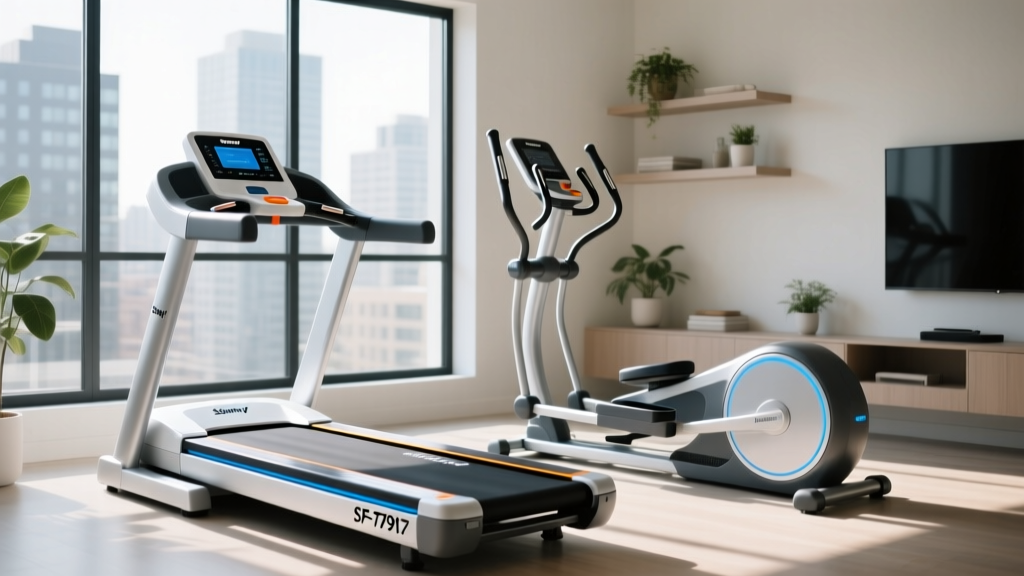
2026 Trends: Elliptical vs Treadmill & Sunny Treadmill SF-T7917
Analyze 2026 elliptical vs treadmill market trends, featuring a deep-dive performance and value analysis of the Sunny Treadmill SF-T7917 for home gyms.

The 2026 Home Cardio Landscape: Shifting Consumer Preferences
As we navigate the 2026 home fitness equipment market, the debate between ellipticals and treadmills has evolved from a simple matter of preference to a data-driven analysis of biomechanics, spatial efficiency, and long-term mechanical reliability. While treadmills continue to dominate the premium commercial sector, the budget-to-mid-tier home market has seen a massive surge in hybrid and low-impact alternatives. However, traditional treadmills remain a staple for osteogenic loading and specific run-training. To understand this market dichotomy, we must benchmark current consumer favorites against established biomechanical standards.
According to the Centers for Disease Control and Prevention (CDC), adults require at least 150 minutes of moderate-intensity aerobic activity weekly. Both machines fulfill this mandate, but their physiological and mechanical footprints differ drastically. In this trend report, we use the highly popular Sunny Treadmill SF-T7917 as our primary benchmark for the mid-tier treadmill segment, comparing its engineering, failure modes, and market positioning directly against comparable mid-tier ellipticals.
Biomechanical Showdown: Ground Reaction Forces vs. Closed-Kinetic Chains
When analyzing market trends, it is crucial to understand why consumers pivot between these two machine types. The decision usually hinges on joint reaction forces (JRF) and bone density requirements.
Expert Insight: The Impact Paradox
Treadmills generate Ground Reaction Forces (GRF) equivalent to 1.5x to 2.5x a user's body weight with each footstrike. This impact is vital for maintaining bone mineral density (osteogenesis). Conversely, ellipticals utilize a closed-kinetic chain movement, reducing JRF to less than 0.5x body weight. While the American Heart Association (AHA) endorses both for cardiovascular health, physical therapists increasingly recommend ellipticals for users with pre-existing meniscal degradation or plantar fasciitis, while reserving treadmills for users prioritizing bone health and running-specific neuromuscular adaptations.
Market Benchmark: Sunny Treadmill SF-T7917 Teardown
The Sunny Treadmill SF-T7917 occupies a highly competitive price bracket (typically retailing between $420 and $550 in 2026). It is engineered to bridge the gap between entry-level walking pads and premium club-series runners. Let us examine the exact specifications that drive its market position:
- Motor Output: 2.5 HP Continuous Duty (Peak output higher, but continuous is the metric that matters for thermal management).
- Running Surface: 20 inches wide by 55 inches long.
- Incline Mechanism: 15% maximum auto-incline via linear actuator.
- Weight Capacity: 300 lbs structural limit.
- Footprint: 69" L x 28" W x 55" H (folded dimensions significantly reduce the spatial footprint).
Engineering Edge Cases and Failure Modes
As domain experts, we must look beyond the spec sheet to real-world failure modes. The SF-T7917's 2.5 HP motor is highly efficient for walking and light jogging. However, an edge case occurs when a user weighing over 240 lbs attempts sustained running at 7.5+ mph on a 15% incline. Under this specific load, the motor's amp draw spikes, which can trigger the internal thermal protection switch or, in poorly ventilated rooms, degrade the lower control board over a 12-month period.
Furthermore, the 55-inch belt length is a critical constraint. Users taller than 6'1" will experience 'stride clipping' during sprint intervals, forcing an unnatural gait alteration that increases Achilles tendon strain. This specific dimensional limitation is a primary reason taller consumers often pivot toward ellipticals with 20-inch or 22-inch adjustable stride lengths, which accommodate longer femurs without spatial penalty.
Comparative Matrix: SF-T7917 vs. Mid-Tier Ellipticals
How does the Sunny SF-T7917 stack up against a similarly priced mid-tier front-drive elliptical (e.g., models in the $400–$600 range with 15-20 lb flywheels)? The following matrix breaks down the operational realities of both platforms in a home environment.
| Feature / Metric | Sunny Treadmill SF-T7917 | Mid-Tier Home Elliptical |
|---|---|---|
| Caloric Expenditure (Avg) | 600-800 kcal/hr (Running) | 500-700 kcal/hr (High Resistance) |
| Joint Impact (JRF) | High (1.5x - 2.5x Bodyweight) | Minimal (< 0.5x Bodyweight) |
| Primary Maintenance | Belt lubrication & tensioning | Pivot bearing greasing & bolt tightening |
| Acoustic Output | 65-75 dB (Motor + Footstrike) | 45-55 dB (Magnetic Resistance) |
| Glute/Hamstring Activation | Maximized at 10-15% incline | Maximized via reverse-striding |
Maintenance Economics: Total Cost of Ownership (TCO)
A major trend in 2026 consumer behavior is the shift toward evaluating Total Cost of Ownership (TCO) rather than just the initial MSRP. Treadmills and ellipticals have vastly different maintenance profiles that impact their long-term value.
The Treadmill Friction Tax
The SF-T7917 utilizes a phenolic-coated deck and a multi-ply PVC belt. This system requires 100% silicone lubricant applied every 150 miles or every 3 months. Critical Warning: Users who apply petroleum-based solvents (like standard WD-40) will instantly degrade the PVC backing, causing the belt to stretch and the motor to overwork. A replacement belt and deck kit for this class of treadmill costs between $80 and $120, effectively adding 20% to the machine's base cost if neglected.
The Elliptical Bearing Reality
Ellipticals eliminate belt friction but introduce complex pivot points. The pedal arms and crank joints rely on needle bearings. In a home environment with fluctuating humidity and dust, these bearings require lithium-based grease every 6 months. If a user hears a rhythmic 'clicking' or 'grinding' from the pedal axis, the needle bearings have likely suffered micro-pitting. Replacing these requires mechanical disassembly, though the parts themselves are cheap (under $30).
The 2026 Decision Framework: Which Machine Wins?
Based on our market analysis and engineering teardowns, the choice between an elliptical and the Sunny Treadmill SF-T7917 should be dictated by a strict decision framework rather than generalized fitness advice.
- Choose the Sunny Treadmill SF-T7917 if: You are under 6'1" tall, weigh under 260 lbs, and require impact loading for bone density. It is also the superior choice if your primary goal is training for outdoor road races, as the 15% auto-incline perfectly simulates hill repeats and specific neuromuscular pacing.
- Choose a Mid-Tier Elliptical if: You reside in an apartment with strict decibel limits (ellipticals are significantly quieter), you have a history of patellofemoral pain syndrome or plantar fasciitis, or you are taller than 6'2" and require a 20+ inch stride length that budget treadmills cannot physically accommodate.
Ultimately, the 2026 market proves that neither machine is universally superior. The Sunny SF-T7917 remains a highly capable, data-backed workhorse for the budget-conscious runner, while ellipticals continue to capture the rehabilitation and low-impact demographics. Align your purchase with your specific biomechanical needs and spatial constraints to ensure long-term adherence and equipment longevity.
More gear to consider
All reviews
Stationary Bike Types vs Conveyor Belt Treadmill Budget Guide
Gold's Gym Treadmill 430i Review: Small Space Layout Guide
Is the Treadmill or StairMaster Better for Weight Loss? 2026 Belt Maintenance Data

Air Bike vs Assault Bike Guide & Ancheer Treadmill Manual Tips

Under Desk Treadmill Review: Office Layouts & Reading on Treadmill