Elliptical vs Treadmill Space: Layouts and Treadmill Bicycle Lopifit
Compare elliptical vs treadmill footprints for home gym layouts. Explore spatial dimensions, clearance needs, and the treadmill bicycle Lopifit alternative.

The Spatial Reality: Footprint Comparisons for Home Cardio
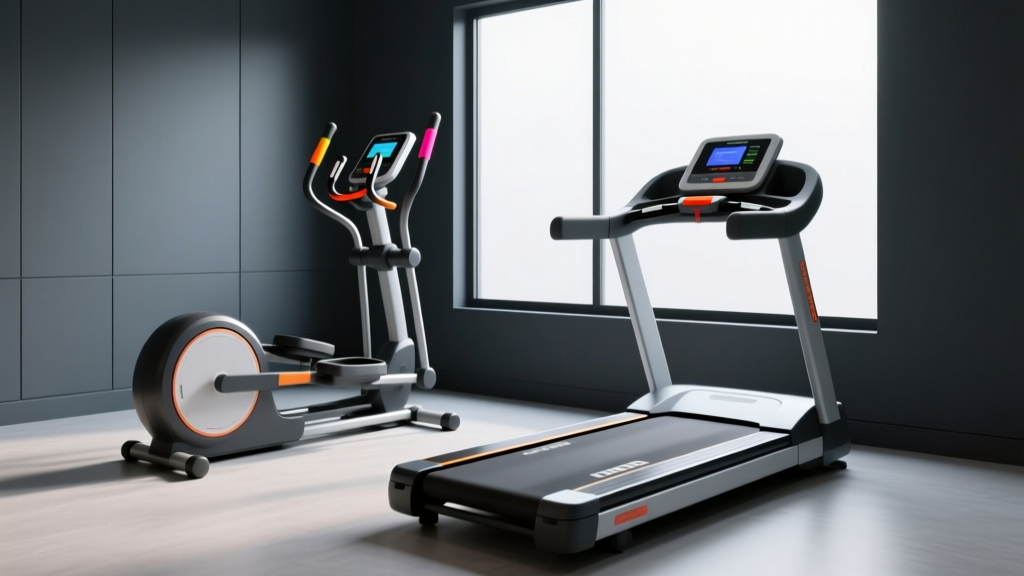
When designing a home gym in 2026, the debate between an elliptical vs treadmill for home cardio rarely hinges on calorie burn alone; it is fundamentally a question of spatial geometry and room layout. Both machines deliver exceptional cardiovascular benefits, aligning with the American Heart Association guidelines for aerobic health. However, their physical footprints dictate entirely different interior design strategies.
Treadmills are inherently longitudinal. A standard high-performance model like the Sole F80 or the NordicTrack Commercial 1750 requires a massive rectangular footprint. Ellipticals, conversely, are more compact in length but demand significant vertical and lateral clearance due to the biomechanics of the pedal stride. Understanding these raw dimensions is the first step in optimizing your home layout.
| Machine Type (Example Model) | Base Footprint (L x W) | Min. Ceiling Clearance | Operational Weight |
|---|---|---|---|
| Standard Treadmill (Sole F80) | 82' x 35' | User Height + 6 inches | 280 lbs |
| Standard Elliptical (NordicTrack SE7i) | 71' x 31' | User Height + 15 inches | 210 lbs |
| Compact Elliptical (Bowflex Max M9) | 49' x 30' | User Height + 12 inches | 145 lbs |
| Folding Treadmill (Horizon 7.4) | 76' x 35' (Folded: 42' x 35') | User Height + 6 inches | 275 lbs |
Note: Dimensions are approximate and represent industry averages for mid-to-high-tier residential machines in 2026.
The Hidden Metrics: Swing Radius and Incline Elevation
The most common failure mode in home gym layout design is ignoring the 'hidden' spatial requirements of cardio machines. A treadmill's base footprint is only half the story. According to safety guidelines highlighted by the U.S. Consumer Product Safety Commission (CPSC), motorized treadmills require a strict clearance zone behind the deck to prevent severe friction injuries in the event of a fall.
The 36-Inch Safety Rule
You must maintain a minimum of 36 inches of unobstructed space directly behind the treadmill belt. If you place a treadmill flush against a wall, a slip could result in the user being pinned against the wall by the moving belt. Furthermore, if your treadmill features a 15% power incline, the rear of the deck will elevate by up to 14 inches, altering the spatial volume of the room and potentially interfering with low-hanging pendant lights or ceiling fans.
Ellipticals bypass the rear-clearance issue but introduce the pedal apex problem. On a standard front-drive elliptical, the pedal reaches its highest point (the apex) during the stride. If you have standard 8-foot (96-inch) ceilings and you are 6 feet (72 inches) tall, an elliptical with a 14-inch pedal apex will put your head at 86 inches at the peak of your stride, leaving only 10 inches of clearance. This creates a claustrophobic environment and risks head strikes if your form breaks down.
Layout Pro Tip: If your home gym is in a basement with low ceilings (under 90 inches), avoid traditional ellipticals. Opt for a low-step-on recumbent elliptical or a compact vertical climber to preserve your vertical spatial envelope.
Rethinking the Layout: The Treadmill Bicycle Lopifit Pivot
What happens when your spatial constraints make traditional indoor machines impossible? When a 7-foot treadmill dominates a small living area, or an elliptical's swing radius disrupts the flow of a multi-purpose room, fitness enthusiasts are increasingly pivoting to hybrid outdoor/indoor locomotion devices. A prime example of this spatial paradigm shift is the treadmill bicycle Lopifit.
How Hybrid Locomotion Solves Indoor Space Deficits
The Lopifit is a unique, walking-powered bicycle that integrates a treadmill belt directly into the bicycle frame's bottom bracket area. Instead of pedaling with your feet, you walk on the belt to propel the bike forward. While it is primarily an outdoor or large-indoor-track machine, its existence offers a radical solution for the space-starved home gym owner.
By shifting your primary walking/running cardio to a device like the treadmill bicycle Lopifit, you completely eliminate the need for a massive indoor treadmill footprint. This frees up 20 to 25 square feet of prime indoor real estate. In a 2026 micro-apartment or a converted garage gym, reclaiming that space allows you to prioritize a power rack, a functional trainer, or a dedicated yoga/mobility zone—equipment that cannot be easily moved outdoors. The Lopifit represents a philosophical shift in space optimization: instead of forcing a massive cardio machine into a small room, you take the cardio machine to the environment where space is infinite.
Strategic Room Planning for 2026 Home Gyms
If you decide to keep your cardio indoors, the placement of your elliptical or treadmill is just as critical as the machine's dimensions. Proper layout design impacts both the longevity of your equipment and your psychological willingness to use it.
- Window-Facing vs. Wall-Facing: Placing a treadmill facing a blank wall increases perceived exertion and boredom. Always orient the machine toward a window or a media center. If a window isn't available, utilize a mirrored wall to create the illusion of depth and expand the room's visual footprint.
- HVAC and Thermal Envelopes: Treadmills and ellipticals generate significant user heat. Do not place them in corners with poor air circulation. Position the machine within the direct path of a ceiling fan or an HVAC vent, but ensure the machine's electronics console is not directly under a condensation-prone AC vent.
- Vibration Dampening: If your home gym is on a second floor or above a living space, treadmills will transmit low-frequency impact noise. Use a 3/8-inch thick vulcanized rubber mat specifically rated for treadmills. This not only protects the floor but reduces the acoustic footprint of the machine by up to 40%.
Decision Framework: Which Machine Fits Your Room?
Use this quick spatial matrix to finalize your home cardio layout decision:
The Spatial Decision Matrix
Choose a Treadmill if: You have a long, narrow room (like a converted hallway or basement corridor) with at least 10 feet of length to accommodate the machine plus the 36-inch rear safety zone. You also have standard or high ceilings.
Choose an Elliptical if: You have a square room with limited length but adequate width, and your ceilings are 9 feet or higher. It is also the superior choice if the room is shared with children or pets, as there is no exposed, high-friction moving belt.
Choose an Alternative (e.g., Lopifit or Air Bike) if: Your total dedicated cardio footprint is under 15 square feet, or your ceilings are below 84 inches. Reclaim your indoor space for strength training and take your walking cardio outdoors.
Final Verdict
The elliptical vs treadmill debate is ultimately won or lost on the blueprint. Treadmills demand length and strict safety perimeters, while ellipticals demand vertical clearance and lateral stride room. By accurately measuring your room's operational volume—not just its floor space—and remaining open to unconventional space-savers like the treadmill bicycle Lopifit for outdoor integration, you can build a home gym in 2026 that is both highly functional and architecturally harmonious.
More gear to consider
All reviews
Beyond Denise Austin Treadmill Reviews: Elliptical vs Treadmill Space Guide
Is the ProForm Treadmill 600 Quiet? 2026 Cardio Noise Comparison

Horizon 7.8 AT Treadmill vs. Competitors: 2026 Feature Comparison
How to Lose Stomach Fat on Treadmill vs. Stationary Bikes

Echelon Treadmill vs. Stationary Bike Types: Space Guide
