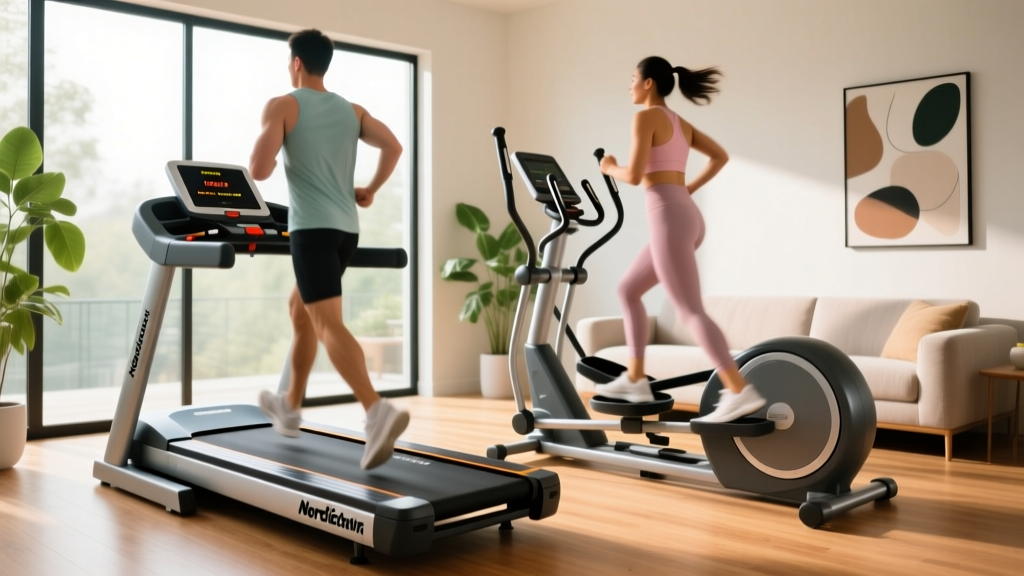
Elliptical vs Treadmill: NordicTrack Treadmill Console Problems
Compare elliptical vs treadmill for home cardio. We review biomechanics, costs, and how to fix common NordicTrack treadmill console problems.

The Home Cardio Dilemma: Biomechanics Meets Digital Reliability
Choosing between an elliptical and a treadmill for your home gym in 2026 is no longer just about counting calories or measuring joint impact. Today’s premium cardio machines are essentially giant tablets with motors attached. While interactive coaching and global route mapping have revolutionized indoor fitness, they have also introduced a new point of failure: the screen. When researching high-end home cardio equipment, many buyers eventually stumble upon forums discussing NordicTrack treadmill console problems, prompting a critical question: Does the risk of software bricking and hardware failure tip the scales in favor of an elliptical?
In this hands-on review, we break down the biomechanical differences between these two cardio staples, analyze the true cost of 'smart' fitness ecosystems, and provide expert-level troubleshooting for the most notorious console glitches plaguing the market's most popular treadmills.
Biomechanical Showdown: Impact vs. Glide
Before we tear down the electronics, we must address the primary function of these machines: cardiovascular conditioning and joint health. According to the American Heart Association, adults need at least 150 minutes of moderate-intensity aerobic activity per week. Both machines can help you hit this target, but the physiological toll differs significantly.
The Treadmill: Natural Gait and Bone Density
Treadmills mimic natural human locomotion. The impact of your foot striking the deck—especially on models with advanced cushioning like the NordicTrack Commercial 1750 (retailing around $1,999 in 2026)—provides osteogenic loading. This impact stimulates bone remodeling, which is crucial for maintaining bone density as you age. However, for users with pre-existing plantar fasciitis, knee meniscus tears, or lower back issues, the repetitive ground reaction forces (often 2 to 3 times your body weight) can exacerbate injuries.
The Elliptical: Zero-Impact Continuous Tension
Ellipticals keep your feet planted on the pedals, eliminating the harsh deceleration forces of running. As noted by the Cleveland Clinic, ellipticals offer a comparable cardiovascular workout to treadmills but with significantly less joint stress. Furthermore, the dual-action handlebars engage the upper body, distributing the workload and slightly lowering the perceived rate of exertion (RPE) at the same heart rate.
Expert Insight: If your primary goal is marathon prep or improving running economy, the treadmill is non-negotiable. But if you are rehabilitating a joint injury or seeking sustainable, daily cardio longevity into your 60s and beyond, the elliptical is the biomechanical winner.
The Hidden Cost of 'Smart' Fitness: Why Software Matters
In 2026, buying a premium treadmill usually means buying into a software ecosystem. NordicTrack’s parent company, iFIT, charges $39 per month for a family subscription. This subscription unlocks auto-adjusting inclines, live coaching, and global routes. However, this 'always-online' requirement is exactly where hardware reliability becomes a massive pain point.
Unlike a traditional elliptical from brands like Sole or Life Fitness, which use closed-circuit, offline LCD consoles that simply read magnetic resistance and stride RPMs, modern NordicTrack treadmills rely on Android-based motherboards, Wi-Fi antennas, and capacitive touchscreens. When these components fail, your $2,500 machine becomes a $2,500 paperweight.
Deep Dive: NordicTrack Treadmill Console Problems
Our repair bench has seen a steady influx of high-end treadmills suffering from specific, recurring digital failures. If you own a NordicTrack Commercial series (1750, 2450, or 2950) or an Incline Trainer (X22i, X32i), you are likely familiar with these three primary console problems:
- The 'Checking Connection' Loop: The console boots to the iFIT logo, attempts to connect to your home Wi-Fi, and gets stuck in an infinite loading loop. This is often caused by a corrupted over-the-air (OTA) firmware update or a failing internal Wi-Fi antenna cable that vibrates loose during heavy running sessions.
- Digitizer 'Ghost Touches': The 14-inch and 22-inch HD touchscreens are highly sensitive to temperature fluctuations and sweat. Over time, the capacitive layer degrades, causing the screen to register phantom taps, making it impossible to adjust speed or pause a workout.
- Black Screen / No Boot: The machine's incline and belt still respond to manual override switches on the handgrips, but the console remains entirely black. This usually points to a failed DC-to-DC step-down converter on the console's internal PCB, which fails to deliver the required 12V to the screen.
⚠️ Warning: The iFIT Lock-In Effect
If your NordicTrack console dies and you are outside the 1-year limited warranty, a replacement console from iFIT can cost between $400 and $800, plus a mandatory active subscription to activate the new hardware. This forced obsolescence is the primary reason many home gym owners are pivoting to 'dumb' or offline-capable ellipticals.
Do Ellipticals Suffer the Same Console Fate?
When comparing an elliptical vs treadmill for home cardio, the elliptical generally wins on long-term electronic reliability. Why? Vibration and heat.
A treadmill deck generates massive harmonic vibrations and friction heat, which slowly degrades the solder joints on a console's motherboard. Ellipticals, utilizing smooth magnetic flywheels and sealed bearings, produce a fraction of the vibration. Furthermore, popular ellipticals like the Sole E95 (approx. $1,199) utilize rugged, non-touch LCD displays with physical membrane buttons. They do not require Wi-Fi to function, meaning a software update cannot brick your morning workout.
Even NordicTrack’s own ellipticals, like the FS14i Freestride, suffer fewer console failures than their treadmill counterparts simply due to the lack of high-impact deck vibration shaking the internal ribbon cables loose.
Head-to-Head Comparison Matrix (2026 Market)
| Feature | NordicTrack Commercial 1750 (Treadmill) | Sole E95 (Elliptical) | NordicTrack FS14i (Elliptical) |
|---|---|---|---|
| Approx. Price | $1,999 | $1,199 | $1,299 |
| Console Type | 14" HD Touchscreen (Wi-Fi Dependent) | 10.1" LCD (Offline Capable) | 14" HD Touchscreen (Wi-Fi Dependent) |
| Joint Impact | High (Running) / Medium (Walking) | Zero Impact | Zero Impact |
| Vibration Risk to PCB | High | Very Low | Low |
| Mandatory Subscription? | Yes (for full functionality) | No | Yes (for full functionality) |
Actionable Troubleshooting: Fixing the 'Checking Connection' Loop
If you are currently dealing with NordicTrack treadmill console problems—specifically the dreaded Wi-Fi loading loop—do not immediately order a $500 replacement screen. Follow this expert-level hard reset protocol to clear the corrupted cache partition on the Android-based console:
- Locate the Pinhole Reset: Look at the back or side edge of your console bezel. You will find a tiny pinhole labeled 'Reset' or situated near the audio jack.
- Perform the Button Combo: Using a straightened paperclip, press and hold the recessed reset button. While holding it, have a second person flip the power switch on the treadmill frame to the OFF position, wait 10 seconds, and flip it back to ON.
- Wait for the Recovery Menu: Keep the paperclip pressed until you see a black screen with white text (the Android Recovery Menu). This bypasses the standard iFIT boot sequence.
- Wipe Cache Partition: Use the physical incline up/down buttons on your handgrips to scroll to 'Wipe Cache Partition' (Do NOT select Factory Reset unless you have your iFIT login credentials ready). Press the speed 'Enter' or '+' button to select.
- Reboot System: Once the cache is cleared, select 'Reboot System Now'. The console will restart and should successfully handshake with your router.
For more complex hardware diagnostics, always refer to the official iFit Customer Support portal, as opening the console bezel yourself will instantly void your manufacturer warranty.
The Final Verdict: Which Machine Wins for Your Home?
The choice between an elliptical and a treadmill ultimately hinges on your tolerance for digital maintenance versus your biomechanical needs. If you are a runner who demands interactive pacing, auto-incline adjustments, and immersive global routes, the NordicTrack Commercial 1750 remains an elite piece of engineering. Just be prepared to treat the console like a fragile laptop—keep it out of direct sunlight, wipe off sweat immediately to protect the digitizer, and ensure your Wi-Fi router is on a dedicated 2.4GHz band to prevent connection timeouts.
However, if your priority is pure, uninterrupted cardiovascular health with zero joint impact and zero software headaches, a premium offline elliptical like the Sole E95 is the smarter long-term investment. It delivers the exact aerobic benefits recommended by cardiologists, without the looming threat of a bricked motherboard ruining your Monday morning workout.
More gear to consider
All reviews
Air Bike vs Assault Bike Comparison Guide: Paw Paws Treadmill Care
NordicTrack T 9.5 S Treadmill vs Walking Pads: 2026 Review

Air Bike vs Assault Bike: Watts & Treadmill Mile Time Chart Guide

Elliptical vs Treadmill: Space Design & Kelsey Kane Treadmill Trail
Treadmill Slope Trends vs Stationary Bike Types: 2026 Market Data
