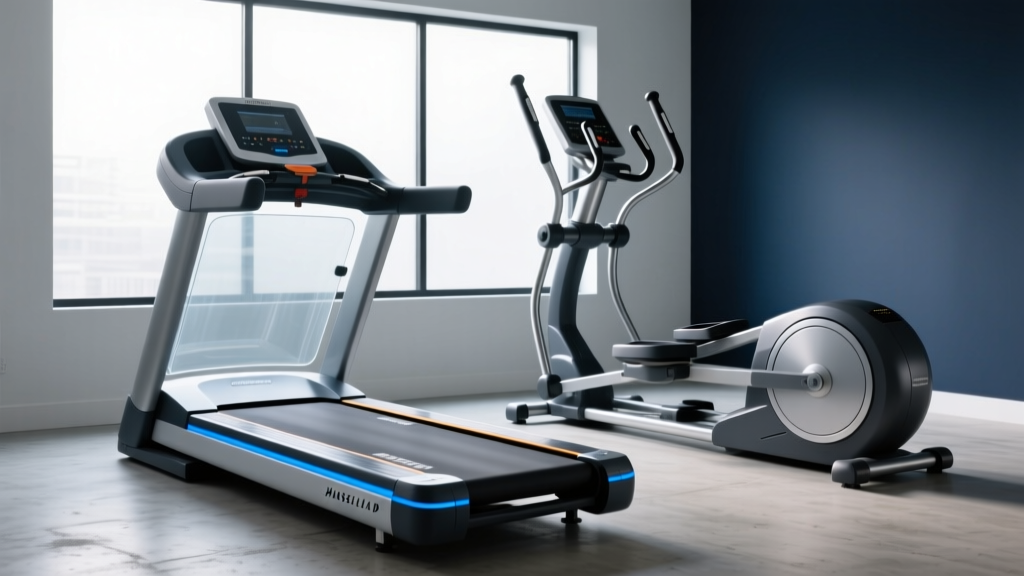
Elliptical vs Treadmill: How Treadmill Motors Impact Home Budgets
Compare elliptical vs treadmill costs. Discover how treadmill motors impact long-term home gym budgets, maintenance, and overall value in 2026.

The Mechanical Cost Divide: Engineering the Home Cardio Experience
When consumers debate the merits of an elliptical vs treadmill for home cardio, the conversation almost exclusively revolves around joint impact, calorie burn, and spatial footprint. However, from a strict budget breakdown and value analysis perspective, the most critical differentiator is hidden beneath the plastic shrouds: the drive system. Specifically, the engineering, maintenance, and replacement costs of treadmill motors fundamentally alter the long-term financial viability of the machine compared to the magnetic resistance systems found in ellipticals.
In the 2026 home fitness market, a premium treadmill like the Sole F85 retails for approximately $1,899, while a comparable premium elliptical like the Sole E95S sits around $1,699. On the surface, the price gap seems negligible. But a deep dive into the component cost allocation and the 5-year Total Cost of Ownership (TCO) reveals that treadmill motors act as a massive financial anchor, driving up both initial manufacturing costs and long-term maintenance expenses.
Understanding Continuous Horsepower (CHP) and Motor Pricing
Unlike ellipticals, which rely on user-generated momentum and eddy current magnetic braking, treadmills require a continuous drive motor to move the belt beneath the user's feet. Home treadmills utilize Direct Current (DC) motors, rated in Continuous Horsepower (CHP). A legitimate 3.5 CHP DC motor—the minimum recommended for runners weighing over 180 lbs—requires heavy copper windings, robust carbon brushes, and a sophisticated Pulse Width Modulation (PWM) controller. Manufacturing a high-torque, thermally stable 3.5 CHP motor costs the manufacturer between $250 and $400 per unit. Ellipticals, by contrast, use a small stepper motor to adjust magnetic proximity to the flywheel, a component that costs less than $30 to produce.
Initial Purchase Breakdown: Where Your Money Goes
To understand the value proposition, we must break down how your $1,500 to $2,000 budget is allocated across the internal components of both machine types. When you buy a treadmill, you are heavily subsidizing the drive system and the structural reinforcement required to handle the dynamic impact of running.
| Component Category | Treadmill (e.g., 3.5 CHP DC) | Elliptical (e.g., 22lb Flywheel) |
|---|---|---|
| Drive / Resistance System | 35% (Motor, MCB, PWM board) | 12% (Flywheel, magnetic array, servo) |
| Frame & Impact Dampening | 30% (Heavy steel, cushioning elastomers) | 25% (Articulating arms, pivot bearings) |
| Deck / Belt / Track | 15% (Phenolic deck, multi-ply belt) | 10% (Pedal rails, roller wheels) |
| Electronics & Console | 15% (Touchscreen, incline lift motor) | 40% (Advanced telemetry, incline servo) |
| Margin & Logistics | 5% | 13% |
As the data illustrates, over a third of your treadmill investment is tied directly to the motor and its associated control boards. On an elliptical, your budget is redirected toward the console, ergonomics, and pivot bearings, resulting in a machine that feels more technologically advanced at a lower price point.
The Hidden Costs of Treadmill Motors: The Failure Cascade
The true budget impact of treadmill motors emerges after the warranty expires. DC motors are highly susceptible to a specific failure cascade triggered by environmental factors and user maintenance habits. Ellipticals, lacking a high-friction belt and a high-amp drive motor, are largely immune to this specific mechanical death spiral.
⚠️ The Belt-Motor Board Failure Edge Case
The number one cause of catastrophic treadmill failure is neglected belt lubrication. When the silicone lubricant between the running belt and the phenolic deck dries out, friction increases exponentially. To maintain the set speed, the DC motor draws higher amperage. This sustained overcurrent generates massive heat in the Motor Control Board (MCB). Eventually, the MCB's capacitors blow, or the PWM transistors short out. If the user ignores the initial thermal shutdown warnings, the motor windings will melt. Replacement cost: $189 for a new MCB, plus $450+ for a replacement motor, plus $150 for labor.
Ellipticals do not suffer from this. The resistance on an elliptical is generated by magnets passing near a spinning steel flywheel. There is no physical contact creating resistance, and therefore no friction-induced amp spikes. The only moving parts requiring regular maintenance are the rail wheels and pivot bearings, which cost less than $40 to replace and can be serviced by the user in ten minutes.
Electricity and Operating Costs: The Amp Draw Reality
While home gym equipment is rarely the primary driver of a household's electric bill, the operational efficiency of treadmill motors versus elliptical magnetic systems is stark, particularly for users who exercise during peak energy pricing hours.
- Treadmill Power Draw: A 3.5 CHP treadmill running at 7.0 mph with a 10% incline can draw between 12 to 15 Amps continuously. Furthermore, the startup surge (inrush current) when a user steps onto the belt can spike to 20 Amps, requiring a dedicated 20-amp household circuit to prevent tripping breakers.
- Elliptical Power Draw: An elliptical's magnetic resistance is entirely passive. The machine only requires electricity to power the console display, the cooling fan, and the small 2-amp servo motor that adjusts the incline. Total continuous draw is typically under 1.5 Amps, meaning it can be safely plugged into any standard household power strip alongside other electronics.
5-Year Total Cost of Ownership (TCO) Matrix
To provide a concrete value analysis, let us project the 5-year TCO for a mid-tier treadmill (Horizon 7.4, 3.0 CHP, ~$1,299) versus a mid-tier elliptical (Horizon EX-59, ~$699). This projection assumes 4 hours of use per week, standard manufacturer warranties, and average user maintenance.
| Cost Factor (5 Years) | Mid-Tier Treadmill | Mid-Tier Elliptical |
|---|---|---|
| Initial Purchase Price | $1,299.00 | $699.00 |
| Assembly / Delivery | $150.00 (Heavy freight) | $99.00 (Standard freight) |
| Preventative Maintenance | $45.00 (Silicone lubricant) | $20.00 (PTFE bearing grease) |
| Expected Out-of-Warranty Repairs | $250.00 (MCB/Belt replacement) | $0.00 |
| Electricity Cost (Est.) | $85.00 | $12.00 |
| 5-Year Total Cost | $1,829.00 | $830.00 |
The data clearly demonstrates that the elliptical offers a 54% cost savings over five years. The treadmill's TCO is heavily inflated by the initial cost of the motor, the specialized freight required to ship a 200lb motorized deck, and the statistical probability of an MCB or belt replacement in years 3 through 5.
Biomechanical ROI: Aligning Cost with Health Guidelines
Financial value is meaningless if the machine does not deliver the required physiological return on investment. According to the American Heart Association, adults require at least 150 minutes of moderate-intensity aerobic activity or 75 minutes of vigorous activity per week to maintain cardiovascular health. Furthermore, the Centers for Disease Control and Prevention emphasizes the importance of sustainable, joint-friendly routines for long-term adherence.
From a biomechanical standpoint, treadmills offer superior specificity for runners training for outdoor events, allowing for precise pacing and exact incline simulations. However, the repetitive ground reaction forces (up to 2.5 times body weight) can lead to shin splints or plantar fasciitis, potentially derailing the 150-minute weekly goal. Ellipticals provide a closed-kinetic-chain movement that eliminates impact forces while still engaging the glutes, hamstrings, and upper body via articulating arms. For the general population seeking cardiovascular compliance without the physical downtime of impact injuries, the elliptical delivers a higher biomechanical ROI per dollar spent.
The Final Decision Framework: Maximizing Your Home Gym Budget
Choosing between an elliptical and a treadmill should not be based solely on which machine you used in a commercial gym five years ago. It requires a pragmatic assessment of your budget, your maintenance tolerance, and your physiological needs. Use this framework to finalize your decision:
- Choose the Treadmill if: You are a dedicated runner requiring exact pace metrics, you have a dedicated 20-amp circuit in your gym space, you are committed to a strict monthly belt lubrication schedule, and your budget comfortably exceeds $1,500 to ensure you acquire a machine with a minimum 3.5 CHP motor and a lifetime motor warranty.
- Choose the Elliptical if: Your primary goal is general cardiovascular health and caloric expenditure, you suffer from lower back or knee sensitivities, you want to maximize your budget (getting premium features like heavy flywheels and advanced consoles for under $1,000), and you prefer a 'plug-and-play' machine that requires virtually zero mechanical maintenance over a 5-year lifespan.
Ultimately, while treadmill motors are marvels of modern DC engineering, they represent a significant financial liability in the home environment. By understanding the mechanical realities and the true cost of ownership, you can allocate your fitness budget toward the machine that offers the most sustainable, long-term value for your specific lifestyle.
More gear to consider
All reviews
Office Under Desk Treadmill Review: Care & Curved Treadmill Benefits

Walking Pad vs ProForm XP Treadmill: Review, Mistakes & Fixes
Curved vs Motorized: Running 2 Miles on Treadmill Compared
Treadmill Levels vs. Ellipticals: 2026 Noise Comparison

Rowing Guide: Outpace Your Fat Burning Walking Workout on Treadmill
