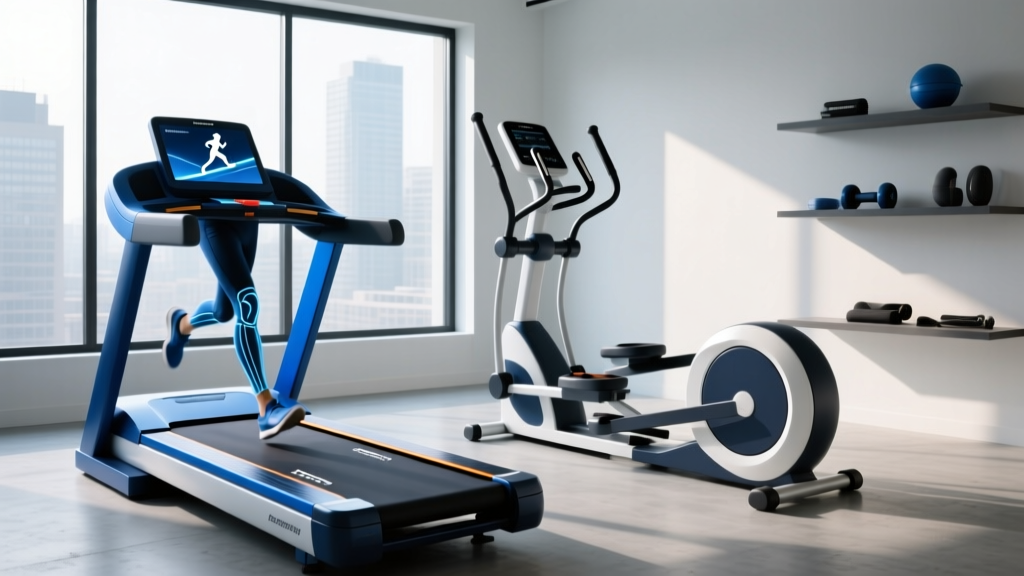
Elliptical vs Treadmill: Is Incline on Treadmill Bad for Knees?
Explore 2026 trends comparing elliptical vs treadmill for home cardio, and discover the biomechanical truth: is incline on treadmill bad for knees?

The 2026 Home Cardio Market: A Shift Toward Joint Longevity
The home fitness equipment landscape has undergone a radical transformation as we move through 2026. No longer is the primary purchasing driver sheer caloric expenditure or high-intensity interval training (HIIT) capabilities. Today, the dominant market force is 'longevity fitness'—a consumer paradigm shift prioritizing joint preservation, mobility, and sustainable cardiovascular health. According to recent industry data from Grand View Research, the global home fitness equipment market has surpassed $16 billion, with a distinct surge in demand for low-impact and biomechanically optimized machines.
This macro trend has reignited the ultimate home gym debate: elliptical vs treadmill for home cardio. While treadmills remain a staple for runners and walkers, ellipticals are rapidly closing the market share gap, driven by an aging demographic and a younger, more injury-conscious cohort of remote workers. To make an informed capital investment for your home gym, we must analyze current market offerings, biomechanical realities, and the specific engineering of 2026's flagship models.
Elliptical vs Treadmill: 2026 Sales Trends and Consumer Behavior
Historically, treadmills have commanded the lion's share of the home cardio market. However, 2026 sales data indicates a fascinating pivot. Treadmills currently hold approximately 44% of the premium home cardio market, while ellipticals and cross-trainers have captured 31%, growing at a compound annual growth rate (CAGR) that outpaces treadmills by 3.8%.
Why the shift? Consumer return rates and secondary market (used equipment) listings reveal that traditional high-impact treadmill running leads to higher abandonment rates among users over 40. Conversely, ellipticals boast higher long-term retention rates due to their perceived safety profile. Furthermore, the integration of AI-driven posture correction and adaptive magnetic resistance in 2026 elliptical models has eliminated the 'clunky' feel of older generations, making them a highly attractive alternative.
Biomechanics Deep Dive: Is Incline on Treadmill Bad for Knees?
When analyzing consumer search trends and physical therapy forums this year, one of the most pressing biomechanical questions is: is incline on treadmill bad for knees? The answer is not a simple yes or no; it requires a nuanced understanding of knee joint anatomy, specifically the difference between the patellofemoral joint (kneecap) and the tibiofemoral joint (the main hinge of the knee).
The Incline Biomechanics Breakdown
- Patellofemoral Stress (Runner's Knee): Walking or running on a steep incline (10% to 15%) significantly increases the activation of the quadriceps. This heightened quad tension pulls the patella tighter against the femur. If you suffer from patellofemoral pain syndrome or chondromalacia, incline work is bad for your knees and will exacerbate anterior knee pain.
- Tibiofemoral Impact (Osteoarthritis/Meniscus): Conversely, walking on an incline reduces the vertical ground reaction force (the 'heel-strike' shock) compared to running on a flat surface. For individuals with mild osteoarthritis or meniscus wear, a 5% to 8% incline walk is highly therapeutic, elevating heart rate without the destructive impact of flat-ground running.
As noted by the American Academy of Orthopaedic Surgeons (AAOS), managing patellofemoral pain requires avoiding activities that load the kneecap under deep flexion—exactly what happens when you push up a steep treadmill hill. Therefore, if your primary concern is anterior knee pain, the elliptical presents a compelling alternative.
The Elliptical Advantage: Closed-Chain Kinetics
The elliptical machine operates on a closed-chain kinetic model, meaning your feet never leave the pedals. This eliminates the 'flight phase' of running, reducing ground reaction forces to near zero. According to Mayo Clinic fitness experts, ellipticals provide a highly effective cardiovascular workout while minimizing the stress placed on weight-bearing joints, making them the gold standard for rehabilitation and longevity-focused training.
In 2026, the Sole E95 ($1,899) leads the premium elliptical market. It features a 20-inch adjustable stride length and a 27-pound flywheel, which creates a fluid, momentum-driven motion that prevents the 'dead spots' found in cheaper models. The heavy flywheel is crucial; it ensures that the knee joint is not subjected to sudden micro-jerks at the apex of the stride, a common failure mode in sub-$1,000 ellipticals that can irritate the IT band and lateral knee structures.
Treadmill Innovations: Mitigating Joint Stress in 2026 Flagships
Treadmill manufacturers have not ignored the joint-health trend. The modern treadmill is no longer just a motorized conveyor belt; it is an engineered shock-absorption system. If you prefer the biomechanics of walking or running but want to protect your knees, the NordicTrack Commercial 2450 ($2,799) utilizes Reflex Cushioning technology. This deck system is engineered to be softer in the strike zone (absorbing up to 30% more impact than asphalt) and firmer in the toe-off zone (providing energy return).
Alternatively, the Peloton Tread ($2,495) abandons the traditional belt entirely in favor of a slat-belt design composed of individual rubberized slats. This design inherently absorbs more micro-vibrations and allows for a more natural foot strike, though it requires a higher upfront capital investment and a mandatory all-access membership for full metric tracking.
Head-to-Head Comparison Matrix
To help you visualize the functional and financial differences between these two cardio giants, we have compiled a direct comparison based on 2026 flagship specifications and clinical biomechanics.
| Feature / Metric | Premium Elliptical (e.g., Sole E95) | Premium Treadmill (e.g., NordicTrack 2450) |
|---|---|---|
| Joint Impact (Ground Reaction Force) | Near Zero (Closed-Chain) | 1.5x to 2.5x Body Weight (Cushioned) |
| Patellofemoral (Kneecap) Stress | Low to Moderate | High (especially on >10% incline) |
| Caloric Expenditure (60 min, Vigorous) | 550 - 700 kcal | 600 - 850 kcal |
| Space Footprint (L x W) | ~80" x 32" | ~80" x 36" |
| 2026 Average Premium Price | $1,699 - $2,299 | $2,495 - $3,299 |
| Maintenance Requirements | Low (Sealed bearings) | Moderate (Belt alignment, lubrication) |
The FitGearPulse Decision Framework
Choosing between an elliptical and a treadmill in 2026 should not be based solely on which machine burns more calories; it must be dictated by your specific orthopedic profile, spatial constraints, and long-term fitness goals. Use the following decision matrix to finalize your purchase.
Buy an Elliptical If:
- You have a history of anterior knee pain: If you have ever been diagnosed with runner's knee or chondromalacia, the closed-chain motion of an elliptical will allow you to build VO2 max without aggravating the patellofemoral joint.
- You want upper-body integration: Premium ellipticals feature moving arm bars that engage the latissimus dorsi and pectorals, offering a true full-body cardio stimulus that a treadmill cannot replicate.
- You are optimizing for quiet operation: Magnetic resistance ellipticals are virtually silent, making them ideal for multi-family homes or early morning workouts where treadmill motor noise and footfalls would be disruptive.
Buy a Treadmill If:
- You are training for outdoor events: If your goal is to complete a 10K, half-marathon, or marathon, the biomechanical specificity of a treadmill is non-negotiable. Ellipticals do not prepare your tendons and ligaments for the eccentric loading of outdoor running.
- You prefer incline walking over running: If you utilize the 12-3-30 method (12% incline, 3 mph, 30 minutes) and do not suffer from patellofemoral pain, a treadmill with a powerful continuous duty motor (minimum 3.5 CHP) is the superior tool for targeted glute and hamstring hypertrophy.
- You value interactive pacing: Treadmills naturally enforce pace. On an elliptical, it is easy to unconsciously slow your stride rate when fatigued; a treadmill forces you to maintain your target cadence, ensuring progressive overload.
Final Market Verdict
The 2026 home cardio market proves that the 'best' machine is entirely dependent on your physiological needs. If your primary search query is driven by joint preservation and you are actively asking if incline on treadmill is bad for knees, the elliptical is the safer, more sustainable investment for long-term daily use. However, if your knees are healthy and your goals require impact adaptation or strict pacing, a modern treadmill with advanced deck cushioning remains an unparalleled tool for cardiovascular excellence. Evaluate your orthopedic history, measure your dedicated floor space, and invest in a commercial-grade frame that will support your longevity journey for the next decade.
More gear to consider
All reviews
Treadmill Boobs & Noise: Quiet Cardio Comparison

Beyond the Treadmill Meme: Head-to-Head Motor HP Guide

NordicTrack Treadmill 2.6 CHP Belt Lubrication & Care

How to Start a Precor Treadmill & Review Under Desk Office Options

Rowing Machine Guide & Technique vs Gold's Gym Treadmill 430i
