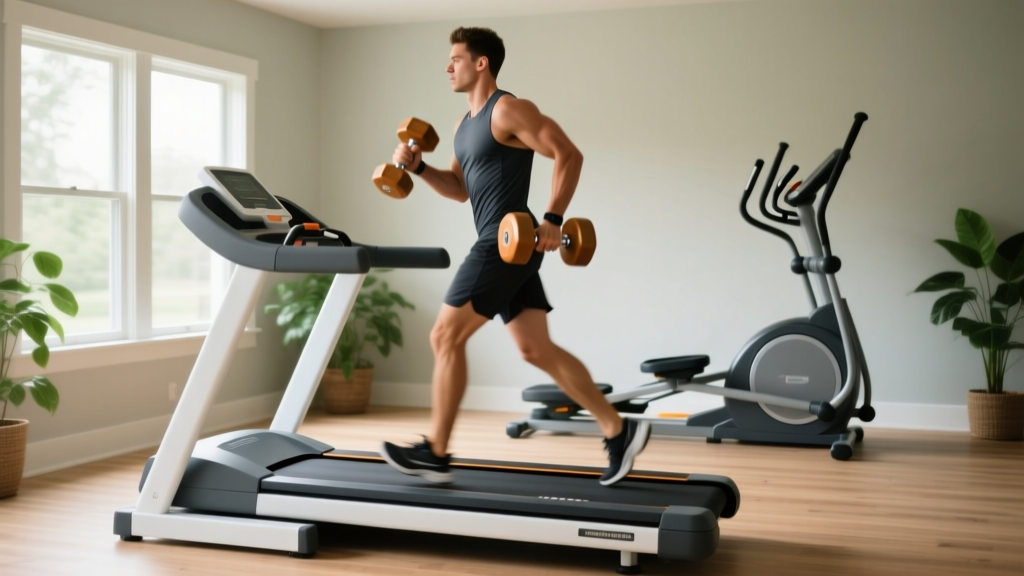
Elliptical vs Treadmill for Home Cardio: The Farmers Carry Treadmill Trend
Analyzing the viral farmers carry treadmill trend against traditional ellipticals and motorized treadmills for home cardio. Expert market data and buying advice.

The home fitness equipment market has undergone a radical transformation as we move through 2026. While the classic elliptical vs treadmill for home cardio debate has raged for decades, a new hybrid training modality has disrupted the search algorithms and buying habits of serious home gym owners: the farmers carry treadmill trend. Driven by functional fitness athletes and hybrid runners who want to combine heavy loaded carries with high-intensity cardiovascular conditioning, this trend is forcing buyers to completely re-evaluate what they need from their primary cardio machine.
According to the Centers for Disease Control and Prevention, adults require at least 150 minutes of moderate-intensity aerobic activity weekly, alongside muscle-strengthening activities. The farmer's carry perfectly bridges this gap, demanding immense core stability, grip endurance, and cardiovascular output. But can your home cardio equipment actually handle it? Let us break down the biomechanics, market data, and mechanical failure points to help you decide between an elliptical, a standard motorized treadmill, and the specialized curved treadmills driving this new trend.
Trend Alert: The Loaded Carry Phenomenon
Search volume for 'farmers carry treadmill' has spiked as athletes realize that walking with heavy kettlebells on a standard motorized treadmill is a recipe for mechanical disaster. The market has responded with a surge in non-motorized, curved manual treadmills designed to withstand extreme dynamic loading, fundamentally shifting the traditional elliptical vs treadmill purchasing framework.
Biomechanics and Load Tolerance: The Mechanical Reality
To understand why the farmers carry treadmill trend is exclusively dominated by curved, non-motorized machines, we have to look at the physics of dynamic loading. When you perform a farmer's carry with two 50 lb kettlebells, you are not just adding 100 lbs of static weight to the deck. The swinging motion of the weights creates kinetic spikes that can momentarily increase the downward force on the belt by 30% to 50%.
Why Motorized Treadmills Fail Under Load
If you attempt a loaded farmer's carry on a standard motorized treadmill (like the popular NordicTrack Commercial 2450 or Horizon 7.4), you will likely trigger a catastrophic failure. Motorized treadmills rely on a continuous belt driven by an electric motor. When heavy, unevenly distributed dynamic weight is applied, the friction between the belt and the deck increases exponentially. This causes the motor's amperage draw to spike past its thermal threshold (usually around 15 amps for residential units), resulting in either a tripped breaker, a fried motor controller, or permanent belt stretching.
The Elliptical Incompatibility
What about the elliptical? Machines like the Sole E95 or Bowflex Max Trainer M9 are exceptional for joint preservation and steady-state cardio. However, they are entirely incompatible with loaded carries. Ellipticals lock the user into a fixed sagittal plane stride (typically a 20-inch elliptical path). Holding heavy dumbbells alters your center of mass and ruins the fluid momentum required to keep the heavy flywheel spinning smoothly. The result is a jarring, uneven stride that places dangerous shear forces on the knees and lower back.
2026 Equipment Comparison Matrix
Below is a comprehensive market comparison evaluating how the three primary home cardio machines handle the demands of modern hybrid training, including the farmer's carry.
| Feature | Curved Manual Treadmill | Motorized Treadmill | Front-Drive Elliptical |
|---|---|---|---|
| Top 2026 Models | AssaultRunner Elite, Rogue Echo | NordicTrack 2450, Sole F85 | Sole E95, Bowflex Max M9 |
| Avg. Market Price | $3,299 - $5,495 | $1,899 - $2,999 | $1,499 - $2,299 |
| Farmer's Carry Safe? | Yes (Up to 400+ lbs dynamic) | No (Motor/Belt failure risk) | No (Biomechanical mismatch) |
| Impact Profile | Moderate (Encourages forefoot strike) | High (Heel strike prevalent) | Zero (Closed kinetic chain) |
| Maintenance Needs | Belt tensioning, bearing lubrication | Deck waxing, motor vacuuming | Pivot point greasing, rail cleaning |
The Elliptical vs Treadmill Decision Framework for Hybrid Athletes
If you are building a home gym in 2026 and want to incorporate functional strength work like loaded carries, the traditional elliptical vs treadmill debate requires a modernized decision tree. The American Heart Association heavily promotes varying your aerobic routines to prevent overuse injuries and maintain cardiovascular health. Here is how to choose your primary machine based on your specific training edge cases.
- The Pure Endurance & Joint Preservation Route (Choose the Elliptical): If your primary goal is Zone 2 cardio recovery, joint rehabilitation, or high-cadence interval work without the impact of pavement, the elliptical remains undefeated. The Sole E95 ($2,199) features a 20-inch stride and heavy 32 lb flywheel that provides a remarkably smooth ride. However, you must perform your farmer's carries on the floor or turf; the elliptical is strictly for unloaded cardio.
- The Tech-Driven Marathoner (Choose the Motorized Treadmill): If you are training for a marathon and require precise pacing, automated incline adjustments (up to 40% on models like the NordicTrack X32i), and interactive programming, a motorized treadmill is mandatory. Just respect the machine's limits: keep the farmer's carries off the deck to avoid voiding your warranty.
- The Functional Hybrid Athlete (Choose the Curved Treadmill): This is where the farmers carry treadmill trend lives. If you want to sprint, perform loaded walks, and push a sled (using a weighted harness) on the same machine, you must invest in a curved manual treadmill. The AssaultRunner Elite ($3,299) utilizes a slat belt and ball bearings that can easily withstand the kinetic force of a 220 lb athlete carrying two 70 lb kettlebells.
Edge Cases: Floor Loading and Spatial Realities
One frequently overlooked factor in the 2026 home gym market is structural floor loading. Curved treadmills are incredibly dense. The Rogue Echo Runner weighs nearly 350 lbs out of the box. When you add a 200 lb user and 140 lbs of iron for a heavy farmer's carry, you are concentrating nearly 700 lbs of dynamic, pounding force into a 4-foot by 6-foot footprint.
'Many home gym owners in residential builds place curved treadmills on second-floor flex spaces without realizing the structural implications of loaded carries. We always recommend placing a 3/4-inch high-density rubber horse stall mat beneath the equipment to disperse the kinetic shock and protect the subfloor from micro-fractures.'
— Home Gym Engineering Best Practices, 2025 Industry Report
Ellipticals, by contrast, distribute weight more evenly through a wider base and lack the percussive impact of foot strikes, making them significantly safer for upper-floor installations in standard residential homes.
Maintenance Warning: The Slat Belt Reality
If you commit to the farmers carry treadmill methodology on a curved machine, be prepared for the maintenance reality. The heavy downward force of loaded carries accelerates the wear on the polyurethane slats and the guide bearings. You will need to check the belt tension every 40 to 50 hours of use. If the belt begins to slip under the heavy load of your kettlebells, it requires immediate tightening via the rear tensioner bolts to prevent permanent damage to the drive chain.
Final Verdict: Aligning Equipment with Your 2026 Goals
The 'farmers carry treadmill' trend is not a passing fad; it is a reflection of a broader market shift toward hybrid, multi-disciplinary fitness. The days of buying a cardio machine solely for steady-state jogging are fading for the serious home gym enthusiast.
If your training strictly separates strength and cardio, the elliptical is still the king of low-impact, high-yield aerobic conditioning, saving your joints for heavy squats and deadlifts later in the week. If you want to blur the lines between strength and conditioning—turning a heavy farmer's carry into a brutal cardiovascular finisher—you must bypass standard motorized treadmills and invest in a curved manual treadmill. Understand your biomechanical needs, respect the mechanical limits of your equipment, and build a home gym that supports the full spectrum of your athletic ambitions.
More gear to consider
All reviews
Under Desk Treadmill Office Review & Benefits of the Treadmill Exercise
Elliptical vs Treadmill: Is a Treadmill Put Together Worth the Cost?

Dick's Horizon Treadmill Motor Guide: HP, CHP, and Sizing

Cadence 4.0 Treadmill vs Stationary Bikes: Upright, Recumbent & Spin

Bowflex BXT8J Treadmill Review: Motor HP Guide & Troubleshooting
