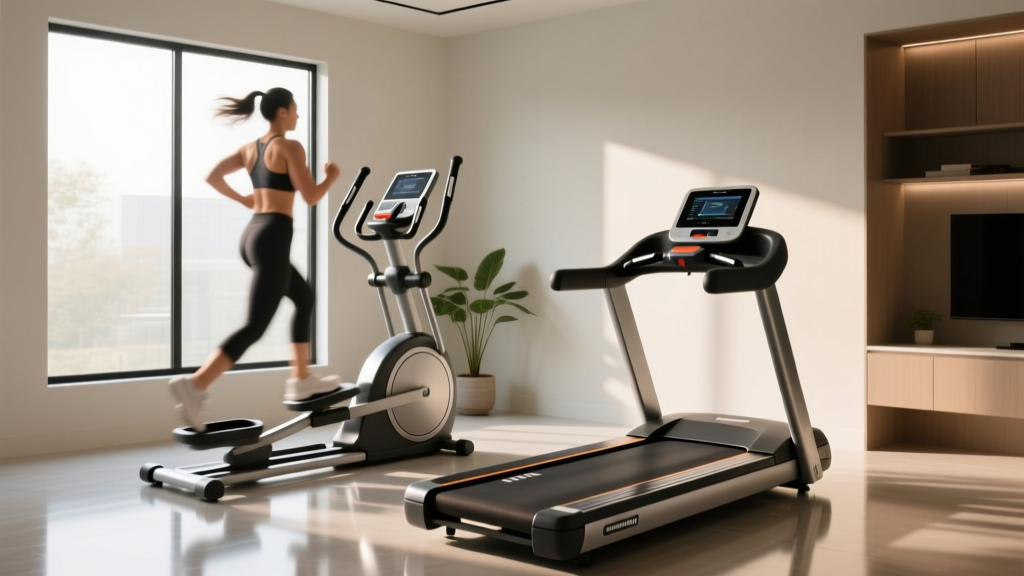
Elliptical vs Treadmill: Optimizing Your Treadmill Exercise Program
Compare top 2026 ellipticals and treadmills. Our expert hands-on review helps you choose the right machine and build an effective treadmill exercise program.

The Biomechanics Debate: Ground Reaction Forces vs. Output
When outfitting a home gym, the debate between an elliptical and a treadmill is less about which machine is universally "better" and more about how your joints handle ground reaction forces (GRF). According to the American Academy of Orthopaedic Surgeons, low-impact exercises like elliptical training are critical for individuals managing osteoarthritis or recovering from lower-extremity injuries, as they keep joint impact near zero. Conversely, treadmill running generates GRF equivalent to 2.0 to 2.9 times your body weight. While this impact is a known stressor for knees and hips, it is also a vital osteogenic stimulus for maintaining bone mineral density.
If your primary goal is to execute a rigorous, structured treadmill exercise program focused on VO2 max improvement and race-day simulation, the treadmill is non-negotiable. However, if you need active recovery or suffer from plantar fasciitis, the elliptical becomes your most valuable asset. Below, we break down our top 2026 hands-on picks for both categories and detail how to integrate them into a cohesive cardiovascular strategy.
Hands-On Review: Top Treadmills for Your Treadmill Exercise Program
To sustain high-intensity interval training (HIIT) and long-duration Zone 2 cardio, a treadmill must offer robust motor cooling, belt stability, and dynamic incline capabilities. We tested dozens of units to find the two that stand out for serious home programmers.
NordicTrack Commercial 1750 (2026 Edition)
Price: $2,599 | Motor: 3.5 CHP | Belt: 22" x 60" | Incline/Decline: -3% to 15%
The NordicTrack Commercial 1750 remains the gold standard for interactive training. The 2026 edition features an upgraded, quieter 3.5 CHP motor and a 14-inch pivoting HD touchscreen. The standout feature for any advanced treadmill exercise program is the -3% decline capability. Downhill running induces eccentric muscle contractions that are vital for quad strengthening and preparing for road races with varied topography. The 22-inch wide belt provides ample lateral margin for runners who experience form breakdown during the final miles of a long run.
- Pros: Automatic trainer control adjusts incline/speed seamlessly; excellent decline feature; smooth cushioning system reduces GRF by up to 15% compared to outdoor asphalt.
- Cons: Requires a mandatory iFit subscription ($39/month) to unlock auto-adjust features; heavy footprint requires dedicated floor space.
Sole F80
Price: $1,199 | Motor: 3.5 CHP | Belt: 20" x 60" | Incline: 0% to 15%
For users who want to build their own treadmill exercise program via third-party apps like Zwift or TrainingPeaks without being locked into a proprietary ecosystem, the Sole F80 is our top workhorse pick. It features a massive 350 lb user weight capacity and a heavy-duty flywheel that prevents belt stuttering during sudden sprint intervals. The Cushion Flex Whisper Deck is noticeably firmer than NordicTrack's system, which translates to better energy return for sprinters but less shock absorption for heavy heel-strikers.
- Pros: No mandatory subscription; excellent Bluetooth FTMS connectivity for third-party apps; foldable deck with hydraulic assist.
- Cons: No decline feature; smaller 9.6-inch LCD screen feels dated compared to smart HD displays.
Hands-On Review: Ellipticals for Cross-Training and Recovery
An effective cardiovascular regimen requires periodization. You cannot run at high intensities daily without risking overuse injuries. This is where the elliptical bridges the gap, allowing you to maintain aerobic volume while sparing your connective tissue.
Sole E95 Elliptical
Price: $1,499 | Flywheel: 32 lbs | Stride: 20" | Ramp: 0 to 20 levels
The Sole E95 mimics the biomechanics of running more closely than almost any other elliptical on the market. The 20-inch stride length accommodates runners over 5'8" without causing hip impingement at the apex of the pedal stroke. The 32-pound flywheel provides immense inertia, meaning you won't experience the "dead spot" at the top of the pedal cycle that plagues cheaper models. By adjusting the ramp to level 15+, you can simulate the glute and hamstring engagement of a steep treadmill hill climb without the impact.
Bowflex Max Trainer M9
Price: $2,299 | Resistance: 20 levels | Footprint: 3' x 3'
If your home gym is constrained by space and your goal is high-intensity anaerobic conditioning rather than long steady-state cardio, the Bowflex Max Trainer M9 is unparalleled. It combines the motion of an elliptical with the upper-body engagement of a stair climber. The Max Intelligence app offers dynamic resistance adjustments that push you to your absolute lactate threshold in just 15 to 30-minute sessions.
Head-to-Head Equipment Matrix
| Feature | NordicTrack 1750 | Sole F80 | Sole E95 | Bowflex M9 |
|---|---|---|---|---|
| Primary Use | Race Prep / Interactive | Heavy Duty / App-Based | Long-Duration Recovery | HIIT / Space-Saving |
| Price (2026) | $2,599 | $1,199 | $1,499 | $2,299 |
| Joint Impact | High (Running) / Med (Walking) | High (Running) / Med (Walking) | Ultra-Low | Low |
| Max Incline/Ramp | 15% (with 3% decline) | 15% | 20 Ramp Levels | N/A (Resistance based) |
| Subscription Needed? | Yes (for full features) | No | No | Optional (JRNY) |
Executing the 80/20 Treadmill Exercise Program
To maximize cardiovascular adaptations while minimizing injury risk, elite coaches utilize the 80/20 polarized training model. This means 80% of your weekly volume should be performed at low intensity (Zone 2), and 20% at high intensity (Zone 4/5). Here is how to structure this treadmill exercise program and adapt it for the elliptical when your joints require a break.
Day 1: Zone 2 Base Building (Treadmill)
- Duration: 45–60 minutes.
- Execution: Set the treadmill to a 1% incline to mimic outdoor wind resistance. Maintain a conversational pace (65-70% of your max heart rate). Do not exceed this pace; the goal is mitochondrial density, not caloric burn.
Day 2: VO2 Max Intervals (Treadmill)
- Duration: 35 minutes total.
- Warm-up: 10 minutes easy jog.
- Work: 5 x 3 minutes at 90-95% max heart rate (use a 3% to 5% incline to elevate HR without requiring unsustainable sprint speeds).
- Recovery: 2 minutes of flat walking between intervals.
Day 3: Active Recovery (Elliptical Modification)
Instead of a light jog on the treadmill, move to the Sole E95 or Bowflex M9. Keep the resistance low and the RPM high (80+ RPM) to flush lactate and promote blood flow to the calves and hamstrings without subjecting the Achilles tendon to the repetitive stretch-shortening cycle of running.
Expert Pro-Tip: The 1% Rule
When translating a treadmill exercise program to outdoor running, always remember the 1% incline rule. Setting your treadmill to a 1% grade accurately offsets the lack of air resistance you would naturally encounter outdoors at paces faster than 8:00/mile. If you are exclusively training indoors for an outdoor event, failing to account for this will result in a 2-3% performance deficit on race day.
Expert Verdict: Which Machine Belongs in Your Home Gym?
Your choice ultimately hinges on your physiological baseline and your programming goals. If you are training for a 10K or marathon, or if you require the bone-density benefits of weight-bearing exercise, investing in a premium unit like the NordicTrack Commercial 1750 is essential. Its decline features and integrated programming make executing a complex treadmill exercise program effortless.
However, if you are over 50, managing BMI-related joint stress, or simply need a secondary modality to maintain the American Heart Association's recommendation of 150 minutes of moderate aerobic activity per week without burning out your central nervous system, the Sole E95 Elliptical offers the best biomechanical transfer to running with zero impact penalty.
For the ultimate home gym setup, pair the budget-friendly Sole F80 treadmill for your high-intensity interval days with a compact cross-trainer for your Zone 2 recovery days. This dual-machine approach ensures you can maintain progressive overload year-round, regardless of joint fatigue or weather conditions.
More gear to consider
All reviews
ProForm iFIT Treadmill Belt Maintenance: Cost & Value Breakdown
Elliptical vs Treadmill Care: Calibrate Incline NordicTrack Treadmill

Air Bike vs Assault Bike & Lubricating Sole Treadmill Trends

How to Get 10k Steps on Treadmill: Noise Fixes & Comparison
Is Treadmill Bad for Knees? Curved vs Motorized Guide (2026)
