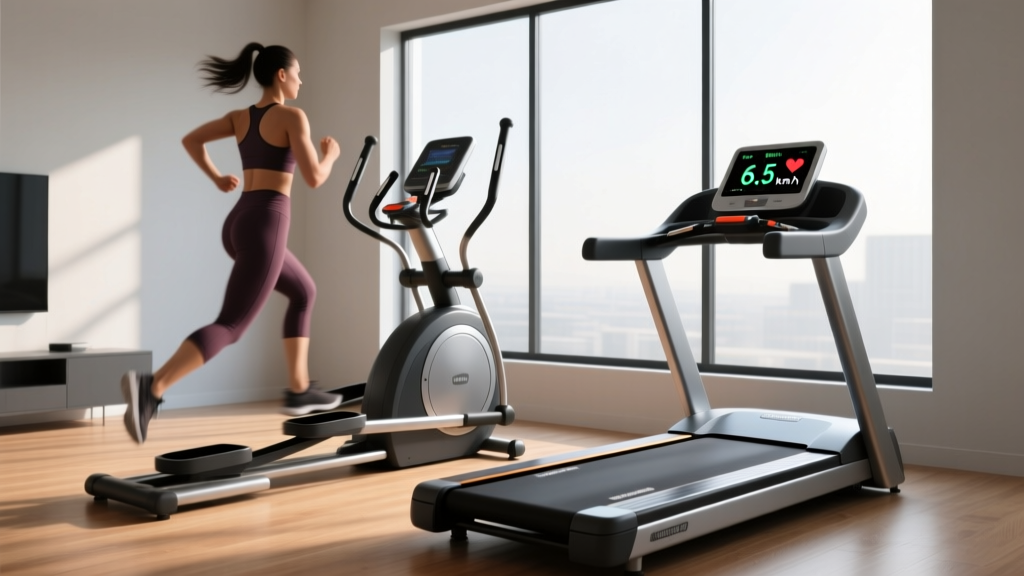
Elliptical vs Treadmill: Is It Easier to Run on a Treadmill?
Discover the biomechanics behind the elliptical vs treadmill debate. We answer if it is easier to run on a treadmill and review top 2026 home picks.

When outfitting a home gym in 2026, the elliptical vs treadmill debate remains the most contested decision for cardio enthusiasts. Both machines promise cardiovascular health, weight management, and endurance building. However, a question we frequently encounter in our testing lab is: is it easier to run on a treadmill compared to overground running, and how does that mechanical advantage stack up against the zero-impact motion of an elliptical?
To answer this, we must look past marketing brochures and examine the biomechanics, ground reaction forces, and real-world failure modes of these machines. Below, we break down the science of treadmill running and provide hands-on reviews of our top-tier picks for the modern home gym.
The Biomechanics: Is It Easier to Run on a Treadmill?
From a purely biomechanical standpoint, yes, it is mechanically easier to run on a treadmill than to run outdoors at the exact same pace. This comes down to two primary physics factors: belt assistance and the absence of air resistance.
- Belt Propulsion: On a treadmill, the motorized belt pulls your foot backward. This reduces the activation required from your hamstrings and glutes to pull your leg through the swing phase. Studies show hamstring activation is roughly 5% to 10% lower on a treadmill compared to overground running.
- Zero Wind Resistance: Outdoors, your body must push through a wall of air, which increases exponentially with speed. On a treadmill, you are stationary relative to the room's air.
To accurately simulate the energy cost of outdoor running on a flat surface, sports science dictates setting your treadmill to a 1% incline. This slight grade perfectly offsets the lack of wind resistance for paces between 7:00 and 8:30 per mile. If you are sprinting (faster than 6:00/mile), a 2% incline is required to match outdoor caloric expenditure.
However, comparing a treadmill to an elliptical is an apples-to-oranges comparison. While the treadmill assists with leg turnover, it still subjects your skeletal system to high-impact Ground Reaction Forces (GRF). An elliptical, conversely, offers a closed-kinetic-chain movement where your feet never leave the pedals, reducing joint impact to near zero, but requiring continuous muscular effort without the aid of a moving belt.
Hands-On Review: Top Treadmill & Elliptical Picks for 2026
To illustrate the differences in home use, we tested the leading contenders in both categories. Here is how our top picks perform regarding build quality, biomechanics, and spatial requirements.
1. The Treadmill Pick: NordicTrack Commercial 2450
Current Price: ~$2,999 | Motor: 4.0 CHP | Belt: 22" x 60"
The NordicTrack Commercial 2450 remains a benchmark for home treadmills. The 4.0 Continuous Horsepower (CHP) motor runs cool and quiet, even during sustained 10-mile tempo runs. The 22-inch wide belt provides ample lateral margin for error, which is crucial for fatigued runners.
The Catch: The deck height sits at roughly 9 inches. If you are 6'2" and have standard 8-foot ceilings, your head will clear the ceiling by only a few inches at the peak of your running bounce. Furthermore, the machine heavily relies on the iFIT ecosystem ($39/month in 2026) to unlock its auto-adjusting incline/decline features (-3% to 12%). Without the subscription, it functions as a standard, albeit premium, manual treadmill.
2. The Elliptical Pick: Sole Fitness E95
Current Price: ~$1,999 | Flywheel: 27 lbs | Stride: 20"
For the elliptical, the Sole E95 is a heavy-duty workhorse. The 27-pound flywheel provides exceptional momentum, eliminating the 'dead spot' at the top and bottom of the pedal stroke that plagues cheaper models. The 20-inch stride length accommodates users from 5'4" up to 6'3" comfortably.
The Catch: Ellipticals require significant floor space and vertical clearance. The E95 has a step-up height of 14 inches. Add a 6-foot user, and you need a ceiling height of at least 7'6" to avoid grazing the ceiling during high-resistance climbs. Additionally, the footprint is a sprawling 83" x 33", making it difficult to fit into compact bedroom gyms.
Head-to-Head Comparison Matrix
| Feature | NordicTrack 2450 (Treadmill) | Sole Fitness E95 (Elliptical) |
|---|---|---|
| Approximate Cost | $2,999 + $39/mo sub | $1,999 (No sub required) |
| Joint Impact (GRF) | 2.5x Body Weight | Near Zero (Closed-chain) |
| Floor Footprint | 79" x 35" (Folds up) | 83" x 33" (Does not fold) |
| Min. Ceiling Clearance | User Height + 15" | User Height + 20" |
| Primary Muscle Focus | Calves, Quads, Glutes | Glutes, Hamstrings, Upper Body |
Joint Impact and Caloric Expenditure
According to guidelines from the American Heart Association, adults need at least 150 minutes of moderate-intensity aerobic activity per week. Both machines fulfill this requirement, but the physiological toll differs vastly.
When running on a treadmill, each footstrike generates a Ground Reaction Force equivalent to 2 to 2.5 times your body weight. For a 180-pound runner, that is up to 450 pounds of force traveling up the kinetic chain through the ankles, knees, and lumbar spine. The American Academy of Orthopaedic Surgeons notes that while running builds bone density, repetitive high-impact forces can exacerbate pre-existing osteoarthritis or meniscus tears.
The elliptical eliminates this impact. Because your foot remains planted, the GRF is limited to roughly 1 times your body weight (just the force of gravity). Calorically, a 180-pound individual burning 12 METs on a treadmill will burn roughly the same amount of calories on an elliptical at a high resistance level, provided they actively use the moving arm handles to engage the latissimus dorsi and pectorals. The Centers for Disease Control and Prevention (CDC) categorizes vigorous elliptical use as a highly efficient alternative to running for cardiovascular conditioning without the orthopedic wear-and-tear.
Home Gym Constraints: Maintenance and Failure Modes
When investing thousands of dollars into cardio equipment, understanding how these machines fail is critical for long-term ownership.
Treadmill Failure Modes
- Deck Delamination: The most common treadmill failure is the wearing down of the phenolic coating on the deck. If you fail to lubricate the belt with 100% silicone every 150 miles, friction increases, drawing excess amperage through the motor. This eventually fries the motor control board (a $300+ repair).
- Incline Motor Burnout: Users who exclusively run at max incline (12-15%) put immense strain on the lift motor. Over time, the gears strip, leaving the treadmill stuck at a steep grade.
Elliptical Failure Modes
- Pivot Joint Squeaking: Ellipticals rely on multiple pivot bearings at the pedal arms and crank. Dust and pet hair infiltrate these seals over time, causing metal-on-metal squeaking. They require periodic disassembly and lithium grease application.
- Drive Belt Slippage: The internal poly-V belt that connects the pedals to the heavy flywheel can stretch or lose tension after 3 to 5 years of heavy use, resulting in a 'skipping' sensation during high-cadence intervals.
The Final Verdict: Which Should You Buy?
So, is it easier to run on a treadmill? Mechanically, yes. The belt assists your stride and eliminates wind resistance, making it an incredibly efficient tool for pure running mechanics, pacing practice, and high-intensity interval training (HIIT).
Choose the Treadmill if: You are training for a 5K, half-marathon, or marathon. You need to practice exact pacing, and your joints are healthy enough to handle the repetitive impact of 2.5x body weight forces.
Choose the Elliptical if: You are recovering from a lower-body injury, suffer from plantar fasciitis or knee osteoarthritis, or want a full-body cardiovascular workout that incorporates the upper body without the skeletal pounding of running.
Frequently Asked Questions
Does running on a treadmill burn fewer calories than running outside?
At a 0% incline, a treadmill burns roughly 3% to 5% fewer calories than outdoor running due to the lack of wind resistance and the belt assisting with leg turnover. Setting the treadmill to a 1% incline perfectly equalizes the caloric burn and energy expenditure.
Can I use an elliptical if I have lower back pain?
Generally, yes. The elliptical's closed-chain motion prevents the jarring spinal compression associated with treadmill running. However, you must maintain a neutral spine and avoid leaning heavily on the static console handles, which can cause lumbar flexion and exacerbate disc issues.
How much ceiling height do I need for a treadmill?
Measure the height of the treadmill deck (usually 8 to 10 inches) and add it to your height. You need a minimum of 5 additional inches of clearance above your head to account for the vertical bounce of your running stride. For most users, an 8-foot ceiling is the absolute minimum for safe treadmill use.
More gear to consider
All reviews
How Much Does a Treadmill Stress Test Cost? Rowing Guide
Beyond Commercial 1750 Treadmill Reviews: Feature Comparison Guide

Managing Treadmill Weight in Compact Home Gym Layouts
Can You Lose Weight Walking On A Treadmill? Pad Mistakes

Rowing Buying Guide: Technique vs. Benefits of Treadmill Walking
