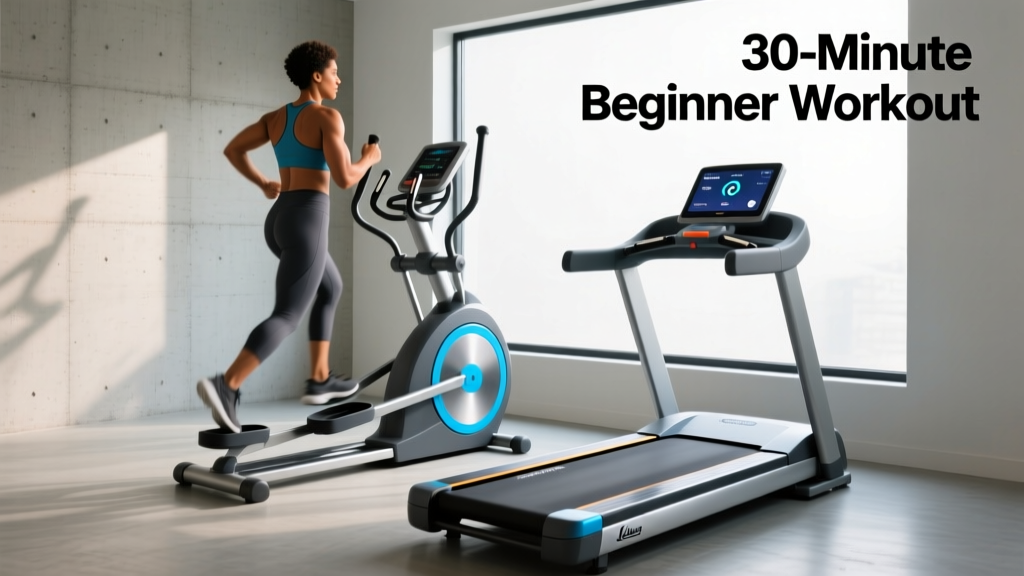
Elliptical vs Treadmill Value & 30 Minute Beginner Treadmill Workout
Compare elliptical vs treadmill costs, hidden fees, and joint impact. Plus, get a complete 30 minute beginner treadmill workout to maximize your investment.

The True Cost of Home Cardio: Treadmill vs. Elliptical
Investing in home cardio equipment is a significant capital expenditure. While most buyers focus purely on the sticker price, the true financial footprint of a treadmill versus an elliptical extends far beyond the initial checkout. As we evaluate the home fitness landscape in 2026, understanding the long-term ROI—including electricity draw, mandatory software subscriptions, and physical maintenance—is critical for making a budget-smart decision. In this comprehensive breakdown, we will dissect the hidden costs of both machines, analyze their biomechanical value, and provide a structured 30 minute beginner treadmill workout so you can immediately put your investment to work.
Upfront Pricing & Long-Term Value Matrix
To compare apples to apples, we must look at machines in the mid-tier to premium residential category. Budget sub-$500 machines often feature 1.5 HP motors and 16-inch stride lengths that fail within 18 months, rendering them a poor long-term value. Below is a 5-year cost analysis comparing top-selling, durable models from 2025 and 2026.
| Machine Model | Type | Upfront Cost | 3-Yr Subscription | 5-Yr Maintenance | Total 5-Yr Cost |
|---|---|---|---|---|---|
| Sole F63 | Treadmill | $1,199 | $0 (Optional) | $60 (Lube/Belt) | $1,259 |
| NordicTrack 1750 | Treadmill | $2,499 | $1,404 (iFIT) | $90 (Lube/Repairs) | $3,993 |
| Schwinn 470 | Elliptical | $999 | $0 | $15 (Grease) | $1,014 |
| NordicTrack FS14i | Elliptical | $1,799 | $1,404 (iFIT) | $25 (Grease) | $3,228 |
Hidden Costs: Electricity, Footprint, and Maintenance
The financial divergence between treadmills and ellipticals becomes even more pronounced when examining operational overhead.
1. Electricity and Power Draw
Treadmills require continuous electrical power to drive the belt against the friction of your body weight. A standard 3.0 CHP treadmill motor running at 6.0 mph with a 200 lb user draws approximately 600 to 700 watts. If you exercise for 150 hours a year, that translates to roughly 105 kWh, costing about $15 to $25 annually depending on local utility rates. Ellipticals, conversely, are largely self-powered. The kinetic energy of the flywheel requires minimal electricity—often less than 50 watts just to power the LCD console and magnetic resistance magnets. Over a decade, the elliptical wins the energy ledger decisively.
2. Physical Maintenance and Failure Modes
- Treadmill Belt Friction: Treadmill decks require 100% silicone lubricant every 150 miles or 3 to 6 months. Failure to do this causes the motor to overwork, overheat, and eventually burn out the control board—a $300+ repair. Budget $12 per bottle of silicone gel annually.
- Elliptical Pivot Points: Ellipticals lack a high-friction belt. Maintenance is restricted to tightening crank arm bolts and applying white lithium grease to the track wheels once a year. The primary failure mode on cheaper ellipticals is the squeaking of unsealed bearings, which is an annoyance rather than a catastrophic motor failure.
Biomechanical ROI: Impact and Caloric Yield
Financial value means little if the machine causes injury or fails to deliver results. According to the Mayo Clinic, treadmills simulate natural walking and running but introduce ground reaction forces equal to 1.5 to 2 times your body weight with every footstrike. Ellipticals offer a zero-impact, closed-chain kinetic movement, making them vastly superior for users with osteoarthritis, plantar fasciitis, or lower back issues.
However, if caloric expenditure is your primary metric, the treadmill holds a slight edge. Data published by Harvard Health Publishing indicates that a 155-pound person running at a 12-minute-per-mile pace (5.0 mph) on a treadmill burns approximately 288 calories in 30 minutes. The same person on an elliptical trainer burns about 324 calories. Wait, the elliptical burns more? Yes, but only if the user actively engages the moving arm handles. Most beginners lean on the static handrails, which drops the elliptical's caloric yield by up to 20%, making the treadmill the more reliable calorie-burner for users with poor form.
Maximize Your ROI: 30 Minute Beginner Treadmill Workout
If the biomechanical and financial analysis leads you to purchase a treadmill, you need a structured plan to build your aerobic base safely. Jumping straight into high-speed running is a primary cause of shin splints and early equipment abandonment. This 30 minute beginner treadmill workout utilizes variable inclines and intervals to elevate your heart rate without overloading your joints.
Phase 1: The Dynamic Warm-Up (Minutes 0-5)
Do not skip this. Cold muscles and stiff tendons are highly susceptible to micro-tears.
- Minute 0-2: Speed 2.5 mph, Incline 0%. Focus on deep breathing and arm swings.
- Minute 2-4: Speed 3.0 mph, Incline 1.0%. Establish a brisk walking pace.
- Minute 4-5: Speed 3.5 mph, Incline 2.0%. Transition into a purposeful stride.
Phase 2: The Incline Interval Core (Minutes 5-25)
We use incline rather than pure speed to spike the heart rate. This protects the knees and Achilles tendons while maximizing glute and hamstring engagement.
- Minutes 5-8 (Push): Speed 3.5 mph, Incline 5.0%. (RPE 6/10)
- Minutes 8-10 (Recover): Speed 3.0 mph, Incline 1.0%. (RPE 4/10)
- Minutes 10-13 (Push): Speed 3.8 mph, Incline 7.0%. (RPE 7/10)
- Minutes 13-15 (Recover): Speed 3.0 mph, Incline 1.0%. (RPE 4/10)
- Minutes 15-18 (Push): Speed 3.5 mph, Incline 9.0%. (RPE 8/10)
- Minutes 18-20 (Recover): Speed 2.8 mph, Incline 2.0%. (RPE 3/10)
- Minutes 20-23 (Peak Push): Speed 4.0 mph, Incline 6.0%. (RPE 8/10)
- Minutes 23-25 (Final Recover): Speed 2.5 mph, Incline 0%. (RPE 3/10)
Phase 3: The Cool Down (Minutes 25-30)
- Minute 25-28: Speed 2.5 mph, Incline 0%. Allow your heart rate to drop below 110 BPM.
- Minute 28-30: Speed 2.0 mph, Incline 0%. Deep nasal breathing to activate the parasympathetic nervous system and begin recovery.
Frequently Asked Questions (FAQ)
Is it cheaper to buy a used commercial treadmill or a new residential one?
Buying a refurbished commercial treadmill (like a Life Fitness T5) can cost around $2,500, similar to a new premium residential model. While the commercial frame is indestructible, finding replacement parts for discontinued commercial control boards in 2026 can be a logistical nightmare. For budget predictability, a new residential model with a 3-year parts warranty is the safer financial play.
Can I use an elliptical to train for a 5K running race?
While the elliptical builds excellent cardiovascular endurance, it does not condition your bones, tendons, and ligaments for the specific impact forces of running. If your goal is a 5K, the treadmill is a mandatory investment to adapt your musculoskeletal system to ground reaction forces.
The Final Ledger: Which Should You Buy?
The ultimate budget breakdown comes down to your physical profile and digital preferences. If you require interactive, gamified coaching to stay motivated, expect to pay a premium for connected treadmills or ellipticals, adding roughly $468 annually to your budget. If you want a set-it-and-forget-it machine with the lowest total cost of ownership, a standalone elliptical like the Schwinn 470 offers unmatched financial efficiency and joint preservation. However, if maximizing caloric burn per minute and training for real-world outdoor mobility is your priority, the treadmill remains the undisputed king of home cardio—just remember to budget $15 a year for silicone lube and follow the 30 minute beginner treadmill workout above to protect your joints while you build your engine.
More gear to consider
All reviews
2026 Trends: Achieving a 10 Incline on Treadmill Portable Models

Air Bike vs Assault Bike: Escaping the Hamster Treadmill Trap

Is the WellFit Treadmill Legit? 2026 Portable Cardio Analysis

How to Use a Manual Treadmill Properly: Layouts & Belt Maintenance

Okay Go Treadmill Trends vs 2026 Air Bike vs Assault Bike Market