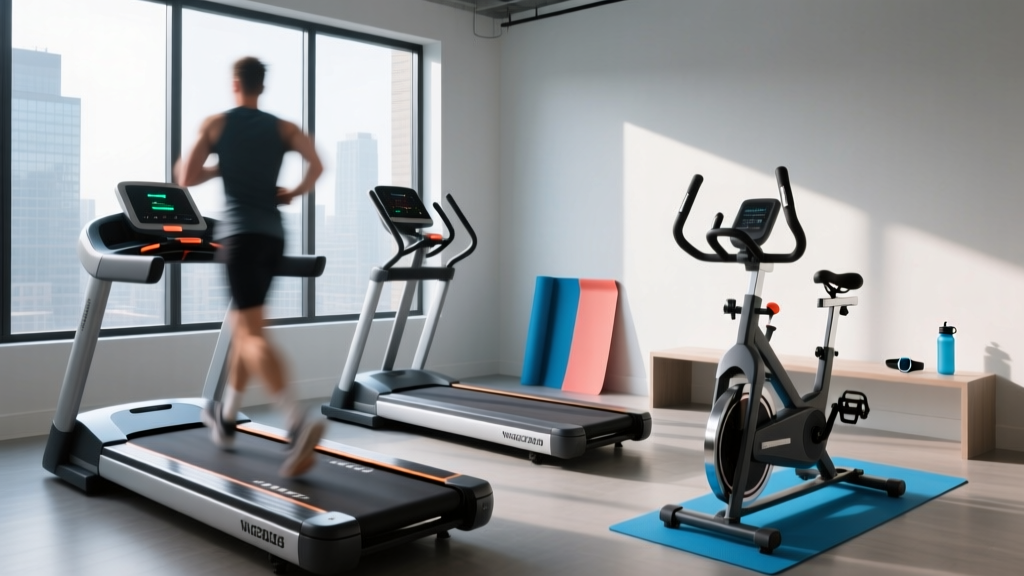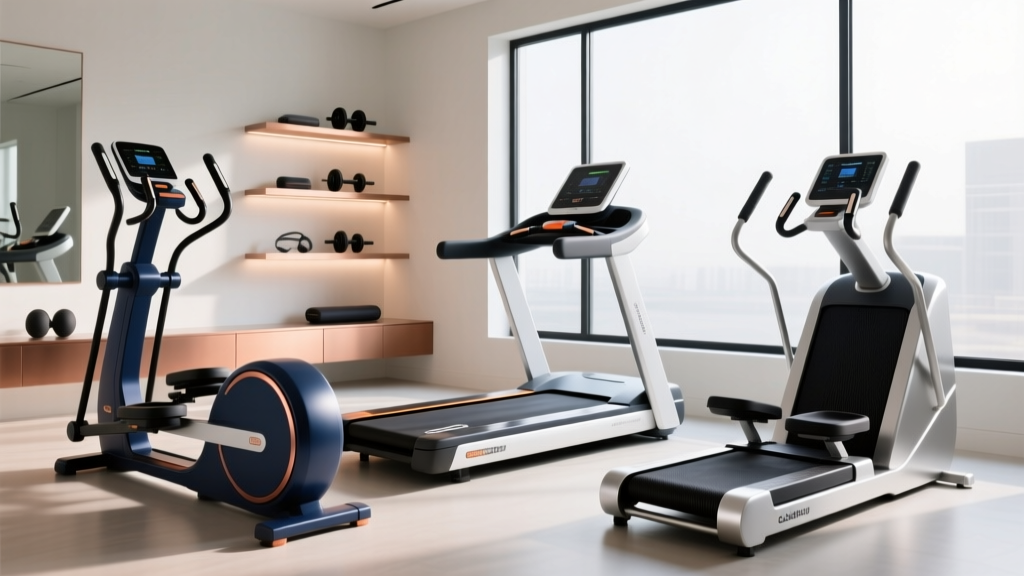
Elliptical vs Treadmill for Home Cardio: Treadmill vs Treadclimber
Analyze the 2026 elliptical vs treadmill market. We compare joint impact, ROI, and the niche treadmill vs treadclimber trend for home gyms.

The 2026 Home Cardio Landscape: Beyond the Basics
As we navigate the fitness equipment market in 2026, the home gym sector has matured from pandemic-era panic buying to a highly calculated, data-driven investment space. The perennial debate of elliptical vs treadmill for home cardio remains at the forefront of consumer research, but the conversation has evolved. Today’s buyers are not just looking at calorie burn; they are analyzing ground reaction forces (GRF), longevity-focused biomechanics, and spatial efficiency. Furthermore, a niche but vocal segment of the market continues to search for the ultimate low-impact, high-yield machine, bringing the treadmill vs treadclimber debate back into the spotlight.
2026 Market Insight: According to recent fitness industry analyses, low-impact cardio machines have seen a 22% year-over-year growth in the premium home sector, driven by an aging demographic and the 'longevity fitness' movement popularized by medical experts. Consumers are prioritizing joint preservation over sheer speed.Biomechanics and Joint Stress: Elliptical vs Treadmill
When deciding between an elliptical and a treadmill, the primary differentiator is impact. The Mayo Clinic notes that while treadmills offer superior weight-bearing benefits for bone density, ellipticals provide a near-zero impact alternative that is crucial for individuals with osteoarthritis or prior meniscus repairs.
The Treadmill Reality: Ground Reaction Forces
Running on a modern treadmill like the Sole F80 ($1,199) or the NordicTrack Commercial 1750 ($2,799) involves repetitive striking. Even with advanced deck flex systems—such as Sole’s cushioned flex deck, which reduces impact by up to 40% compared to asphalt—the ground reaction force (GRF) during a running gait cycle peaks at 2.0 to 2.5 times your body weight. For a 180 lb runner, that is 450 lbs of force transmitted through the calcaneus (heel bone) up to the lumbar spine per step.
- Pros: Natural gait mechanics, superior bone-density stimulation, high ceiling for VO2 max interval training.
- Cons: High joint shear forces, requires significant ceiling clearance (add 10-15 inches to the deck height for user headroom), and higher acoustic output.
The Elliptical Advantage: Closed-Kinetic Chain Movement
Ellipticals utilize a closed-kinetic chain movement, meaning your feet never leave the pedals. A premium model like the Sole E95 ($1,699) features a 20-inch stride length and a heavy 9kg flywheel, which mimics the biomechanics of running without the eccentric muscle damage caused by foot-strike deceleration. Furthermore, the E95 boasts a 2.5-inch Q-factor (the distance between the pedals), which aligns the hips, knees, and ankles in a natural vertical plane, drastically reducing IT band friction.
"Studies published in the National Institutes of Health (PMC) demonstrate that elliptical training elicits similar cardiovascular and metabolic responses to treadmill running, but with significantly lower perceived exertion and joint loading."
The Niche Disruptor: Where the Treadmill vs Treadclimber Debate Fits
While the elliptical vs treadmill matchup dominates the mainstream, advanced home gym builders often investigate the treadmill vs treadclimber comparison. The TreadClimber, historically dominated by Bowflex (specifically the TC200 model), combines the forward motion of a treadmill with the upward step of a stair climber.
The 2026 TreadClimber Market Reality
It is impossible to analyze this machine in 2026 without addressing the corporate restructuring of Nautilus/Bowflex following their 2024 financial challenges. Consequently, the primary market for new TreadClimbers has severely contracted. Today, the treadmill vs treadclimber debate is largely playing out in the certified refurbished and secondary markets. A refurbished Bowflex TC200, which originally retailed for $2,299, can now be acquired for roughly $1,100 to $1,400.
The TreadClimber’s dual independent treadles rise to meet your foot, creating a 'stepping' motion at speeds capped around 4.5 mph. You cannot run on a TreadClimber. However, at a brisk 3.5 mph walk on a level 12 incline, the muscular demand on the gluteus maximus and gastrocnemius is vastly superior to a standard treadmill walk, yielding high caloric expenditure without the high-impact GRF of running.
2026 Buyer’s Matrix: Footprint, Cost, and Maintenance
To make a data-driven purchasing decision, you must look beyond the brochure and evaluate the total cost of ownership, spatial requirements, and mechanical failure points.
| Feature | Treadmill (e.g., Sole F80) | Elliptical (e.g., Sole E95) | TreadClimber (Refurb TC200) |
|---|---|---|---|
| Avg 2026 Cost | $1,199 - $2,799 | $1,299 - $2,499 | $1,100 - $1,400 (Secondary) |
| Footprint (L x W) | 82" x 35" (Requires 10' ceiling) | 83" x 32" (Standard 8' ceiling OK) | 76" x 31" (Compact, low profile) |
| Joint Impact (GRF) | High (2.0x - 2.5x Bodyweight) | Near Zero (Closed-chain) | Low (1.2x - 1.5x Bodyweight) |
| Primary Failure Point | Motor control board / Belt friction | Rail wheel bearings / Pivot joints | Hydraulic lift cylinders / Drive belt |
| Maintenance Need | 100% Silicone lube every 150 miles | Annual bearing inspection / vacuuming | Treadle alignment & belt tensioning |
Failure Modes and Maintenance Realities
A critical aspect of the 2026 market analysis is understanding what actually breaks in these machines once the warranty expires. The American Heart Association recommends 150 minutes of moderate-intensity aerobic activity per week, which translates to heavy wear and tear on home equipment.
Treadmill Failure Modes
The most common point of failure in treadmills is not the motor itself, but the motor control board (MCB) frying due to excessive amperage draw. This happens when users neglect to lubricate the belt-deck interface. A dry belt creates immense friction, forcing a 3.25 CHP motor to draw maximum amps to maintain speed, eventually overheating the MCB. Actionable Advice: Use a laser temperature gun on the motor hood after a 30-minute run; if it exceeds 140°F, your deck needs immediate silicone lubrication.
Elliptical and TreadClimber Edge Cases
Ellipticals suffer from 'rail flat-spotting' if the polyurethane wheels are not kept clean of household dust and pet hair, leading to a grinding sensation during the stride. TreadClimbers, due to their complex dual-treadle mechanism, often experience hydraulic cylinder seal degradation if left unused for months, resulting in a 'drooping' treadle that requires a $150-$200 part replacement.
Expert Verdict: Which Machine Wins Your Floor Space?
The choice between an elliptical, a treadmill, and a treadclimber ultimately hinges on your biomechanical history and spatial constraints.
- Choose the Treadmill if: You are training for outdoor road races, require high-velocity sprint intervals (12+ MPH), and have a dedicated room with ceilings over 9 feet. The Sole F80 remains the undisputed value king for serious runners.
- Choose the Elliptical if: You are prioritizing joint longevity, recovering from lower-body injuries, or share the home gym with users of vastly different heights (the adjustable stride on models like the NordicTrack FS14i solves this). It is the safest long-term investment for general cardiovascular health.
- Choose the TreadClimber if: You are strictly a 'walker' who wants to maximize glute engagement and caloric burn without running, and you are comfortable navigating the secondary/refurbished market in 2026 due to the brand's corporate shifts.
In the modern era of home fitness, data and biomechanics must drive your purchase. Whether you opt for the closed-chain safety of an elliptical, the traditional performance of a treadmill, or the niche stepping mechanics of a treadclimber, prioritizing structural maintenance and proper form will ensure your investment pays dividends for your cardiovascular health for years to come.
More gear to consider
All reviews
Is It Okay to Run Barefoot on a Treadmill? Curved vs Motorized

Elliptical vs Treadmill: Budget & ProForm Treadmill Maintenance Kit

Treadmill Motor Size Guide: How the Sole F65 Treadmill Compares

The Fastest Treadmill for Small Spaces: 2026 Folding Reviews

Skip the Equine Aqua Treadmill: Top Compact Portable Cardio (2026)