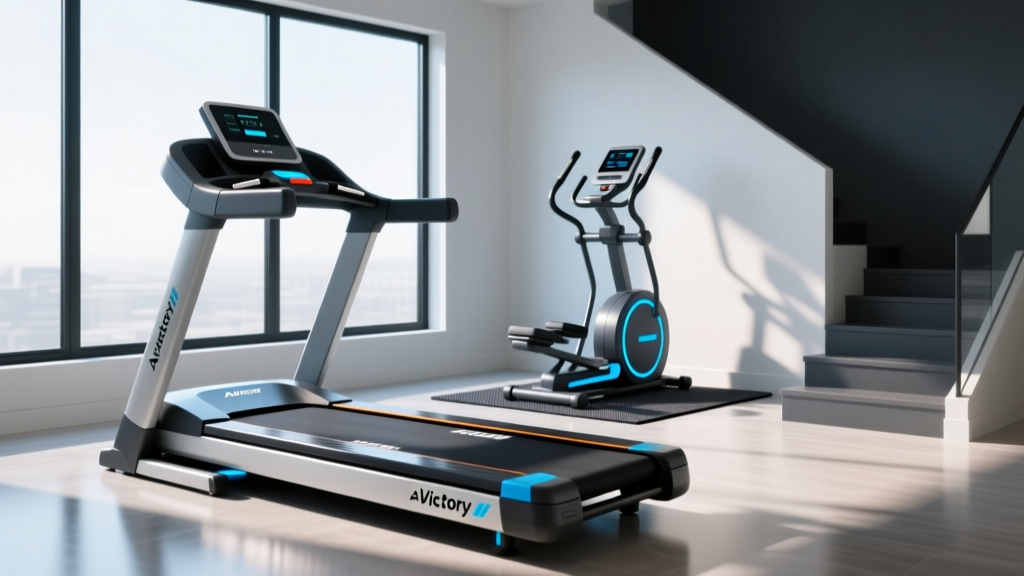
Elliptical vs Treadmill: Training for a Half Marathon on a Treadmill Schedule
Compare elliptical vs treadmill durability and maintenance when training for a half marathon on a treadmill schedule. Protect your joints and your gear.

Committing to a 13.1-mile race is a massive physiological undertaking, but it is also a severe stress test for your home gym equipment. When you are training for a half marathon on a treadmill schedule, you are subjecting your machine to 30 to 50 miles of repetitive, high-impact friction every single week. Over a standard 16-week training block, that equates to upwards of 600 miles of localized wear and tear. This raises a critical question for home gym owners: how does an elliptical compare to a treadmill in terms of mechanical longevity, required maintenance, and joint preservation during high-volume endurance training?
At FitGearPulse, we look beyond the basic spec sheets. We evaluate how these cardio machines survive the brutal reality of endurance schedules. Below, we break down the maintenance realities, failure modes, and longevity tips for both machines when pushed to their limits.
The Mileage Toll: Treadmill Wear vs. Elliptical Stress
Understanding how your equipment degrades is the first step in preventing mid-training-block breakdowns. The mechanical forces at play on a treadmill are vastly different from those on an elliptical.
Data Highlight: The 600-Mile Threshold
During a rigorous half-marathon training cycle, a runner averaging 40 miles a week will log 640 miles in 16 weeks. Entry-level treadmills (under $800) typically experience motor control board failure or deck warping between 400 and 500 miles of continuous use. Mid-tier ellipticals (like the Sole E95) can easily surpass 2,000 miles before requiring pivot bearing replacements, as they lack the high-friction belt-to-deck interface.
On a treadmill, the primary points of failure are the walking belt, the deck, and the drive motor. Every footstrike generates heat and friction. If the belt is improperly tensioned or lacks 100% silicone lubrication, the motor must draw excess amperage to keep the belt moving, leading to thermal shutdowns or blown capacitors.
On an elliptical, the stress is transferred to the pivot points, the drive belt (or internal alternator), and the guide rails. While there is no abrasive friction like a treadmill deck, the lateral torque generated during a 90-minute long run can loosen crank arm bolts and wear out polyurethane wheels if the machine is not properly leveled and maintained.
Machine Maintenance: Keeping Your Gear Alive Through Race Day
According to equipment testing by Consumer Reports, routine maintenance is the single biggest differentiator between a treadmill that lasts three years and one that lasts a decade. When following a high-volume half-marathon schedule, your maintenance intervals must be compressed.
| Interval | Treadmill (e.g., Sole F80, NordicTrack 1750) | Elliptical (e.g., Sole E95, Bowflex M9) |
|---|---|---|
| Weekly | Wipe down console and handrails to prevent sweat corrosion on electronic contacts. Vacuum around the motor hood to prevent static buildup. | Wipe down guide rails with a damp microfiber cloth. Inspect pedal straps for micro-tears. |
| Bi-Weekly (High Mileage) | Check belt tension. You should be able to lift the belt 2-3 inches off the deck in the center. Apply 100% silicone lubricant if dry. | Check all crank arm and pivot bolts with an Allen wrench. High-torque intervals can loosen these over time. |
| Post-Training Block | Deep clean the deck. If the deck shows visible grooves or the belt is fraying at the seams, replace both simultaneously ($150-$250 part cost). | Apply white lithium grease to all major pivot bearings. Inspect the internal drive belt for cracking or slipping. |
The Golden Rule of Treadmill Lubrication
Never use WD-40, petroleum jelly, or household oils on a treadmill belt. These substances will degrade the cotton under-layer of the walking belt and destroy the deck coating. Always use manufacturer-approved 100% liquid silicone. Apply roughly 0.5 ounces under the belt, run the machine at 2.0 mph for three minutes to distribute it, and wipe away excess from the edges.
Human Maintenance: Joint Longevity and Biomechanics
Equipment longevity is only half the equation; your body's longevity is equally critical when training for a half marathon on a treadmill schedule. The biomechanical impact of these two machines dictates how well your joints will hold up by mile 10 of your long run.
"While treadmill running closely mimics outdoor biomechanics, the consistent, unyielding surface can lead to repetitive stress injuries if the runner does not vary their incline and speed. Ellipticals offer a zero-impact alternative that maintains cardiovascular conditioning while allowing micro-fractures in the lower extremities to heal."
— Adapted from insights by the Mayo Clinic on aerobic exercise and joint health.
The American Heart Association recommends 150 minutes of moderate-to-vigorous aerobic activity per week, a threshold easily shattered during half-marathon prep. To prevent IT band syndrome and shin splints, implement a cross-maintenance strategy:
- The 80/20 Split: Perform 80% of your scheduled mileage on the treadmill to build specific bone density and tendon stiffness required for road racing. Use the elliptical for the remaining 20% (specifically for recovery days and warm-ups) to flush lactic acid without impact shock.
- Incline Variation: Never run a full 16-week schedule at a 0% incline. Keep the treadmill at a 1% to 1.5% baseline incline to simulate outdoor wind resistance and reduce the braking forces on your patellar tendons.
- Footwear Rotation: Just as your machine needs maintenance, your running shoes compress and lose EVA foam resilience after 300 miles. Rotate two pairs of shoes during your training block to allow the foam to decompress between runs.
Cost of Ownership: Repair Realities for High-Mileage Runners
If you neglect maintenance during your half-marathon schedule, you will face out-of-pocket repair costs. Here is what typically breaks first under high-volume endurance training, and what it costs to fix:
Treadmill Failure Modes
- Walking Belt/Deck Friction Burn ($200 - $350): Caused by skipping silicone lubrication. The motor overheats, melting the belt seam and scoring the phenolic deck.
- Motor Control Board Failure ($250 - $450): Caused by dust ingestion or excessive amp draw from a tight/dry belt. The board simply shorts out, and the machine will not start.
- Drive Belt Snapping ($50 part, $150 labor): The ribbed belt connecting the motor to the front roller stretches and slips, causing a sudden loss of speed.
Elliptical Failure Modes
- Pivot Bearing Degradation ($40 - $90): Results in a loud 'clunking' noise during the stride transition. Easily fixed by replacing the sealed bearings and applying marine-grade grease.
- Guide Rail Pitting ($150 - $250): On rear-drive ellipticals, sweat dripping onto the rails causes rust and pitting, which shreds the polyurethane wheels. Prevent this by strictly wiping down rails post-workout.
Step-by-Step: The 15-Minute Weekly Treadmill Rescue
Integrate this rapid maintenance flow into your rest day routine to ensure your treadmill survives your peak mileage weeks:
- Unplug the Machine: Always sever power before inspecting the motor hood.
- Vacuum the Hood: Remove the plastic motor cover (usually 4-6 Phillips screws). Use a brush attachment to pull dust away from the motor fan and lower control board.
- The Lift Test: Reach under the walking belt in the center of the deck. Lift it. If it raises less than 2 inches, your belt is too tight and is choking the motor. If it raises more than 4 inches, it is too loose and will slip during hill sprints. Adjust the rear roller bolts accordingly in quarter-turn increments.
- Inspect the Seam: Run your hand along the belt seam. If you feel fraying or heat blisters, order a replacement belt immediately before it snaps mid-run.
Frequently Asked Questions
Can I use an elliptical to completely replace my long runs on a treadmill schedule?
While the elliptical is phenomenal for cardiovascular conditioning and zero-impact recovery, it does not replicate the specific eccentric muscle contractions and bone-loading required for road running. If your goal is to finish a half-marathon without injury, use the elliptical for up to 30% of your weekly volume, but keep your longest weekly efforts on the treadmill or pavement to condition your joints for race day impact.
Does a treadmill's continuous horsepower (CHP) matter for half-marathon training?
Absolutely. If you weigh over 180 lbs and are running long intervals, you need a minimum of a 3.0 CHP motor (not peak horsepower). Motors smaller than 3.0 CHP will overheat and trigger thermal shutoffs during 90-minute long runs. Models like the Horizon 7.4 or Sole F80 feature 3.5 CHP motors specifically designed to dissipate heat during sustained endurance efforts.
How do I know if my elliptical's drive belt needs replacing?
If your elliptical feels like it is 'slipping' or stuttering at the apex of your stride, but the pedals still have resistance, the internal drive belt is likely stretched or glazed. Unlike a treadmill belt, you cannot easily tension an elliptical drive belt; it usually requires a full replacement, which is a relatively inexpensive part ($30-$60) but requires disassembling the side shrouds.
More gear to consider
All reviews
Air Bike vs Assault Bike Space & Treadmill Handrail Attachment

Air Bike vs Assault Bike: What's Better, StairMaster or Treadmill?

Under Desk Treadmill vs Walking Outside: Which Burns More Calories?

Navigating the Walking Treadmill Bicycle Debate: 2026 Setup & Feature Guide

Bike Types vs ProForm 725EX Treadmill: Expert Review