Elliptical vs Treadmill Care: Calibrate Incline NordicTrack Treadmill
Compare elliptical vs treadmill longevity. Learn essential maintenance, including how to calibrate incline NordicTrack treadmill models for peak performance.

The Hidden Cost of Home Cardio: Elliptical vs. Treadmill Longevity
When debating the merits of an elliptical vs treadmill for home cardio, most buyers focus on calorie burn, joint impact, or interactive programming. However, as fitness equipment technicians, we look at a metric that rarely makes the marketing brochures: the five-year cost of ownership and mechanical longevity. A cardio machine is only as good as its maintenance schedule. Treadmills and ellipticals endure vastly different physical stresses, and understanding these mechanical realities is the key to protecting your investment.
According to Consumer Reports, the average lifespan of a mid-tier home treadmill is 7 to 12 years, while ellipticals can often push past the 15-year mark due to the absence of high-impact deck friction. Yet, both machines have specific failure points that can prematurely end their lifespan if ignored.
Mechanical Wear: Friction vs. Rotational Sheer
To understand maintenance, you must understand the physics of the machine.
The Treadmill: Friction and Gravity
Treadmills are linear friction engines. The continuous rubbing of the PVC belt against the phenolic wood deck generates immense heat and physical degradation. Furthermore, the incline motor must lift the entire weight of the running deck and the user—often exceeding 350 pounds of dynamic force—against gravity. This leads to potentiometer drift, gearbox wear, and belt stretching.
The Elliptical: Rotational Sheer and Pivot Stress
Ellipticals operate on rotational sheer force. The primary wear points are the needle bearings, pivot bushings, and the rear drive belt (on rear-drive models). While they lack the abrasive friction of a treadmill deck, the lateral torque applied to the pedal arms during heavy striding can warp unsealed bearings and snap drive belts if tension is neglected.
Expert Insight: The American Council on Exercise (ACE) notes that while ellipticals provide superior low-impact biomechanics for the user's joints, the machine's internal pivot points endure continuous multi-directional torque, requiring stricter lubrication schedules than the linear bearings of a treadmill.Treadmill Deep Dive: Incline Motor Drift and Calibration
The most common non-belt failure on modern treadmills is incline motor desynchronization. Over time, dust accumulation, voltage spikes, and heavy load-bearing cause the internal potentiometer to lose its 'zero' reference point. This results in 'phantom inclines' (the deck shifts randomly during a run) or an Error Code 3 (Incline Keypad/Stuck).
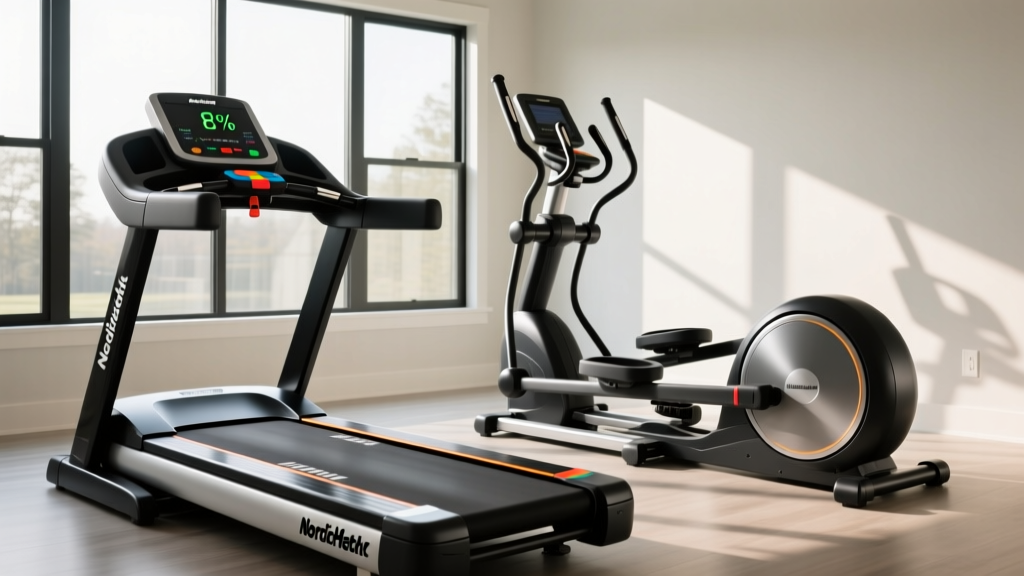
Knowing how to calibrate incline NordicTrack treadmill systems is a critical skill for owners of the Commercial Series (e.g., 1750, 2950) and T-Series models. Calibration forces the logic board to re-establish the absolute minimum and maximum physical limits of the incline motor's worm gear.
Step-by-Step: NordicTrack Incline Calibration
- Power Down and Reset: Turn off the treadmill using the master switch near the power cord. Wait 60 seconds to allow the console capacitors to discharge.
- Remove the Safety Key: Pull the magnetic safety key from the console.
- Enter Diagnostic Mode: Press and hold the Incline Up and Speed Up buttons simultaneously. (Note: On newer iFit-enabled consoles without physical incline buttons, hold the iFit or Program button while pressing the physical incline up arrow on the bezel).
- Engage the Console: While holding the buttons, insert the safety key. The console will beep, and the display should read 'Calibration', 'EP:00', or 'CL11'.
- Execute the Sweep: Release all buttons and press Incline Up once. Do not stand on the belt. The treadmill will automatically raise to its maximum incline (usually 15%), pause for three seconds, and lower back to 0%.
- Exit Mode: Once the deck returns to a flat 0% position, remove the safety key to exit calibration mode. Re-insert it to resume normal operation.
Elliptical Deep Dive: Pivot Bearings and Drive Belts
Unlike treadmills, you cannot 'calibrate' an elliptical's resistance electronically to fix mechanical grinding. Elliptical longevity relies entirely on physical lubrication and belt tensioning.
Pivot Point Lubrication
The pedal arms and upright striders connect via needle bearings. If you hear a rhythmic 'creak' or 'pop' that aligns with your stride, the factory grease has dried out. The Fix: Every 6 months, wipe the pivot rods with a microfiber cloth and apply a thin layer of PTFE-based synthetic grease or white lithium grease. Never use WD-40 or standard silicone spray, as these will attract dust and create an abrasive paste that destroys the bearing seals.
Drive Belt Tensioning (Rear-Drive Models)
On rear-drive ellipticals (like the Sole E95 or NordicTrack SpaceSaver SE), the poly-v drive belt connects the front crank to the rear magnetic flywheel. Over 1,000 hours of use, the belt stretches. If you experience 'slipping' at the top of your stride, the tensioner pulley must be adjusted. The Fix: Remove the side shroud, locate the motor mount bolts, and loosen them by two turns. Slide the motor housing outward by exactly 1/4 inch to increase tension on the poly-v belt, then re-torque the bolts to 15 ft-lbs.
5-Year Maintenance Cost & Effort Matrix
To make an informed buying decision, consider the financial and temporal upkeep required for both machines over a standard 5-year warranty period.
| Maintenance Task | Treadmill | Elliptical | Est. Cost (Parts) |
|---|---|---|---|
| Belt / Deck Lubrication | Every 3-6 months (100% Silicone) | N/A | $12 - $20 |
| Pivot Bearing Greasing | N/A | Every 6 months (White Lithium) | $8 - $15 |
| Belt Replacement | Years 3-5 (Depending on mileage) | Years 5-7 (Drive belt) | $40 - $150 |
| Incline / Resistance Calibration | As needed (Software reset) | N/A (Magnetic eddy current) | $0 (DIY) |
| Deck Resurfacing/Flipping | Year 4 (If reversible) | N/A | $100 - $250 |
Environmental Threats: PCBs and Magnetic Flywheels
Beyond moving parts, the environment dictates longevity. According to the Mayo Clinic, placing cardio equipment in a garage or basement is common, but environmental factors severely impact machine lifespan.
- Humidity and Ellipticals: High humidity causes the iron core of an elliptical's magnetic flywheel to oxidize. Rust on the flywheel creates uneven eddy-current resistance, resulting in a 'jerky' pedal stroke that cannot be fixed via software.
- Dust and Treadmill PCBs: Treadmill motor brushes shed carbon dust. Combined with household pet dander, this creates a conductive layer on the lower control board (PCB). This leads to short circuits and blown IGBT transistors. Vacuuming the motor hood every 90 days is non-negotiable for treadmill owners.
- Power Surges: Both machines utilize sensitive logic boards. Always plug your machine into a UL-listed surge protector rated for at least 4,000 joules, never directly into a wall outlet or an extension cord, which can cause voltage drops that burn out the drive motor.
Expert Verdict: Which Machine Survives Your Routine?
If your primary goal is minimizing long-term maintenance and avoiding complex calibration procedures, the elliptical is the undisputed winner. Its sealed magnetic resistance system and lack of abrasive belt friction mean that a simple bi-annual greasing of the pivot points will keep it running silently for over a decade.
However, if you require the biomechanical specificity of running and opt for a treadmill, you must commit to the maintenance matrix. Learning how to safely maintain belt tension, apply pure silicone lubricants, and perform system resets to calibrate incline NordicTrack treadmill hardware will save you hundreds of dollars in out-of-warranty service calls. Choose the machine that aligns not just with your fitness goals, but with your willingness to maintain the hardware that supports them.
More gear to consider
All reviews
Bowflex T22 Treadmill vs Under Desk Treadmills: Office Use Review

Elliptical vs Treadmill: Budgeting a 28 Day Treadmill Challenge
Curved vs Motorized: Top Brands of Treadmills for Beginners

Lifespan Treadmill Review: Walking Pad Comparison 2026

Under Desk Treadmill Review: Maintenance vs Barry's Treadmill