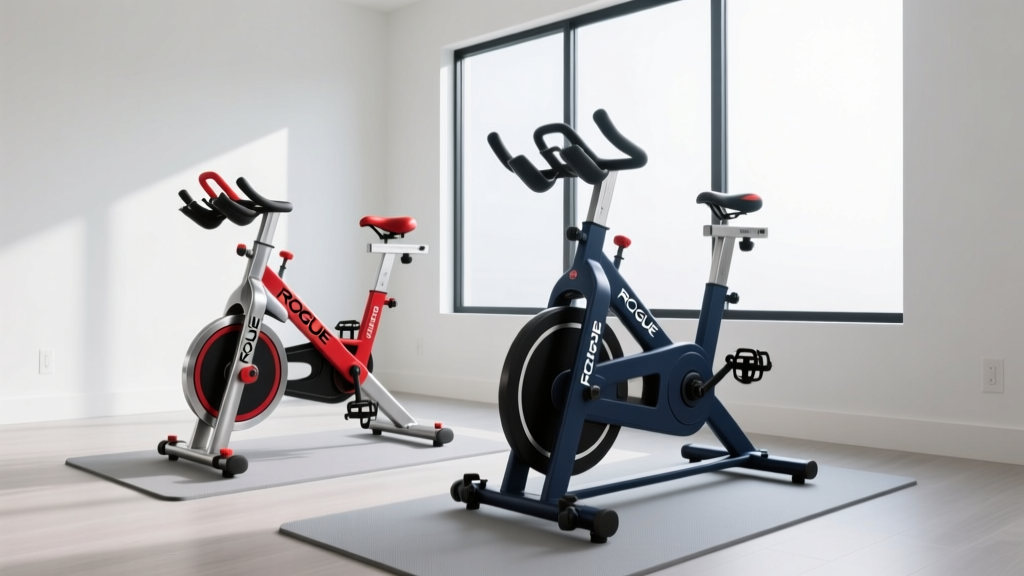
Echo Bike vs Assault Bike: Space for a Treadmill Interval Program
Compare Rogue Echo and Assault AirBike footprints to optimize your home gym layout for high-intensity cardio and a safe treadmill interval program.

The Spatial Dilemma: High-Intensity Cardio in Compact Zones
As home fitness spaces evolve in 2026, the demand for multi-modal cardio setups has never been higher. Athletes and enthusiasts alike are no longer satisfied with a single piece of equipment; they want the ability to execute max-effort air bike sprints and seamlessly transition into a rigorous treadmill interval program. However, fitting two massive pieces of cardio equipment into a standard 10x12 spare bedroom or a corner of the garage requires a masterclass in spatial geometry.
This guide serves as your definitive air bike assault bike comparison guide, but with a critical twist: we are evaluating the Rogue Echo Bike V2 and the Assault AirBike Elite strictly through the lens of space optimization, layout design, and safety clearances. When you are pushing your heart rate past 170 BPM, the physical dimensions of your equipment dictate not just your room's aesthetics, but your physical safety.
⚠️ The 48-Inch Eject Zone Rule
Before comparing bikes, we must establish the non-negotiable safety perimeter for your treadmill. According to industry safety standards and the American College of Sports Medicine (ACSM), any treadmill used for high-speed interval training requires a minimum of 48 inches of clear space behind the deck and 24 inches on each lateral side. If a user slips during a 10 MPH sprint interval, they will be ejected backward. If that space is occupied by the steel frame of an air bike, the result is a severe laceration or fracture. Your layout must prioritize this eject zone above all else.
Footprint Face-Off: Rogue Echo V2 vs. Assault AirBike Elite
To understand how these machines interact with your floor plan, we must look past the marketing hype and focus on the raw dimensional data. The Rogue Echo and the Assault Elite are the undisputed heavyweights of the wind-resistance market, but their architectural footprints differ in ways that profoundly impact room layout.
| Specification | Rogue Echo Bike V2 | Assault AirBike Elite |
|---|---|---|
| Overall Length | 53.0 inches | 51.0 inches |
| Overall Width | 29.5 inches | 22.7 inches |
| Overall Height | 53.0 inches | 53.5 inches |
| Shipping Weight | 125 lbs | 115 lbs |
| Drive System | Belt Drive (Quiet) | Belt/Chain Hybrid |
| 2026 Est. Price | $1,250.00 | $1,099.00 |
The most critical data point in this Assault AirBike Elite vs Rogue Echo V2 comparison is the width discrepancy. The Echo Bike is nearly 7 inches wider than the Assault. In a spacious commercial gym, 7 inches is irrelevant. In a 120-square-foot home gym where you are trying to carve out a safe 48-inch eject zone for a treadmill interval program, those 7 inches dictate whether your layout is functional or fundamentally compromised.
Designing the Layout: Integration Configurations
When mapping out your cardio zone, the placement of the air bike relative to the treadmill determines your workflow, safety, and spatial efficiency. Below are the two most effective layout configurations for combining these machines.
Configuration A: The Parallel Gauntlet (Best for Assault Elite)
In this layout, the air bike and the treadmill are placed parallel to one another, facing the same direction, with a shared lateral walkway between them. This is the ideal setup for hybrid workouts where you alternate between the bike and the treadmill every 3 to 5 minutes.
- Total Width Required: 24" (Treadmill side clearance) + 22.7" (Assault Width) + 24" (Shared Walkway) + 24" (Treadmill side clearance) = 94.7 inches (7.9 feet).
- The Echo Problem: If you swap the Assault for the Rogue Echo, the total width jumps to 101.5 inches (8.4 feet). In many standard spare bedrooms that are exactly 10 feet wide, accounting for baseboards and door swings, the Echo Bike will compress the shared walkway to a hazardous 17 inches, violating the ACSM's lateral safety guidelines.
Configuration B: The L-Shape Sprint Zone (Best for Rogue Echo)
If your heart is set on the belt-driven smoothness of the Rogue Echo, the parallel layout is likely too wide. Instead, utilize an L-Shape configuration. Place the treadmill against the longest wall, honoring the 48-inch rear eject zone. Position the Echo Bike in the adjacent corner, perpendicular to the treadmill, facing into the room.
The 3-Step Pivot Rule: When transitioning from an air bike sprint to a treadmill interval program, fine motor skills degrade rapidly due to elevated heart rates. The distance from the bike's outer pedal arc to the treadmill's safety handrail must not exceed 36 inches. The L-Shape layout allows you to step off the Echo's wide 29.5-inch base and pivot directly onto the treadmill deck in exactly three steps, maintaining the safety perimeter without requiring a 10-foot wide room.
Transition Logistics: The Hybrid Workout Reality
Space optimization is not just about static storage; it is about dynamic movement. A popular 2026 conditioning protocol involves 'The 30/30 Hybrid'—30 seconds of max-watt output on the air bike, followed immediately by a 30-second sprint on a treadmill interval program.
This specific workout exposes the hidden flaws in poorly designed home gym layouts. If your air bike is placed directly behind the treadmill, the user must navigate around the treadmill's motor hood while fatigued. If the air bike is placed too far away, the 30-second transition window turns into a 45-second walk, ruining the work-to-rest ratio of the interval program.
Expert Recommendation: Always position the air bike on the non-dominant side of the treadmill. If you are right-handed, you will naturally grab the right handrail of the treadmill when mounting at high speeds. Therefore, place the air bike on the left side of the treadmill, ensuring the user's dominant hand remains free to stabilize their body during the transition.
Flooring, Acoustics, and Vibration Dampening
When cramming heavy cardio equipment into a residential space, structural impact and acoustic bleed become major constraints. Both the Echo and the Assault generate immense downward force and lateral sway during standing sprints. Simultaneously, a treadmill interval program generates rhythmic, high-impact shockwaves that travel through floor joists.
Targeted Matting Strategy
Do not waste money and space on wall-to-wall rubber flooring. It traps heat, limits layout flexibility, and makes cleaning beneath the treadmill deck a nightmare. Instead, use a targeted matting approach:
- Under the Treadmill: Use a 3/8-inch thick vulcanized rubber mat (often sold as horse stall mats) cut precisely to 3x6 feet. This absorbs the heel-strike impact of a 10 MPH sprint.
- Under the Air Bike: Use a high-density PVC equipment mat. Air bikes do not generate vertical impact; they generate lateral torque. A thinner, wider PVC mat prevents the bike's leveling feet from gouging your hardwood or concrete without adding unnecessary height that creates a tripping hazard during transitions.
Final Verdict: Which Bike Wins the Space Game?
If your primary constraint is absolute spatial efficiency and you are trying to fit a treadmill interval program into a room narrower than 10 feet, the Assault AirBike Elite is the undisputed champion. Its 22.7-inch width allows for compliant, safe lateral clearances that the Rogue Echo simply cannot match in tight quarters. It leaves the necessary 24-inch safety buffers intact, ensuring that a missed step during a high-speed treadmill sprint doesn't result in a collision with steel tubing.
However, if you have a 12x12 or larger space, or if you are utilizing the L-Shape corner configuration, the Rogue Echo Bike V2 is the superior investment. Its belt-drive system is virtually silent, meaning you can run early morning interval sessions without waking the rest of the household, and its wider base provides a more stable platform for out-of-the-saddle sprints.
Ultimately, successful space optimization in 2026 is about respecting the invisible perimeters of your equipment. Measure your 48-inch eject zones first, map your transition pivots second, and let the raw dimensional data—not just the brand loyalty—dictate whether the Echo or the Assault earns the floor space in your home gym.
More gear to consider
All reviews
Rogue Woodway Curve LTG Treadmill & Under Desk Office Market Trends

NordicTrack C2000 Treadmill vs Home Stair Climbers: 2026 Guide

ProForm 415 Treadmill Motor Guide: Is 2.0 HP Enough?

ProForm 770 EKG Treadmill Review: Small Space Value Analysis
Elliptical vs Treadmill: Bowflex T9 Review & Value
