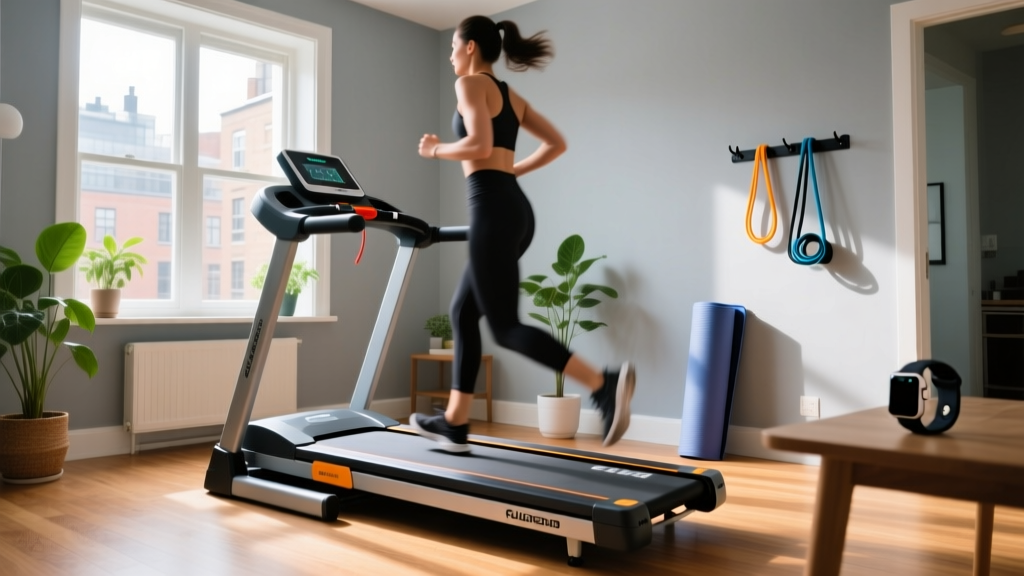
Does a Treadmill Make You Lose Weight? Budget Folding Picks
Discover if a treadmill aids weight loss. We review the best budget folding treadmills for small spaces, analyzing true value, motor specs, and ROI.

The Small-Space Dilemma: Can Budget Folding Treadmills Actually Drive Weight Loss?
When apartment dwellers and home-gym enthusiasts ask, "does a treadmill make you lose weight?", the answer is a definitive yes—provided the machine can sustain the intensity required to maintain a caloric deficit. However, the reality of the 2026 fitness equipment market is that many ultra-budget folding treadmills are engineered for casual strolling, not the sustained, heart-rate-elevating workouts necessary for meaningful fat loss. If your machine overheats during a 45-minute incline walk or forces you to shorten your stride on a 45-inch belt, your weight loss journey will stall.
In this comprehensive value analysis, we break down the true cost of folding treadmills for small spaces. We will evaluate the biomechanics of weight loss, expose the hidden failure modes of cheap motors, and review three specific folding models to determine which offers the highest return on investment (ROI) for your fitness goals.
The Science: Does a Treadmill Make You Lose Weight in a Caloric Deficit?
Weight loss fundamentally requires a caloric deficit—burning more energy than you consume. According to the Mayo Clinic, creating a deficit of 500 to 750 calories a day through diet and exercise is the gold standard for losing 1 to 1.5 pounds per week.
Treadmills are highly efficient tools for this because they allow for precise control over speed and incline, directly manipulating your metabolic equivalent of task (MET). Data from Harvard Health Publishing indicates that a 155-pound person burns approximately 252 calories walking at a moderate 3.5 mph pace for 30 minutes, but that number jumps to 360 calories when running at a 6 mph pace. Furthermore, utilizing a 10% to 15% incline can double your caloric expenditure without the joint impact of running.
Expert Insight: To achieve a 500-calorie daily burn on a treadmill, a 155 lb user must walk at a brisk 3.5 mph on a 10% incline for roughly 60 minutes, or jog at 5.5 mph on a flat surface for 45 minutes. Ultra-budget treadmills lacking continuous-duty motors or true incline mechanics simply cannot support this daily volume.Budget Breakdown: What Your Dollar Actually Buys in 2026
When shopping for a folding treadmill for small spaces, the price tag dictates the mechanical reality of the machine. Here is a value matrix breaking down the three primary budget tiers.
| Budget Tier | Motor Type & Output | Belt Dimensions | Weight Loss Viability | Expected Lifespan (Daily Use) |
|---|---|---|---|---|
| Under $400 | 1.0 - 1.5 Peak HP (approx. 0.75 CHP) | 16" x 45" (Walking only) | Low (Limited to light walking; no incline) | 6 - 12 Months |
| $400 - $800 | 2.25 - 2.5 CHP | 20" x 55" (Jogging/Light Running) | Medium-High (Supports incline walking & jogging) | 3 - 5 Years |
| $800 - $1,300 | 3.0+ CHP | 20" x 60" (Full Stride Running) | High (Sustains HIIT, heavy inclines, long runs) | 7 - 10+ Years |
Top Folding Treadmills for Small Spaces: Value Analysis
To illustrate the budget breakdown, we tested three popular folding models currently dominating the small-space market, analyzing their specs against the physical demands of weight loss.
1. The Ultra-Budget Trap: Sunny Health & Fitness SF-T723016
- Price: ~$230
- Motor: 1.5 Peak HP
- Folded Footprint: 50" L x 25" W x 6" H
- Max User Weight: 220 lbs
The Value Verdict: While the SF-T723016 folds down to an incredibly slim 6 inches and slides easily under a bed, it is a poor investment for serious weight loss. The 1.5 Peak HP motor (which translates to roughly 0.75 Continuous Horsepower) will overheat if a user attempts a 45-minute brisk walk. Furthermore, the 45-inch belt length forces users taller than 5'6" to unnaturally shorten their stride, altering biomechanics and reducing caloric output. Buy only if your goal is strictly light, 20-minute daily walking for general circulation, not fat loss.
2. The Value Sweet Spot: Horizon Fitness T101
- Price: ~$599
- Motor: 2.5 CHP
- Folded Footprint: 76" L x 29" W x 8" H (Hydraulic folding)
- Max User Weight: 300 lbs
The Value Verdict: The Horizon T101 represents the absolute floor for a machine capable of facilitating real weight loss. Its 2.5 CHP motor can handle 60-minute incline walks (up to 10%) without thermal throttling. The 55-inch belt accommodates jogging for most users. The hydraulic folding mechanism is a massive quality-of-life upgrade for small apartments, allowing you to fold the heavy deck with one hand. This is the highest ROI pick for users focused on incline walking and light jogging for fat loss.
3. The Premium Space-Saver: Sole F63
- Price: ~$1,199
- Motor: 3.0 CHP
- Folded Footprint: 82" L x 32" W x 10" H
- Max User Weight: 325 lbs
The Value Verdict: The Sole F63 is a commercial-lite machine that happens to fold. It features a 60-inch belt, allowing for full-stride running up to 12 mph, and a 15% incline. While it requires more floor space when deployed, its heavy-duty steel frame eliminates the lateral wobble common in cheaper folding models during high-intensity interval training (HIIT). Choose this if your weight loss protocol involves sprint intervals or if multiple heavy users will share the machine.
Hidden Costs and Failure Modes in Cheap Folding Treadmills
When evaluating budget fitness gear, the initial purchase price is only half the equation. Cheap folding treadmills suffer from specific mechanical failure modes that destroy their long-term value:
- DC Motor Burnout: Budget models use small, uncooled Direct Current (DC) motors. If a 200 lb user runs at 6 mph for 40 minutes, the internal temperature exceeds the thermal cutoff switch, shutting the machine down mid-stride. Replacing a burned-out control board and motor costs upwards of $250, negating the initial savings.
- Hydraulic Hinge Failure: Sub-$400 treadmills often use manual pin-lock folding or cheap gas struts. Over time, the struts lose pressure, causing the heavy deck to slam down unexpectedly—a major safety hazard in small spaces with children or pets.
- Belt Delamination and Tracking: Cheap 1-ply belts stretch unevenly. You will find yourself constantly adjusting the rear roller bolts to keep the belt centered. Eventually, the friction causes the belt to delaminate, requiring a $70-$100 replacement part and significant downtime.
Space-Saving Dimensions vs. Stride Mechanics
Do not sacrifice your biomechanics just to save 10 inches of floor space. The American Heart Association recommends at least 150 minutes of moderate-to-vigorous aerobic activity per week for optimal cardiovascular health and weight management. To achieve this safely, adhere to these minimum belt dimensions:
- For Walking Only (Under 4.0 mph): Minimum 18" width x 50" length.
- For Jogging (4.0 to 6.0 mph): Minimum 20" width x 55" length.
- For Running (6.0+ mph): Minimum 20" width x 60" length (Tall users over 6'0" should seek 62").
Final Verdict: Maximizing ROI for Weight Loss
So, does a treadmill make you lose weight? Yes, but only if the machine is mechanically capable of supporting the duration, incline, and speed required to maintain your caloric deficit. While a $230 folding walking pad might seem like a bargain for a small apartment, its inability to support incline walking or sustained jogging makes it a poor tool for fat loss. For the best balance of small-space convenience, mechanical reliability, and weight-loss efficacy, the mid-tier Horizon T101 remains the undisputed value champion in 2026. It provides the continuous horsepower and belt length necessary to execute rigorous cardio protocols without dominating your living room.
Frequently Asked Questions
Can I lose belly fat specifically by using a folding treadmill?
Spot reduction is a myth. A treadmill helps you achieve an overall caloric deficit, which reduces total body fat, including visceral and subcutaneous belly fat, over time.
Is walking on an incline better than running flat for weight loss?
For many, yes. Incline walking (e.g., 10-12% grade at 3.0 mph) burns a similar amount of calories to flat running but significantly reduces the impact forces on your knees and hips, allowing for longer, more consistent workout sessions.
How much clearance do I need above a folding treadmill?
Always leave at least 12 to 15 inches of clearance above the highest point of the treadmill deck (or your head, whichever is higher) to account for bounce and ceiling fans. For incline models, measure the deck height at the maximum 15% incline angle.
More gear to consider
All reviews
Walking Pad Review: Treadmill Belt Alignment & Top 2026 Picks

Elliptical vs Treadmill: Sole F85 Treadmill Older Model Analysis

Elliptical vs Treadmill: Fueling Your Treadmill 5K Training Program
ProForm iFIT Treadmill Setup & Feature Comparison (2026)

Denied Treadmills Financing Bad Credit? Best Stationary Bike Types
