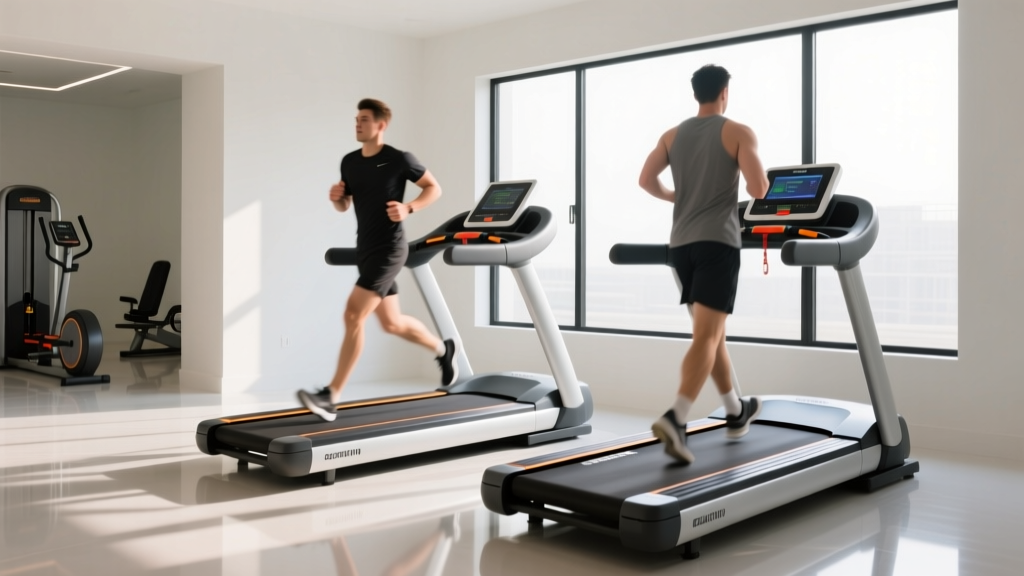
Curved vs Motorized: Top Brands of Treadmills for Beginners
Choosing between curved manual and motorized? Our beginner step-by-step guide compares top brands of treadmills, pricing, and biomechanics.

Step 1: Decode the Core Mechanics
When beginners begin researching the top brands of treadmills, they immediately encounter a critical fork in the road: curved manual treadmills versus traditional motorized treadmills. Understanding the mechanical differences is the first step to making a smart investment in 2026. A motorized treadmill relies on an electric motor (measured in Continuous Horsepower, or CHP) to drive a continuous PVC or rubber belt at a pre-set speed. You are essentially trying to keep up with the machine.
Conversely, a curved manual treadmill is entirely self-powered. It features a concave, slatted running surface angled at roughly 15 to 20 degrees. Your body weight and the friction of your foot strike pull the belt down and back. There is no top speed limit, no motor to burn out, and no electrical outlet required. According to biomechanical research highlighted by the American Council on Exercise (ACE), curved treadmills naturally encourage a mid-foot or forefoot strike, which significantly alters lower-body joint loading compared to the heel-strike pattern often induced by motorized belts.
Step 2: Compare the Leading Brands of Treadmills
Not all manufacturers build both types of machines. The market is distinctly segmented. Here is a breakdown of the premier brands of treadmills in each category, including exact pricing and model specifications for the current market.
The Curved Manual Contenders
- Woodway (The Curve): The gold standard for curved treadmills. The Curve features 56 individual vulcanized rubber slats and a robust ball-bearing system. Price: ~$6,899.
- TrueForm (Runner): A slightly more aggressive curve with 40 slats, favored by CrossFit athletes for high-intensity interval sprints. Price: ~$5,495.
- Technogym (Skillrun): A premium commercial-grade option that integrates digital sled-push and parachute-resistance modes via magnetic braking. Price: ~$8,500+.
The Motorized Heavyweights
- Sole Fitness (F80): The undisputed king of sub-$2,000 home motorized treadmills. It features a 3.5 CHP motor, a 20x60-inch running deck, and heavy-duty steel rollers. Price: ~$1,999.
- NordicTrack (Commercial 2450): Known for its interactive iFIT programming and automatic incline/decline capabilities (-6% to 40%). It utilizes a massive 4.0 CHP motor. Price: ~$2,799.
- Horizon Fitness (7.4): A budget-friendly but durable option featuring a 3.0 CHP motor and Bluetooth connectivity. Price: ~$1,299.
Step 3: Analyze the Biomechanical Data
Choosing between these brands of treadmills isn't just about budget; it is about how your body moves. Below is a side-by-side data matrix comparing the physiological and physical demands of both machine types.
| Metric | Curved Manual Treadmill | Motorized Treadmill |
|---|---|---|
| Caloric Expenditure | ~30% higher at perceived same effort | Standard baseline (varies by incline) |
| Foot Strike Pattern | Mid-foot / Forefoot | Rearfoot / Heel strike common |
| Joint Impact (Knees) | Reduced peak knee extension torque | Higher impact without advanced cushioning |
| Achilles/Calf Load | Significantly increased demand | Moderate, adjustable via heel drop |
| Max Speed Capability | Unlimited (User-dependent, up to 20+ mph) | Capped (Typically 12 to 15 mph) |
| Incline/Decline | Fixed curve (simulates ~8% grade) | Adjustable (-6% to 40% on premium models) |
Step 4: Audit Your Space and Electrical Infrastructure
Before purchasing from any of the top brands of treadmills, you must evaluate your home's infrastructure. Beginners frequently overlook the physical and electrical requirements of these massive machines, leading to costly returns or damaged home wiring.
⚠️ Critical Electrical Warning for Motorized Treadmills
Premium motorized treadmills (like the NordicTrack 2450 or Sole F80) feature high-torque motors that can draw 15 to 20 amps under heavy load, especially during high-incline acceleration. Plugging these into a shared 15-amp household circuit with other appliances will trip your breaker and can degrade the motor's control board over time. Always install a dedicated 20-amp circuit for motorized units. Furthermore, review the FDA's safety guidelines on treadmill clearances to ensure you have at least 24 inches of clearance on all sides to prevent entrapment injuries.
Spatial Considerations: Ceiling Height and Footprint
Curved treadmills sit significantly higher off the ground than motorized models. While a standard Sole F80 has a deck height of about 5.5 inches, the Woodway Curve sits at nearly 9 inches due to the large side rails and slat-belt housing. If you have standard 8-foot ceilings and are 6 feet tall, running on a curved treadmill will leave you with less than 15 inches of head clearance, creating a claustrophobic and potentially dangerous environment for high-bounding sprints. Measure your ceiling height and add your height plus 4 inches for vertical bounce before ordering a curved model.
Step 5: Match the Machine to Your Training Reality
To finalize your decision among the various brands of treadmills, apply this practical decision framework based on your specific training goals and physical profile.
Choose a Curved Manual Treadmill If:
- You focus on HIIT and Sprint Mechanics: The ability to instantly accelerate to top speed without waiting for a motor to spool up makes curved treadmills superior for Tabata and sprint intervals.
- You want to fix your running form: The concave shape physically prevents over-striding. If you try to heel-strike on a curve, you will immediately feel a braking sensation, forcing you to adopt a more efficient mid-foot strike.
- You lack dedicated electrical circuits: Because they are 100% human-powered, you can place a TrueForm or Woodway in a garage, basement, or off-grid studio without worrying about voltage drops.
Choose a Motorized Treadmill If:
- You are training for long-distance endurance: Maintaining a steady 8-minute mile pace for 90 minutes is mentally and physically easier on a motorized belt where the machine does the work of pulling your legs through the swing phase.
- You require incline/decline specificity: If you are training for the Boston Marathon or a hilly trail race, the automated -6% to 40% grade adjustments on a NordicTrack are irreplaceable.
- You have Achilles or calf vulnerabilities: Because curved treadmills demand heavy plantarflexion, runners with a history of Achilles tendinopathy or plantar fasciitis should opt for the cushioned, flat deck of a motorized Sole or Horizon to reduce distal leg strain.
Step 6: Understand the Maintenance Realities
Every machine requires upkeep. According to maintenance guidelines outlined in the Consumer Reports Treadmill Buying Guide, neglecting belt care is the number one cause of premature motor failure in motorized units.
- Motorized Maintenance: You must lubricate the deck with 100% silicone every 150 miles. Additionally, you need to vacuum the motor hood every 3 months. Dust acts as an insulator, causing the motor to overheat and the control board to fry.
- Curved Maintenance: Slat belts do not require deck lubrication, but the rubber slats themselves can dry out and crack. You must apply a specialized rubber protectant to the slats every 6 months and check the tension of the internal drive belts annually to prevent slippage during heavy sled-push simulations.
Expert Insight: 'The best treadmill is the one that aligns with your biomechanical weaknesses and your home's physical constraints. Don't buy a curved treadmill just because it looks elite in a CrossFit gym; if you have tight calves and low ceilings, a high-quality motorized deck will yield far better long-term consistency.'
Final Verdict: Making Your Purchase
Navigating the top brands of treadmills requires looking past marketing hype and focusing on raw specifications. If your budget allows for a $5,000+ investment and your primary goal is explosive power, sprint mechanics, and form correction, the Woodway Curve or TrueForm Runner are unmatched. However, for 80% of beginners seeking reliable, long-distance cardio, interactive programming, and joint-friendly cushioning, a premium motorized unit like the Sole F80 or NordicTrack 2450 remains the most practical and versatile choice for the modern home gym.
More gear to consider
All reviews
Walking Pad vs Treadmill: Setup & Treadmill Pace Conversions Guide

Kelsey Kane Treadmill Tale: Expert Belt Maintenance & Lube Picks

Does Holding Onto the Treadmill Burn Less Calories? Noise Guide
Walking Pad vs Horizon CST 3.5 Treadmill: Mistakes & Fixes

12 30 30 Treadmill Motor Guide: Sizing & Troubleshooting
