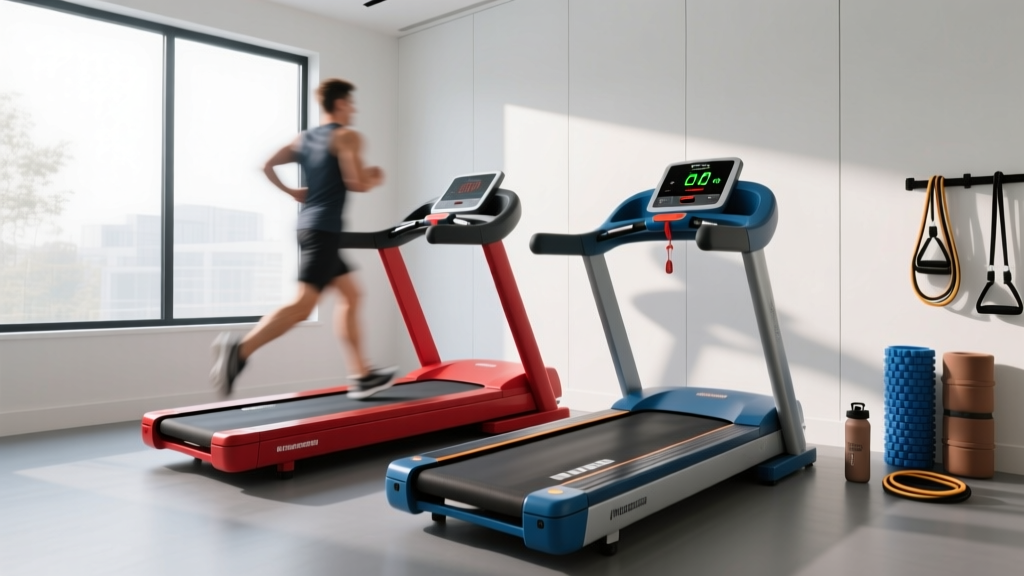
Curved vs Motorized Treadmill Speed Conversion & Troubleshooting
Master curved vs motorized treadmill speed conversion. Fix pacing mistakes, decode RPE metrics, and troubleshoot slat belt console errors like an expert.

The Great Pace Deception: Curved vs. Motorized Treadmills
Transitioning from a traditional motorized treadmill to a curved manual treadmill is one of the most jarring experiences in indoor cardio. You step off a motorized deck like the Sole F80 or NordicTrack Commercial 1750, lace up your shoes, and jump onto an AssaultRunner Elite or Woodway Curve. You settle into what feels like your standard 9:00-minute mile pace, glance at the console, and realize you are barely pushing a 10:30-minute mile. Alternatively, you try to hold your usual 8:00-minute mile pace on the curve, and your heart rate skyrockets into Zone 4 within three minutes.
This discrepancy is the core of the treadmill speed conversion dilemma. Because curved manual treadmills lack a motor driving the belt, the user must overcome both the inertia of the heavy slat belt and the slight upward incline of the curve's apex. Understanding how to convert your motorized pacing to a curved manual effort—and troubleshooting the unique hardware quirks of non-motorized machines—is essential for athletes, coaches, and home-gym owners in 2026.
The Biomechanics: Why Your Pace Feels Different
On a motorized treadmill, the belt pulls your foot backward, assisting with hip extension and reducing the metabolic cost of pulling your leg forward. On a curved treadmill, you are the engine. You must actively drive your foot down into the slats to rotate the belt and use your hamstrings to pull the belt backward.
According to research published in the Journal of Strength and Conditioning Research and biomechanics guidelines from the American College of Sports Medicine (ACSM), running on a non-motorized curved treadmill requires approximately 15% to 30% more oxygen uptake (VO2) and energy expenditure than running at the exact same speed on a motorized treadmill.
This means a 6.0 mph (10:00/mile) pace on a curved treadmill is metabolically equivalent to running 7.0 to 7.5 mph on a flat, motorized belt. If you attempt a direct 1:1 speed conversion without adjusting for Rate of Perceived Exertion (RPE), you will inevitably overtrain, burn out, or alter your running mechanics to compensate.
Treadmill Speed Conversion Chart: Motorized vs. Curved
Rather than fixating on the MPH or KPH readout on the console, elite coaches recommend using RPE and heart rate zones to dictate your curved treadmill workouts. Below is a practical treadmill speed conversion matrix based on a standard 150-lb runner.
| Motorized Pace (Flat) | Motorized Speed (MPH) | Target RPE (1-10) | Equivalent Curved Pace | Curved Speed (MPH) |
|---|---|---|---|---|
| 12:00 /mile | 5.0 mph | 3 (Easy Recovery) | 13:30 /mile | 4.4 mph |
| 10:00 /mile | 6.0 mph | 5 (Aerobic Base) | 11:15 /mile | 5.3 mph |
| 08:00 /mile | 7.5 mph | 7 (Tempo/Threshold) | 09:00 /mile | 6.6 mph |
| 06:30 /mile | 9.2 mph | 9 (VO2 Max Intervals) | 07:15 /mile | 8.2 mph |
Note: Always cross-reference your effort with a chest-strap heart rate monitor. The American Council on Exercise (ACE) emphasizes that RPE can fluctuate based on sleep, hydration, and ambient room temperature, making HR data the ultimate source of truth for curved treadmill conversions.
Top 4 Mistakes When Switching to a Curved Treadmill
1. The 'Motor-Pull' Fallacy (Overstriding)
On a motorized belt, runners tend to overstride, letting the belt do the work of pulling the lead leg back. On a curved treadmill (like the TrueForm Trainer), overstriding causes your heel to strike the upward slope of the front curve. This acts as a braking mechanism, forcing you to work twice as hard to re-accelerate the heavy rubber slats. The Fix: Shorten your stride by 10-15%. Focus on a mid-foot strike directly beneath your center of mass, driving the slat down and back.
2. Holding the Handrails During Tempo Runs
Many users grip the side rails when the metabolic tax of the curve becomes uncomfortable. Holding the rails alters your pelvic tilt, disables your core stabilization, and artificially unloads your body weight, rendering the calorie-burn and VO2 metrics on the console completely invalid. The Fix: Keep your arms pumping at a 90-degree angle. If you must hold on, you are running too fast for your current curved-treadmill fitness level. Drop your speed until you can run hands-free.
3. Trusting the Console Calorie Counter
Most curved treadmill consoles calculate calories based on standard motorized algorithms, occasionally adding a flat 20% buffer. However, because the curve's resistance increases exponentially with your speed and stride force, a 200-lb athlete sprinting on a Woodway Curve is burning vastly more calories than the console displays. The Fix: Ignore the console's calorie metric. Use a wearable like a Garmin Forerunner or Apple Watch Ultra to track active energy expenditure based on your actual heart rate.
4. The Panic Stop (Improper Deceleration)
Motorized treadmills have a safety clip and a deceleration algorithm. Curved treadmills only stop when you stop. A common and dangerous mistake is trying to jump off the sides or abruptly backpedal to stop a heavy slat belt moving at 8.0 mph. The Fix: Follow the step-by-step deceleration protocol below.
Step-by-Step Curved Treadmill Deceleration Protocol
- Shift Posture: Stand tall and move your body weight slightly backward, away from the downward slope of the front curve.
- Shorten Stride: Transition from a run to a jog, then to a fast walk, keeping your feet near the flat apex (the top-middle) of the curve.
- Apply Friction: Gradually widen your stance, allowing the inner edges of your shoes to lightly drag against the side rails to assist in slowing the belt's momentum.
- Step Off Safely: Only step onto the stationary side platforms once the belt has come to a complete, dead stop.
Troubleshooting Curved Treadmill Hardware & Console Errors
Because curved treadmills rely on user-generated kinetic energy and magnetic reed switches rather than digital motor controllers, they experience a unique set of mechanical failures. Here is how to troubleshoot the most common issues in 2026's top models.
AssaultRunner Elite: Console Reads 0.0 MPH While Running
The Problem: You are sprinting, but the LCD screen shows zero speed and zero distance. This is almost always caused by a misaligned magnetic reed switch on the front-left flywheel.
The Fix: Unplug the console (if using the optional power adapter) or remove the battery cover. Locate the small black sensor bracket pointing at the toothed flywheel. Using a 4mm Allen wrench, loosen the mounting bolt. Slide the sensor so the gap between the sensor tip and the passing magnet is exactly 2mm to 3mm. If it's too far, it won't read the magnet; if it's too close, it will scrape and snap. Retighten the bolt, spin the belt by hand, and verify the console registers movement.
TrueForm Trainer: Slat Belt Drifting to the Left or Right
The Problem: The Kevlar-reinforced rubber slat belt is rubbing against the side frame, causing a loud squeaking noise and uneven wear on the slats.
The Fix: Belt tracking on the TrueForm is adjusted via the rear tensioner bolts. If the belt is drifting to the right, locate the rear-right adjustment bolt. Using a 17mm socket wrench, turn the bolt clockwise by exactly one-quarter (1/4) turn. Do not over-tighten, as excessive tension will destroy the internal ball bearings. Walk on the treadmill at 3.0 mph for two minutes to let the belt seat into the new alignment. Repeat if necessary.
Woodway Curve: Sluggish Belt Feel and High Friction
The Problem: The belt feels heavy, sticky, or requires immense effort to get up to speed, negating the smooth glide Woodway is famous for.
The Fix: The vulcanized rubber slats run on a track of over 100 sealed ball bearings. If the treadmill is kept in a high-humidity garage or basement, surface rust can form on the bearing tracks. Wipe the metal tracks with a lint-free cloth and a mild degreaser. Apply a silicone-based dry lubricant (never WD-40 or petroleum-based oils, which attract dust and gum up the slats) to the tracks. Wipe away excess and run the belt manually to distribute the lubricant.
Expert Verdict: Mastering Your Indoor Run
The transition to a curved manual treadmill is a masterclass in biomechanical awareness. By abandoning the flawed 1:1 treadmill speed conversion mindset and instead tuning into your RPE and heart rate data—as recommended by the Mayo Clinic's guidelines on exercise intensity—you will unlock a vastly superior, joint-friendly, and high-yield cardio stimulus. Treat the machine not as a passive belt, but as a dynamic resistance tool. Respect the curve, maintain your hardware, and let your effort dictate the pace.
More gear to consider
All reviews
Treadmill Box Noise Showdown: 2026 Compact Models Compared

Curved Manual vs Motorized Treadmill: How to Fix a Slipping Belt
Treadmill Walking Challenge: Belt Maintenance in Small Spaces

Quiet Cardio: Noise Levels & Calories Burned Treadmill 30 Minutes

Air Bike vs Assault Bike Comparison: Adapting the 15 3 25 Treadmill Workout
