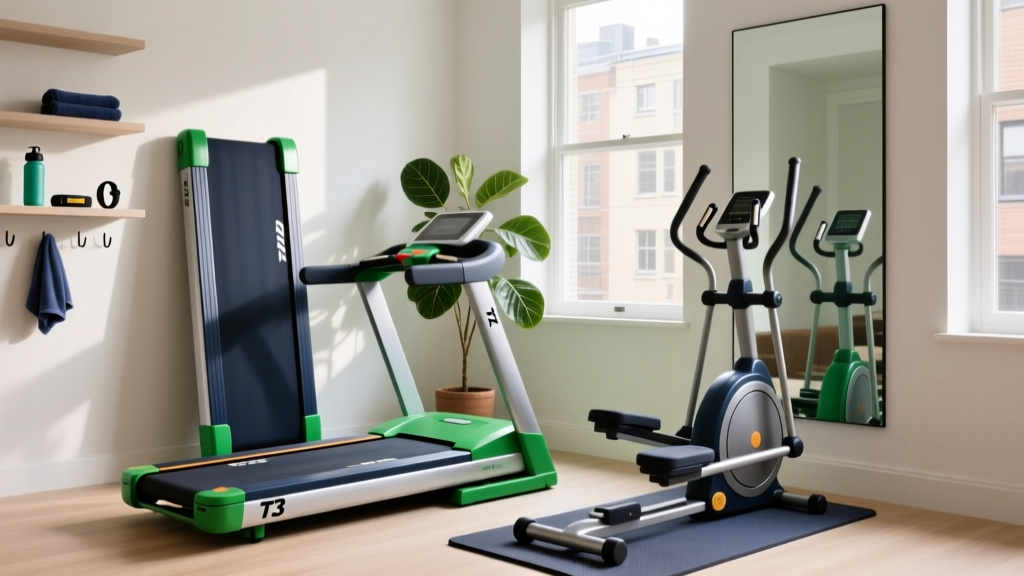
Compact Portable Cardio and T3 Treadmill Gym Layouts
Master space optimization with our guide to integrating a T3 treadmill and compact portable cardio equipment into small home gym layouts for 2026.

The Small-Space Dilemma: Premium Footprints vs. Ultra-Portable Gear
In 2026, the home fitness industry has decisively shifted away from sprawling, multi-car garage gyms toward high-density, multi-use spaces. The average dedicated home workout room is now roughly 10x12 feet (120 square feet). Designing an effective cardio zone within this constraint requires a rigorous approach to spatial geometry, traffic flow, and equipment modularity. The challenge peaks when a user desires club-quality biomechanics but is constrained by architectural boundaries.
This guide explores the spatial realities of anchoring a premium, non-folding machine—specifically the Life Fitness T3 treadmill—while strategically deploying compact portable cardio equipment options to maximize the remaining floorplan. By treating your home gym as an architectural layout rather than a simple storage closet, you can achieve a comprehensive cardiovascular training environment without sacrificing livable space.
The Anchor: Spatial Realities of the T3 Treadmill
The Life Fitness T3 treadmill is a staple for runners demanding commercial-grade shock absorption (via the FlexDeck system) and a continuous-duty 3.0 HP motor. However, unlike budget folding models, the T3 is a rigid, non-folding chassis. This makes it a permanent architectural anchor in your room layout.
Dimensional Breakdown: Life Fitness T3- Physical Footprint: 77" L x 32" W x 56" H (Approx. 17.2 sq. ft.)
- Unit Weight: 280 lbs.
- Operational Clearance (ASTM F2278 Standard): Minimum 24" rear drop-zone, 12" lateral clearance.
- Total Required Zone: ~35 square feet of dedicated, unobstructed space.
Because the T3 treadmill cannot be folded and tucked into a corner, it must dictate the primary axis of the room. According to safety guidelines outlined by the U.S. Consumer Product Safety Commission (CPSC), failing to respect the 24-inch rear clearance on motorized treadmills is a leading cause of domestic friction-burn injuries. Therefore, your layout must treat the T3's 35-square-foot operational zone as immutable. The remaining ~85 square feet in a standard 10x12 room must be optimized using compact portable cardio equipment options that offer high metabolic output with minimal spatial permanence.
Compact Portable Cardio Equipment Options for Secondary Zones
Once the T3 treadmill claims the primary wall, the secondary cardio modalities must vanish when not in use. Here are the top compact portable cardio equipment options that integrate seamlessly into a space-optimized layout, categorized by their storage vector.
1. Bi-Fold Walking Pads (Under-Furniture Vector)
For active recovery days or low-impact LISS (Low-Intensity Steady State) cardio, bi-fold walking pads are unmatched in spatial efficiency. The KingSmith WalkingPad R2 features a 180-degree fold mechanism.
- Active Footprint: 57.5" x 21.1"
- Stored Footprint: 38.2" x 21.1" x 4.9"
- Weight: 57 lbs
- Layout Application: When folded, the 4.9-inch profile allows it to slide directly beneath the elevated front motor hood of the T3 treadmill (which sits roughly 8 inches off the deck at the front cowl), or under a nearby sofa or bed. It claims zero permanent floor space.
2. Vertical-Stowing Rowers (Corner-Height Vector)
Rowing provides a massive cardiovascular stimulus but requires an 8-foot longitudinal track during use. The Concept2 RowErg solves this via vertical separation.
- Active Footprint: 93" x 24"
- Stored Footprint: 17" x 17" x 8' (Vertical)
- Layout Application: By separating the rail, the Concept2 stores in a 17x17 inch square footprint. It can be stood upright in the corner behind the T3 treadmill's rear clearance zone (provided ceiling height permits), effectively utilizing dead vertical air space rather than valuable floor area.
3. Micro-Movement Ellipticals (Seated-Integration Vector)
For days when high-impact running on the T3 is contraindicated, seated ellipticals offer joint-friendly alternatives. The Cubii JR2 is a masterclass in micro-footprint design.
- Dimensions: 23" x 17" x 9"
- Weight: 27 lbs
- Layout Application: It can be stored on a standard bookshelf or slid under a desk. It requires no dedicated floor zone, relying instead on existing furniture footprints.
Spatial Comparison Matrix: T3 vs. Portable Alternatives
Understanding the volumetric cost of your equipment is critical for layout planning. The table below contrasts the spatial demands of the primary anchor against portable secondary options.
| Equipment Model | Active Floor Area | Storage Volume | 2026 MSRP Range |
|---|---|---|---|
| Life Fitness T3 Treadmill | 17.2 sq. ft. (35 sq. ft. w/ clearance) | Non-Folding (68 cu. ft. static) | $3,999 - $4,299 |
| KingSmith WalkingPad R2 | 8.4 sq. ft. | 2.7 cu. ft. (Bi-Fold) | $549 - $599 |
| Concept2 RowErg | 15.5 sq. ft. | 1.9 cu. ft. (Vertical Split) | $1,125 - $1,250 |
| Cubii JR2 Elliptical | 2.7 sq. ft. | 2.0 cu. ft. (Shelf-Storable) | $249 - $299 |
Step-by-Step Layout Design for a 10x12 Room
To successfully integrate the T3 treadmill alongside these compact portable cardio options, follow this sequential layout protocol.
- Anchor to the Load-Bearing Wall: Place the T3 treadmill against the longest unbroken wall, ideally one backed by structural load-bearing studs. The 280 lb unit, combined with a 200+ lb user generating dynamic impact forces, requires a stable subfloor. Position the front motor hood near a dedicated 15-amp or 20-amp circuit outlet to prevent voltage drops during heavy incline acceleration.
- Establish the Rear Drop-Zone: Measure exactly 24 inches from the rear roller of the T3. Use a contrasting color of interlocking EVA foam matting or a subtle floor decal to visually demarcate this safety zone. Nothing—including folded rowers or walking pads—may be stored in this zone while the machine is plugged in.
- Deploy the Vertical Vector: Place the Concept2 RowErg in the corner adjacent to the T3's lateral clearance zone. Ensure the ceiling height is at least 96 inches to accommodate the vertical storage of the separated rails.
- Utilize the Sub-Chassis Void: Slide the folded WalkingPad R2 beneath the front incline motor housing of the T3. This capitalizes on the dead space created by the treadmill's incline mechanics.
Expert Insight on Thermal Management: According to the American College of Sports Medicine (ACSM), environmental factors heavily influence cardiovascular performance and safety. A 3.0 HP treadmill motor generates significant ambient heat. In a compact 120 sq. ft. room, running the T3 treadmill for 60 minutes can raise the ambient room temperature by 4°F to 6°F. Always position a high-velocity floor fan in the lateral clearance zone, directing airflow across the user and toward the motor hood exhaust vents.
Expert Troubleshooting: Edge Cases in Compact Layouts
Even the best-designed layouts encounter physical edge cases. Here is how to troubleshoot common spatial conflicts when mixing heavy anchors with portable cardio.
Edge Case 1: Baseboard Heater Interference
Many older homes feature hydronic or electric baseboard heaters along exterior walls. The T3 treadmill's 32-inch width often overlaps with these units. Solution: Never block the convection flow of a baseboard heater with a treadmill motor hood, as this creates a fire hazard and degrades the treadmill's internal electronics. If wall placement is mandatory, install a custom floating shelf or deflector shield to redirect heat outward, or relocate the T3 to an interior partition wall.
Edge Case 2: Door Swing and Traffic Choke Points
In a 10x12 room, the inward swing of a standard 32-inch door can easily collide with the rear safety zone or the handlebars of a stored rowing machine. Solution: Replace standard hinges with offset pivot hinges (which add 1.5 inches of clearance), or invest $150 in a barn-door track slider to eliminate the interior swing arc entirely, reclaiming up to 7 square feet of usable floor space for your portable cardio equipment.
Edge Case 3: Floor Joist Deflection
Standard residential floors are rated for a 40 lbs/sq. ft. live load. While the static weight of the T3 and user falls within this limit, the dynamic force of running can cause micro-deflections in floor joists, leading to noisy operation and premature wear on the treadmill's deck. Solution: Place a 3/4-inch thick vulcanized rubber mat (minimum 80 durometer) beneath the T3. This distributes the dynamic point-loads across a wider surface area and dampens acoustic transfer to the rooms below.
Conclusion: Designing for Movement Diversity
Integrating a premium, non-folding machine like the Life Fitness T3 treadmill into a compact home gym does not require sacrificing modal diversity. By respecting the immutable safety clearances of the primary anchor and leveraging the folding, splitting, and sliding mechanics of modern compact portable cardio equipment options, you can engineer a space that supports everything from heavy marathon training to active recovery rowing. The key to 2026 home gym design is not just buying the right equipment, but understanding the three-dimensional geometry of how that equipment lives, moves, and breathes within your home.
For more foundational guidelines on weekly cardiovascular volume and modality mixing, refer to the physical activity frameworks provided by the Centers for Disease Control and Prevention (CDC), ensuring your spatial layout directly supports your long-term health outcomes.
More gear to consider
All reviews
Under Desk Treadmill Review vs Assault Fitness Air Runner Treadmill
Can You Walk on a Curved Treadmill? 2026 Belt Maintenance Trends

Rowing Guide & Technique: Upgrading From a ProForm 600i Treadmill

2026 Market Trends: Naipo Walking Pad Treadmill & Compact Cardio
Xterra Treadmill Review: Belt Maintenance & Value Analysis
