Best Treadmill for CrossFit in 2026: Curved vs Motorized Buyer Guide
Discover the best treadmill for CrossFit in 2026. We compare curved vs. motorized models, analyze belt specs, and match treadmills to specific WODs.

Finding the right treadmill for CrossFit is fundamentally different from buying a standard walking machine for your home office. When your daily programming includes 400-meter sprints, 800-meter repeats, or grueling metcons that demand rapid transitions, the equipment must withstand high-impact, multi-directional forces. A standard motorized belt simply cannot replicate the biomechanics of overground running, which is why selecting the correct treadmill for CrossFit requires a deep understanding of belt propulsion, slat durability, and footprint constraints.
In this 2026 buyer guide, we break down the exact specifications you need to look for, compare the top curved runners against high-end motorized alternatives, and provide a practical framework to match the equipment to your specific WOD (Workout of the Day) programming.
The Biomechanics of WODs: Why Belt Propulsion Matters
The core issue with traditional motorized treadmills in a functional fitness environment is that the motor pulls the belt beneath your feet. According to biomechanical analyses published by the National Strength and Conditioning Association (NSCA), this motorized assistance reduces hamstring activation and alters your natural stride mechanics. In a CrossFit environment, where the goal is to build functional, overground speed and power, this discrepancy can lead to poor sprint mechanics and increased injury risk when athletes transition from the treadmill to the track or the rig.
Self-powered, curved treadmills solve this problem. Because the athlete must drive the belt backward using the balls of their feet, the posterior chain (glutes, hamstrings, and calves) is heavily recruited. Studies referenced by the American College of Sports Medicine (ACSM) indicate that running on a non-motorized curved treadmill can increase caloric expenditure by up to 30% compared to a motorized equivalent at the same perceived pace. This metabolic demand is exactly what coaches look for when scaling high-intensity interval training (HIIT) protocols.
Evaluating a Curved Treadmill for CrossFit Programming
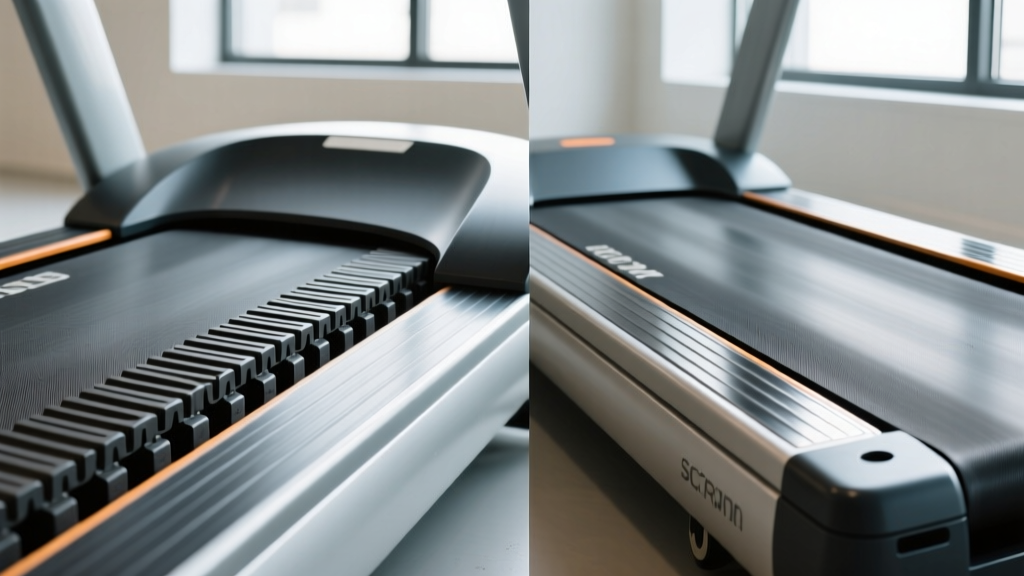
If you are outfitting a garage gym or a commercial box, a curved runner is the undisputed gold standard. However, not all curved models are built equally. The market is dominated by three primary contenders, each with distinct engineering philosophies.
The Big Three: TrueForm, Rogue Echo, and AssaultRunner
- TrueForm Trainer ($3,499): The original disruptor. It features a low-profile deck and a 17-inch wide vulcanized rubber slat belt. It is exceptionally quiet and offers the most natural foot strike, but the narrower belt requires precise foot placement during fatigue-heavy WODs.
- AssaultRunner Elite ($5,499): Built like a tank. It features a heavier flywheel, which creates more inertia. This means it takes slightly more effort to accelerate, but it holds momentum beautifully during long 800m or 1-mile runs. The console provides highly accurate wattage and pace metrics.
- Rogue Echo Runner ($5,995): The premium choice. It utilizes a proprietary magnetic resistance system and a wider belt surface. The console integrates seamlessly with the Rogue ecosystem, making it ideal for affiliate gyms running virtual competitions or tracking leaderboard times.
Curved Runner Comparison Matrix
| Model | Price (2026) | Belt Width | Weight Capacity | Best For |
|---|---|---|---|---|
| TrueForm Trainer | $3,499 | 17 inches | 400 lbs | Technical sprinters, tight spaces |
| AssaultRunner Elite | $5,499 | 17.5 inches | 350 lbs | Longer metcons, data-driven athletes |
| Rogue Echo Runner | $5,995 | 18.5 inches | 400 lbs | Commercial boxes, heavy athletes |
When a Motorized Treadmill for CrossFit Actually Makes Sense
While curved runners dominate the functional fitness space, there are specific scenarios where a high-end motorized treadmill for CrossFit is the superior choice. If your programming heavily features endurance work, long-distance time caps (like 5k or 10k WODs), or if you are rehabilitating an injury where the high-impact deceleration of a curved runner is contraindicated, a motorized belt provides a more forgiving surface.
Furthermore, motorized treadmills are significantly more affordable. A commercial-grade motorized unit like the Sole F80 ($1,199) or the NordicTrack Commercial 1750 ($1,599) costs a fraction of a premium curved runner. If you are a home gym owner on a strict budget who still needs to complete the cardio elements of benchmark WODs like "Helen" or "Mary" (modified with runs), a motorized unit is a pragmatic compromise.
Critical Specs: Belt Dimensions, Slat Durability, and Footprint
Whether you choose curved or motorized, the physical dimensions of the machine will dictate its usability in a high-intensity environment. CrossFit workouts often involve mounting and dismounting the treadmill rapidly, sometimes while carrying a kettlebell or wearing weight vests (like the 20/14 lb RX vests used in "Murph").
1. Belt Width and Length
For motorized treadmills, a 20-inch belt is the absolute minimum, but a 22-inch belt is highly recommended for WODs. When an athlete is fatigued at minute 18 of a 20-minute AMRAP, their foot placement becomes sloppy. A 22-inch belt prevents them from stepping on the side rails and catching an ankle. For curved treadmills, belt width is naturally constrained by the curve geometry, usually maxing out around 18.5 inches, which is acceptable due to the lack of motorized side-rail tripping hazards.
2. Deck Height and Step-Up
Curved treadmills sit much closer to the ground (typically 6 to 8 inches at the lowest point of the curve) compared to motorized treadmills, which can sit 10 to 14 inches high due to the motor housing. A lower deck height reduces the kinetic impact of jumping off the machine and eliminates the "cliff" effect when stepping backward to grab a barbell.
3. Console and Metric Tracking
According to official CrossFit methodology, measurable, observable, and repeatable data is the foundation of fitness. Your treadmill must accurately track distance (in meters, not just miles) and pace. Many cheap motorized treadmills suffer from belt slip, which artificially inflates distance metrics. Curved treadmills use optical sensors on the flywheel, providing near-perfect distance accuracy regardless of the athlete's weight or stride length.
Final Verdict: Matching the Equipment to Your Box
The ultimate treadmill for CrossFit depends entirely on your primary training stimulus and budget. If you are building a dedicated functional fitness space, prioritizing sprint mechanics, and have the capital, the Rogue Echo Runner or AssaultRunner Elite are non-negotiable investments that will last a decade under heavy abuse. They replicate overground running mechanics and force the athlete to do the work.
However, if you are outfitting a home gym on a budget, or if your programming skews heavily toward Zone 2 endurance and long-distance aerobic capacity, a heavy-duty motorized option like the Sole F80 provides excellent shock absorption and reliable pacing at less than half the cost. Whichever route you choose, prioritize belt width, structural weight capacity, and accurate optical tracking to ensure your WOD times remain valid and your joints stay protected.
More gear to consider
All reviews
Treadmill Belt Care: Layout Space & Treadmill Speed Miles Per Hour

2026 Air Bike vs Assault Bike: Kinomap Treadmill App Value Analysis
How Do Treadmills Calculate Calories Burned? Belt Friction & Layout

Air Bike Assault Bike Comparison & TrueForm Runner Curved Treadmill

Elite Runner Treadmill Setup: Motor & Horsepower Guide