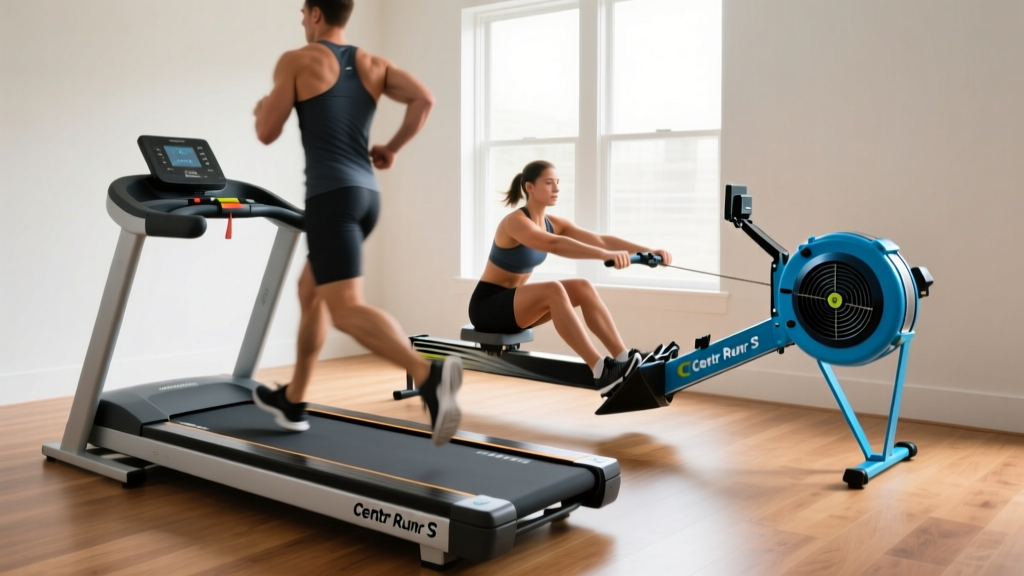
Centr Runr S Treadmill vs Rowing: Buying Guide & Technique Mistakes
Transitioning from a Centr Runr S treadmill to a rowing machine? Avoid common buying errors and technique flaws with our expert troubleshooting guide.

The Cardio Shift: Why Runr S Owners Are Adding Rowers
If you have invested in a Centr Runr S treadmill, you already appreciate premium home fitness equipment. Priced around $1,499, the Runr S offers a reliable 1.25 HP continuous motor, auto-incline capabilities up to 12%, and a compact footprint ideal for dedicated home gym spaces. However, as fitness enthusiasts progress through their 2026 training cycles, many hit a biomechanical plateau. Running is inherently a lower-body, high-impact, sagittal-plane movement. To build a truly resilient, full-body cardiovascular engine, the logical next step is the rowing machine.
According to the American Heart Association, cross-training with varying modalities is essential for preventing overuse injuries and improving overall cardiac output. Yet, transitioning from the rhythmic, high-cadence footstrikes of a treadmill to the forceful, full-body lever mechanics of a rower introduces a steep learning curve. This guide serves as your definitive troubleshooting manual and buying guide, specifically tailored for athletes looking to complement their treadmill routines with indoor rowing.
Rowing Machine Buying Guide: Avoiding the $2,000 Mistake
When you buy a treadmill like the Centr Runr S, you are paying for motor reliability, screen integration, and belt cushioning. When buying a rowing machine, the value proposition shifts entirely to resistance type, rail ergonomics, and monitor accuracy. The most common mistake treadmill owners make is buying a rower based solely on screen size, ignoring the actual drive mechanics.
Resistance Types: Air vs. Magnetic vs. Water
Understanding resistance is critical for matching your training goals. Here is how the top tier of the 2026 market breaks down:
| Resistance Type | Top Model (2026) | Price Range | Best For | Troubleshooting Note |
|---|---|---|---|---|
| Air | Concept2 RowErg | $1,000 - $1,200 | Data nerds, CrossFit, competitive rowers | Requires chain oiling; louder than magnetic. |
| Magnetic | Hydrow | $2,495+ | Screen-first users, quiet apartments | Magnetic drag can feel 'flat' at high stroke rates. |
| Water | WaterRower Club | $1,500 - $1,800 | Aesthetics, sensory feedback | Water purification tablets required every 6 months. |
Sizing and Rail Length Troubleshooting
Unlike a treadmill where the belt length (the Runr S features a 20" x 55" belt) dictates your stride, a rower's rail length dictates your maximum leg extension. If you are taller than 6'2", you must verify the inseam capacity. The standard Concept2 RowErg accommodates up to a 38-inch inseam, but taller athletes must purchase the optional tall legs or extended monorail to avoid 'bottoming out' the slide, which causes severe lower back compression at the catch.
Technique Troubleshooting: Treadmill Habits That Ruin Your Row
The biomechanics of running and rowing are fundamentally opposed. On your Centr Runr S treadmill, you are trained to maintain a high cadence (160-180 steps per minute) with a slight forward lean. Applying this mindset to a rowing machine will result in immediate lower back pain and zero power output. Here are the three most critical technique errors and how to troubleshoot them.
Mistake 1: Setting the Damper to 10 (The Heavy Gear Trap)
On the side of the Concept2 flywheel is a damper setting from 1 to 10. Treadmill runners, accustomed to pushing heavy inclines on the Runr S, instinctively set the damper to 10. This is a massive error. Setting the damper to 10 is equivalent to riding a bicycle in its heaviest gear; it causes rapid muscular fatigue before your cardiovascular system is even challenged.
Expert Troubleshooting Fix: Do not look at the 1-10 number. Instead, use the PM5 monitor to find your Drag Factor (Menu > More Options > Display Drag Factor). According to Concept2's official training resources, a drag factor between 100 and 130 simulates the actual water drag of a racing shell. For most athletes, this correlates to a damper setting between 3 and 5.Mistake 2: Pulling with the Arms First
Runners are used to pumping their arms to drive leg speed. On a rower, the arms are merely the 'ropes' connecting your body's engine to the handle. If you bend your elbows before your legs are fully extended, you are 'shooting the slide' and isolating your biceps, which will fail within 60 seconds.
- The Correct Sequence (The Drive): Legs push first (60% of power), then the hips swing open (30% of power), and finally the arms pull to the chest (10% of power).
- The Correct Sequence (The Recovery): Arms extend, hips hinge forward, then legs bend.
- Drill to Fix: Perform 'Legs-Only' rowing. Keep your arms completely straight and your torso locked at a 10-degree backward lean. Drive only with your legs for 20 strokes to rewire your neural pathways.
Mistake 3: Rushing the Recovery (High Cadence Panic)
On a treadmill, a slow cadence means you are over-striding and braking. On a rower, a slow recovery is mandatory. The drive (the work portion) should be explosive and take about 1 second. The recovery (the slide back to the front) should be controlled and take 2 to 3 seconds. A 1:2 or 1:3 work-to-recovery ratio is essential for flushing lactic acid. If your stroke rate is above 32 strokes per minute (spm) during a steady-state 5K piece, you are rushing the slide and robbing yourself of rest.
"The rowing machine is not a test of how fast you can move back and forth; it is a test of how much force you can apply to the flywheel per stroke while maintaining a rhythmic, controlled recovery."
Maintenance Troubleshooting: Treadmill vs. Rower Upkeep
Owning a Centr Runr S treadmill requires periodic silicone belt lubrication and vacuuming dust from the motor hood. Rowing machines require an entirely different maintenance protocol. Neglecting this leads to the dreaded 'bumpy slide' and degraded drive smoothness.
- The Monorail Wipe-Down (Daily): The roller wheels under the seat pick up microscopic dust and sweat, depositing it onto the stainless steel or aluminum monorail. Over a week, this creates a hardened, bumpy track. Fix: After every single session, wipe the entire length of the monorail with a non-abrasive microfiber cloth dampened with isopropyl alcohol or a mild glass cleaner. Never use abrasive scouring pads.
- Chain Lubrication (Every 50 Hours): Unlike treadmill belts, the nickel-plated steel chain on an air rower stretches and dries out. Fix: Apply 1-2 teaspoons of purified mineral oil (or 3-in-1 oil) to a paper towel, grasp the chain, and pull it through the towel while the chain is extended. Wipe off the excess. Never use WD-40 or thick greases, which attract dust and ruin the internal clutch mechanism.
- Bungee Cord Tension (Annual): If the chain fails to retract quickly when you release the handle, the internal elastic bungee cord has lost tension. Consult your manufacturer's manual to adjust the tension screw located near the flywheel housing.
Expert Verdict: Integrating Both into Your 2026 Routine
The Centr Runr S treadmill remains an elite choice for building lower-body bone density, practicing incline walking protocols, and executing high-intensity interval sprints. However, integrating a rowing machine like the Concept2 RowErg provides the missing link: posterior chain development, core stabilization, and zero-impact cardiovascular conditioning.
By avoiding the common purchasing traps—like prioritizing screens over resistance mechanics—and troubleshooting the ingrained treadmill habits that lead to poor rowing form, you can build a dual-machine home gym that rivals any commercial facility. Remember to drop the damper setting, drive with your legs, and respect the recovery phase. Your heart rate will climb, your joints will thank you, and your overall athletic resilience will reach new heights.
More gear to consider
All reviews
Air Bike vs Assault Bike & TrueForm Trainer Curved Treadmill Trends
Bowflex Treadmill 56 Review: Small Space Value Breakdown
Aviron Victory Treadmill Reviews & Stair Climber Troubleshooting Guide

Elliptical vs Treadmill: How Much Electric Does a Treadmill Use?

Air Bike vs Treadmill: What Is a Good Walking Pace on a Treadmill?
