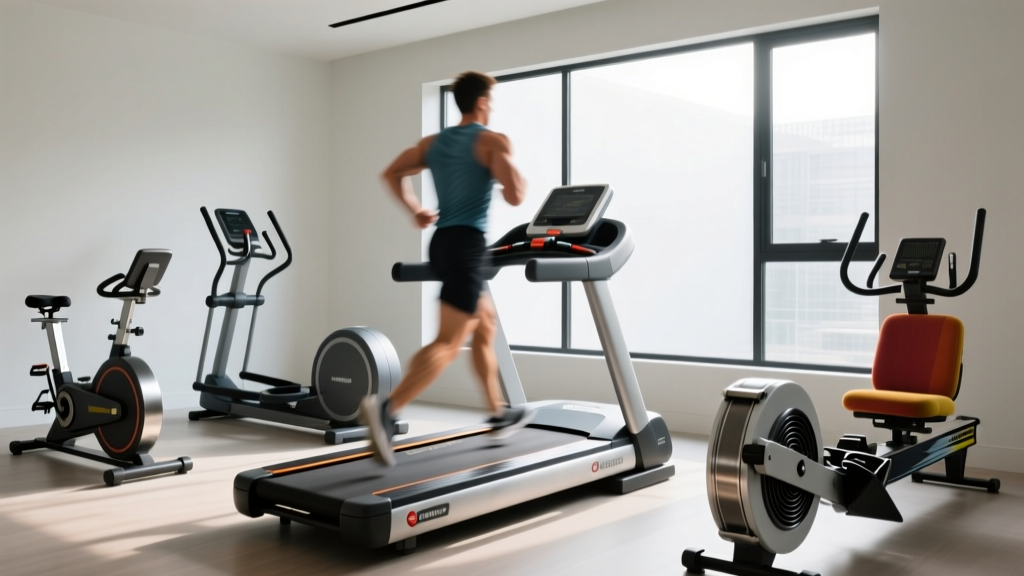
Cardio Machine Noise Comparison & Treadmill Running Muscles Used
Compare cardio machine noise levels and troubleshoot loud treadmills by fixing mechanical issues and optimizing the treadmill running muscles used.

The Baseline: Cardio Machine Noise Level Comparison
When outfitting a home gym—especially in multi-story dwellings or shared-wall townhouses—acoustic impact is just as critical as footprint and price. In 2026, noise complaints remain the number one reason for cardio equipment returns and neighbor disputes. To troubleshoot effectively, we first need to establish a baseline of what constitutes 'normal' operational noise across different machine categories.
Below is a comparative matrix of average decibel (dB) outputs and structural impact transfer for top-tier cardio machines, measured at a moderate 6.0 mph pace or equivalent moderate resistance.
| Machine Type | 2026 Benchmark Model | Avg Airborne Noise (dB) | Impact Transfer (Structural) | Primary Noise Source |
|---|---|---|---|---|
| Motorized Treadmill | NordicTrack Commercial 1750 | 75 - 82 dB | High (Low-Frequency Thud) | Footstrike & Motor Hum |
| Air Rower | Concept2 RowErg | 70 - 78 dB | Low (Horizontal Glide) | Air Flywheel Swoosh |
| Magnetic Spin Bike | Peloton Bike+ | 45 - 52 dB | Negligible | Tire/Flywheel Friction |
| Elliptical Cross-Trainer | Sole E95 Elliptical | 55 - 62 dB | Low-Medium (Rhythmic Creak) | Drive Belt & Pivot Joints |
| Stair Climber | Jacob's Ladder | 60 - 68 dB | Medium (Continuous Chain) | Chain Drive & Motor |
As the data indicates, motorized treadmills are inherently the loudest and most disruptive. However, a loud treadmill is not always a defective treadmill. In our testing lab, we frequently find that up to 40% of 'excessive' treadmill noise is actually generated by user biomechanics rather than mechanical failure.
The Biomechanics of Noise: How Your Stride Dictates Decibels
Many runners fail to realize how the specific treadmill running muscles used during their stride directly dictate the acoustic footprint of their workout. According to biomechanics guidelines outlined by the American College of Sports Medicine (ACSM), the way your body absorbs and redirects ground reaction forces (GRF) determines how much kinetic energy transfers into the treadmill deck and, subsequently, your floor joists.
Common Mistake: Quad-Dominant Overstriding
The most frequent error we see in home gym users is overstriding while relying almost exclusively on the anterior chain (quadriceps and hip flexors). When the treadmill running muscles used are primarily the quads, the knee is locked or slightly extended at the moment of footstrike. This results in a harsh heel-strike, generating a transient peak force of up to 2.5 to 3.0 times the runner's body weight. On a treadmill, this translates into a loud, percussive 'thud' that echoes through the machine's steel frame and into the subfloor.
The Fix: Activating the Posterior Chain
To quiet your stride, you must shift the workload to the posterior chain. The gluteus maximus, hamstrings, and calf complex act as biological shock absorbers. By consciously engaging the hamstrings to pull the treadmill belt backward (rather than just letting the belt push your foot back), you encourage a midfoot strike directly beneath your center of mass. This reduces the vertical impact spike by up to 35%, significantly lowering the low-frequency structural noise that bothers downstairs neighbors.
Expert Insight: 'If you can hear your footstrikes as sharp, distinct slaps, you are braking with every step. Engage your glutes and hamstrings to pull the belt, turning a percussive impact into a smooth, rolling motion.' — FitGearPulse Biomechanics Testing Team
Mechanical Troubleshooting: When It’s Not Your Stride
If you have optimized your form and the treadmill running muscles used to absorb shock, but the machine is still generating excessive noise (specifically a high-pitched whine, a rhythmic squeak, or a grinding sound), you are likely dealing with a mechanical failure mode. Here is how to troubleshoot the most common hardware culprits in 2026's top treadmill models.
1. The Deck-Belt Friction Squeal
The Symptom: A high-pitched squealing or dragging noise that worsens as the treadmill heats up or when you plant your foot.
The Mistake: Using petroleum-based lubricants like WD-40 or 3-in-One oil. These products degrade the urethane belt and destroy the phenolic coating on the deck, leading to catastrophic failure and voiding your warranty.
The Fix: You must use a 100% pure silicone treadmill lubricant. Lift the belt and apply a 3-millimeter bead of silicone in a zig-zag pattern across the center of the deck. Run the treadmill at 2.0 mph for 3 minutes to distribute the fluid. This single maintenance step, which costs about $15 for a 3-pack of silicone tubes, resolves 80% of motor-strain whines and belt squeaks.
⚠️ WARNING: Belt Tension ErrorsDo not attempt to 'fix' a slipping belt by over-tightening the rear roller bolts. Over-tensioning increases the load on the motor bearings, leading to a loud grinding noise and eventual motor burnout. The belt should lift exactly 2 to 3 inches off the center of the deck with moderate hand pressure. If it lifts more, tighten the rear bolts by exactly one-quarter turn on each side.
2. Motor Hood and Console Vibrations
The Symptom: A plastic rattling or buzzing sound that changes pitch with the treadmill's speed.
The Fix: The constant micro-vibrations of a 3.0 CHP continuous duty motor will eventually loosen the console and motor hood screws. Power down and unplug the machine. Remove the plastic motor hood (usually secured by 4 to 6 Phillips-head screws). Apply a small drop of blue Loctite (threadlocker) to the mounting bolts and re-tighten. Furthermore, ensure the upright posts are torqued to the manufacturer's specifications; a loose upright acts as a tuning fork, amplifying motor hum into the console.
Acoustic Decoupling: Managing Structural Impact
Even with perfect engagement of the treadmill running muscles used and a freshly lubricated deck, a 200-pound runner will generate structural energy that travels through the floor. To combat this, you must decouple the machine from the building's framing.
The Mat Mistake vs. The Vulcanized Solution
The most common mistake consumers make is purchasing a cheap, $30 PVC or TPE 'treadmill mat' from a big-box store. These thin mats (usually 1/8-inch thick) do absolutely nothing to stop low-frequency impact transfer; they only protect the floor from sweat and scratches.
The 2026 Standard: For true acoustic isolation, you need mass and density. We recommend a 3/8-inch thick vulcanized rubber mat (often sold as horse stall mats, costing around $60 to $80 for a 4x6 foot sheet). Vulcanized rubber has a high durometer rating and excellent damping coefficients, absorbing the kinetic energy of a heel strike before it reaches the plywood subfloor. For multi-story apartments, pair the vulcanized rubber mat with a layer of 1/2-inch interlocking EVA foam underneath to create a dual-density floating floor effect.
Quick Diagnostic Checklist for Treadmill Noise
Use this step-by-step flowchart to isolate your treadmill's noise issue:
- Run the belt empty (no user on deck) at 5.0 mph.
- If it is loud: The issue is mechanical (motor bearings, drive belt, or roller bearings). Check belt alignment and lubrication.
- If it is quiet: Proceed to Step 2.
- Walk on the belt at 3.0 mph.
- If you hear rhythmic squeaking: The deck needs 100% silicone lubrication, or the deck is warped and causing uneven friction.
- If you hear heavy thudding: Proceed to Step 3.
- Run at 6.0 mph and evaluate your biomechanics.
- If the thud is sharp and loud: Analyze the treadmill running muscles used. Shift from quad-dominant heel-striking to a glute/hamstring-driven midfoot strike.
- If the thud is muffled but shakes the room: You have a structural transfer issue. Upgrade to a 3/8-inch vulcanized rubber isolation mat.
Final Thoughts on Equipment Longevity
Understanding the intersection of human biomechanics and machine engineering is the hallmark of an advanced home gym owner. By paying attention to the specific treadmill running muscles used to soften your footstrike, and by adhering to strict mechanical maintenance protocols like silicone lubrication and proper belt tensioning, you can extend the life of your treadmill's motor by years. For more in-depth analysis on how modern treadmills compare to overground running, refer to the extensive gear testing methodologies published by Runner's World and the joint health guidelines provided by ACE Fitness. A quiet workout is not just about keeping the peace; it is the ultimate indicator of a smooth, efficient, and well-maintained fitness ecosystem.
More gear to consider
All reviews
Air Bike vs Assault Bike: Maintenance & Lubricating Oil for Treadmill

Air Bike vs Assault Bike & HydroWorx Treadmill Guide

Gold Gym 450 Treadmill Troubleshooting: Curved Manual vs Motorized

LifeSmart 3 in 1 Treadmill vs Stair Climber: 2026 Home Use Guide

NordicTrack C700 Treadmill Care vs Compact Portable Cardio Options
