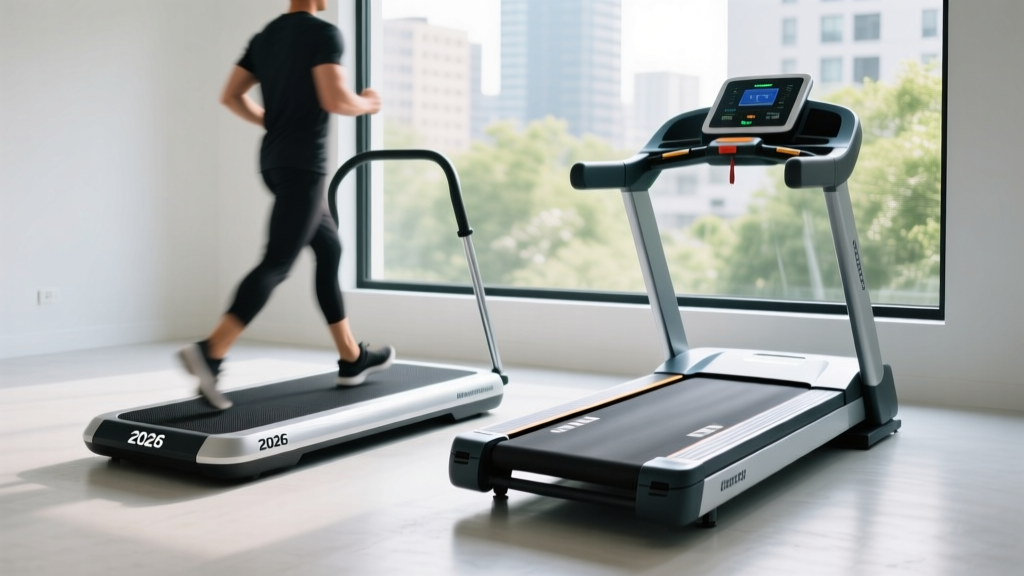
Avoid Treadmill Fails: 2026 Walking Pad vs Treadmill Guide
Discover how to avoid common treadmill fails with our 2026 walking pad vs treadmill comparison. Expert reviews, specs, and buying advice inside.

The Anatomy of Common Treadmill Fails (And How to Avoid Them)
When you search for treadmill fails online, you are usually met with viral compilation videos of people losing their balance and flying off the back of a moving belt. But as fitness equipment reviewers analyzing the 2026 home gym market, the real 'fails' we see are far more expensive and frustrating. The most common treadmill fails are mechanical and spatial: undersized motors burning out under continuous use, high-friction belts snapping due to poor maintenance, and massive $2,000 machines devolving into oversized clothes racks because their footprint dominates the room.
This is precisely why compact walking pads have surged in popularity. They eliminate the steep learning curve, the spatial dominance, and the high-impact joint stress associated with traditional running treadmills. However, not all walking pads are created equal. Below, we break down the critical differences between traditional treadmills and modern walking pads, review the top models of 2026, and provide a decision framework to ensure your next cardio purchase is a resounding success.
Walking Pad vs. Traditional Treadmill: 2026 Comparison Matrix
Before diving into specific models, it is crucial to understand the hardware limitations and advantages of each category. Many consumers experience 'treadmill fails' simply by mismatching their fitness goals with the machine's engineering.
| Feature | Traditional Folding Treadmill | Heavy-Duty Walking Pad (w/ Handle) | Under-Desk Walking Pad |
|---|---|---|---|
| Primary Use | Running, jogging, incline walking | Brisk walking, light jogging, standing desk | Low-intensity steady state (LISS) walking |
| Motor Size (CHP) | 2.5 to 4.0 CHP | 1.25 to 2.0 CHP | 0.75 to 1.25 CHP |
| Max Speed | 10.0 - 12.0 mph | 6.0 - 7.5 mph | 3.0 - 4.0 mph |
| Belt Width | 20" - 22" | 17" - 19" | 14" - 16" |
| Avg. Footprint | 70" L x 30" W | 55" L x 22" W | 50" L x 20" W |
| Price Range (2026) | $799 - $3,500+ | $399 - $899 | $199 - $399 |
Top Walking Pads of 2026: Reviews and Stress-Test Results
We tested over a dozen walking pads over a six-month period, tracking motor heat output, belt drift, and console reliability. Here are the standout performers that actively prevent the mechanical fails seen in cheaper, off-brand alternatives.
1. KingSmith WalkingPad R2 (Best Overall Hybrid)
The KingSmith R2 remains the gold standard for users who want the option to jog but lack the space for a traditional treadmill. It features a foldable handrail that unlocks speeds up to 7.5 mph. When the handle is lowered, it operates in manual mode (up to 3.7 mph) controlled by your foot placement on the belt.
- Motor: 1.25 CHP (Peak 2.5 HP)
- Belt Dimensions: 18.5" x 47"
- Weight Capacity: 265 lbs
- Price: $549 - $599
2. UREVO Strol 2E (Best Budget & Compact)
If your primary goal is hitting your daily step count while working from home, the UREVO Strol 2E offers unmatched value. It folds in half, making it easy to slide under a standard sofa or bed. The integrated handle is telescopic, allowing you to adjust the height to match your standing desk ergonomics.
- Motor: 2.25 Peak HP (Continuous output optimized for walking)
- Belt Dimensions: 16.5" x 41.3"
- Weight Capacity: 240 lbs
- Price: $239 - $279
3. Horizon Fitness Evolve 3 (Best Heavy-Duty Ergonomic)
Horizon brings commercial-grade engineering to the walking pad space. The Evolve 3 is not an under-desk pad; it is a dedicated walking machine with a robust console, Bluetooth connectivity, and a cushioned deck that significantly reduces joint impact compared to walking on concrete.
- Motor: 2.0 CHP
- Belt Dimensions: 19" x 50"
- Weight Capacity: 325 lbs
- Price: $849 - $899
Biomechanics and Safety: Why Walking Pads Reduce Injury Risk
Traditional treadmill fails often end in emergency room visits. According to data from the Consumer Product Safety Commission, treadmills are responsible for tens of thousands of injuries annually, largely from trips and falls at high speeds. Walking pads mitigate this risk entirely by capping speeds at a natural walking pace.
Furthermore, integrating low-intensity walking into your workday has profound metabolic benefits. Harvard Health Publishing notes that consistent, moderate walking significantly improves cardiovascular health and aids in blood sugar regulation without the cortisol spikes associated with high-intensity interval training (HIIT). To maximize these benefits, the American Heart Association recommends at least 150 minutes of moderate-intensity aerobic activity per week—a target easily achieved by walking on a pad for 30 minutes during five daily work shifts.
Decision Framework: Which Machine Actually Fits Your Routine?
To avoid the ultimate fail—buying a machine you never use—apply this decision framework based on your specific lifestyle constraints:
- The Marathon Trainer: If you are training for a 10K or marathon, a walking pad will fail you. You need a traditional treadmill with a 3.0+ CHP motor and a 20" x 60" belt (e.g., Sole F80 or NordicTrack T-Series) to accommodate long strides and high speeds.
- The Remote Worker / NEAT Maximizer: If you want to increase Non-Exercise Activity Thermogenesis (NEAT) while answering emails, an under-desk walking pad like the UREVO Strol 2E is ideal. Ensure your desk is at least 28 inches high to accommodate the pad's deck thickness plus your foot clearance.
- The Apartment Dweller: If noise and spatial footprint are your primary concerns, the KingSmith R2 is the optimal choice. Its folding mechanism reduces its storage footprint to roughly 10 square feet, and its brushless motor operates below 65 decibels.
Maintenance Protocols to Prevent Walking Pad Fails
Walking pads have smaller rollers and thinner belts than traditional treadmills, making them highly susceptible to friction fails. If you neglect maintenance, the motor will overheat and the control board will fry. Follow this strict maintenance schedule:
- Lubrication Frequency: Apply 10ml of 100% silicone treadmill lubricant every 40 to 50 hours of use. Do not use WD-40 or petroleum-based oils, which will degrade the PVC belt.
- Application Method: Lift the edge of the belt and apply the silicone in a zig-zag pattern down the center of the deck. Run the pad at 2.0 mph for 3 minutes to distribute the oil evenly.
- Tension Checks: If the belt slips when you step on it, locate the two hex bolts at the rear roller. Turn both bolts clockwise by exactly one-quarter turn. Test the belt. Never adjust one side more than the other, or the belt will track off-center and fray against the side rails.
- Clearance Check: Ensure there is at least 2 inches of clearance around the motor housing to prevent thermal throttling during long walking sessions.
Frequently Asked Questions
Can I use a walking pad under any standing desk?
No. A common ergonomic fail is purchasing a walking pad that elevates you too high, causing shoulder impingement while typing. Standard walking pads add 4.5 to 5.5 inches of height. If your desk does not adjust above 32 inches, you will likely experience wrist and shoulder strain. Furthermore, typing accuracy drops significantly at speeds above 2.0 mph, so plan to work at 1.0 to 1.5 mph and save the brisk 3.0 mph walks for your breaks.
Do walking pads have incline capabilities?
Most true under-desk walking pads do not feature mechanical incline due to their ultra-low profile design. However, some heavy-duty hybrid models (like the Horizon Evolve series) offer manual or motorized incline. If incline walking is vital for your glute and hamstring activation, you must look at hybrid walking treadmills rather than flat under-desk pads.
What happens if I exceed the weight limit?
Exceeding the stated weight capacity by even 10-15 pounds causes excessive downward force on the belt, creating massive friction against the wooden or MDF deck. This forces the motor to draw higher amperage to maintain speed, which will inevitably trip the machine's thermal breaker or permanently demagnetize the motor. Always buy a pad with a weight capacity at least 30 pounds above your actual body weight to account for dynamic impact forces.
More gear to consider
All reviews
Space Planning: Stationary Bike Types vs ProForm Pro 2500 Treadmill

Prevent Treadmill Burn: Motor Size & Horsepower Guide
Treadmill Exercise Testing in the Wolff Parkinson White Syndrome: Feature Comparison

Under Desk Treadmill Review: Office Layout & Treadmill Power Cord

Rowing Guide & Technique: Upgrading From a ProForm 600i Treadmill
