Assault Bike vs Air Bike: Space Layouts & T Series 6.5 S Treadmill
Compare Assault and Echo air bikes for home gym layouts. Expert space optimization tips, clearances, and integration with the T Series 6.5 S treadmill.

The 2026 Home Gym Spatial Dilemma: Fixed vs. Dynamic Footprints
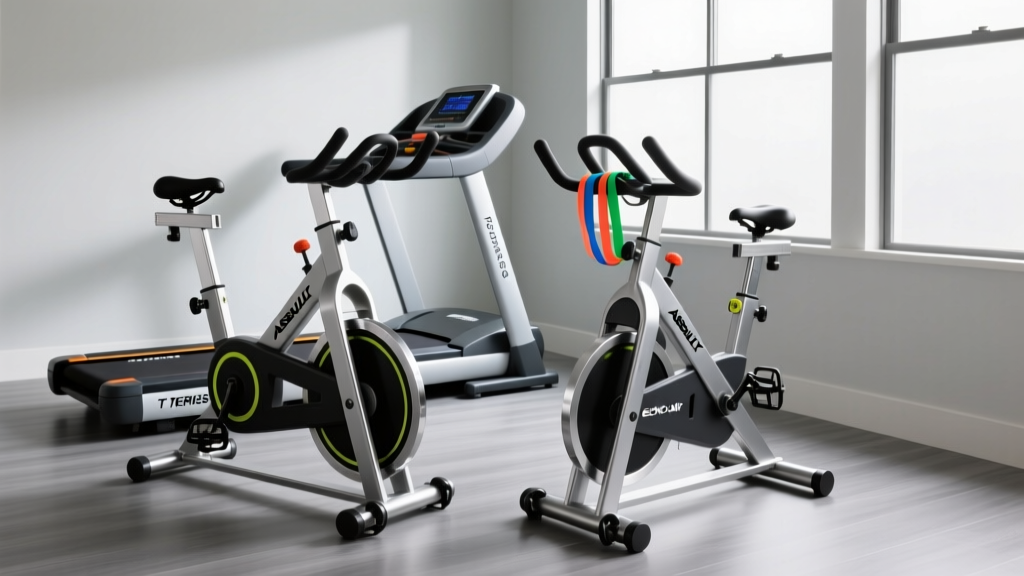
Designing a high-performance home gym in 2026 requires moving beyond simply buying equipment and shoving it into available corners. True space optimization demands a rigorous understanding of dynamic footprints, thermal displacement, and acoustic zoning. When building a cardio corner, the debate between the Assault Bike Classic and the Rogue Echo (the industry-standard air bikes) is usually framed around resistance curves and drive systems. However, from a layout design perspective, the real challenge is integrating these massive, fixed-footprint machines alongside dynamic, folding equipment like the T Series 6.5 S treadmill.
While the T Series 6.5 S treadmill offers a collapsible footprint that reclaims up to 45% of its floor space when stored, fan bikes are permanently deployed monoliths. This guide provides a deep-dive architectural comparison between the two leading fan bikes, detailing exactly how to map their spatial, thermal, and acoustic requirements within a multi-equipment home gym.
Dimensional Matrix: Rogue Echo vs. Assault Bike Classic
Before drawing your floor plan, you must understand the exact dimensional tolerances of your primary cardio engines. The Rogue Echo (often referred to generically as an air bike) and the Assault Bike Classic have distinct physical profiles that dictate room placement.
| Spatial Metric | Rogue Echo Bike (2nd Gen) | Assault Bike Classic V2 |
|---|---|---|
| Length x Width | 52.25" x 29.25" (10.6 sq ft) | 50.9" x 23.3" (8.2 sq ft) |
| Height (to Handlebar Peak) | 52.5" | 50.9" |
| Total Weight | 135 lbs | 120 lbs |
| Stance Width (Stabilizers) | Wider, requires flat hard surface | Narrower, slightly more forgiving |
| Drive System | Belt-Drive (Quieter, smoother) | Chain-Drive (Louder, mechanical) |
As noted in equipment teardowns by Rogue Fitness, the Echo’s wider stabilizer footprint provides superior lateral stability during high-RPM sprints but demands an extra 6 inches of lateral clearance compared to the Assault Bike Classic. If you are designing a narrow galley-style gym (e.g., an 8-foot wide converted hallway or basement alcove), the Assault Bike’s narrower 23.3-inch width is the superior spatial choice.
The Airflow Imperative: Why Corner Placement Fails
The most common layout mistake in home gym design is pushing the fan bike into a corner to "save space." This fundamentally misunderstands the thermodynamics of the equipment.
Thermal Displacement and Intake Zones
Fan bikes operate by pushing massive volumes of air backward to create resistance. A 200-watt output on an air bike displaces air at speeds exceeding 15 mph directly behind the flywheel. If placed in a corner or flush against a wall, this air creates a high-pressure turbulent zone. The consequences are twofold:
- Recirculation: The bike begins pulling its own hot, turbulent exhaust air back into the intake, reducing cooling efficiency for the internal bearings and the rider.
- Structural Wear: Dust and particulate matter are blasted into the drywall corner, creating permanent "shadowing" and accelerating the accumulation of grime in the bike's bottom bracket.
Always maintain a minimum of 48 inches of unobstructed clearance directly behind the flywheel of any air bike. Do not place open shelving, mirror panels, or loose paper in this exhaust corridor.
Integrating Fan Bikes with the T Series 6.5 S Treadmill
When space is at a premium, pairing a stationary fan bike with a folding treadmill is the gold standard for 2026 home layouts. The T Series 6.5 S treadmill features a hydraulic folding mechanism that reduces its operational length of 73.5 inches down to a stored depth of roughly 42 inches.
The 12x12 Room Blueprint
In a standard 144-square-foot room (12x12), here is the optimal spatial arrangement to accommodate both machines while maintaining safety clearances recommended by the American Council on Exercise (ACE) for equipment egress:
- The Treadmill Zone (Wall A): Position the T Series 6.5 S treadmill facing the room's entryway or a window. When folded, it hugs the wall, leaving a 7-foot deep open zone in the center of the room for stretching, kettlebell work, or yoga.
- The Air Bike Zone (Wall B - Adjacent): Place the fan bike on the perpendicular wall, angled at 45 degrees toward the center of the room. This satisfies the 4-foot rear exhaust rule while allowing the rider to face the room rather than staring at a blank wall.
- The Transit Path: Ensure a minimum 30-inch walking path between the side of the deployed treadmill and the handlebars of the air bike to allow for safe mounting and dismounting without collision.
Acoustic Zoning: Chain vs. Belt in Shared Spaces
Space optimization isn't just about square footage; it's about acoustic volume. If your home gym shares a drywall partition with a living room, bedroom, or home office, the choice between the Assault Bike and Rogue Echo dictates where the machine can legally and politely exist.
Decibel Profiles and Vibration Transfer
The Assault Bike Classic utilizes a traditional steel chain drive. While durable, it generates a distinct metallic clatter that scales linearly with RPM. At 80+ RPM, the acoustic output can exceed 75 dB, and the high-frequency vibration transfers directly through the floor stabilizers into the subfloor.
Conversely, the Rogue Echo uses a Kevlar-reinforced belt drive. It operates at roughly 10-15 decibels lower at equivalent wattages and produces a low-frequency "whoosh" rather than a mechanical rattle.
💡 Acoustic Layout Pro-TipIf you must place an Assault Bike Classic against a shared wall, elevate the stabilizers onto 3/4-inch thick vulcanized rubber horse stall mats. This decouples the high-frequency chain vibration from the floor joists, reducing structural noise transfer to adjacent rooms by up to 40%.
Ceiling Height and Overhead Hazards
While both bikes peak at roughly 52.5 inches in height, the spatial envelope expands significantly once a rider is mounted. A 6-foot-tall rider on an air bike will have their head and hands reaching up to 78 inches (6.5 feet) above the floor during standing sprints or aggressive climbs.
Edge Case Troubleshooting: If you are designing a layout in a basement with dropped ceilings, exposed HVAC ducts, or overhead track lighting, you must map a "strike zone" above the bike. Never place an air bike directly beneath a ceiling fan, recessed lighting fixture, or exposed sprinkler head. The lateral sway of the handlebars during out-of-the-saddle efforts can easily clip low-hanging fixtures.
Summary: Choosing Your Spatial Champion
Ultimately, the choice between the Assault Bike and the Rogue Echo for your specific layout comes down to your room's geometry and acoustic tolerance:
- Choose the Assault Bike Classic if: You have a narrow galley space (under 30 inches of lateral width), need to frequently roll the bike into a closet (it is 15 lbs lighter), and have a dedicated, acoustically isolated room.
- Choose the Rogue Echo if: You have a wider floor plan, require a quieter belt-drive system for shared-wall environments, and prefer a heavier, more planted chassis that won't shift on uneven garage concrete.
- The Treadmill Synergy: Regardless of your bike choice, pairing it with the collapsible T Series 6.5 S treadmill remains the most mathematically efficient way to secure both steady-state and high-intensity interval modalities in a sub-150-square-foot footprint.
By respecting the thermal exhaust zones, acoustic transfer vectors, and dynamic folding clearances outlined above, you can engineer a home gym layout that is as functional as it is space-efficient.
More gear to consider
All reviews
Training for Half Marathon on Treadmill? Under-Desk Reviews

NordicTrack Treadmill Elite 3700 vs Curved Manual Treadmills

Curved vs Motorized: Incline Treadmill Benefits for Beginners

Curved vs Motorized: WalkingPad R3 Hybrid+ Foldable Treadmill
Setup Guide: Motor Size for an 8:30 Pace on Treadmill