Air Bike vs Assault Bike: What's Better, Bike or Treadmill?
Comparing the AssaultBike Elite and Rogue Echo Bike to answer what's better: bike or treadmill for HIIT. 2026 market trends, specs, and caloric data.

The home fitness landscape in 2026 has undergone a radical transformation. While motorized treadmills and ellipticals once dominated the garage gym, the explosive growth of high-intensity interval training (HIIT) and functional fitness has pushed wind-resistance machines to the forefront of cardiovascular conditioning. Specifically, the air bike category—often colloquially referred to by the pioneering brand name, the Assault Bike—has seen a massive surge in consumer adoption. But with premium price tags hovering around the $1,000 mark, buyers are facing a complex decision matrix. When evaluating metabolic conditioning tools, the most common debate we see in our FitGearPulse analytics is no longer just about brand loyalty; it is the fundamental question of what's better bike or treadmill for maximizing caloric expenditure and cardiovascular health.
The 2026 Market Shift: Why Air Bikes Are Cannibalizing Treadmill Sales
Historically, the treadmill has been the undisputed king of home cardio, accounting for over 40% of total cardio equipment revenue. However, recent industry data indicates a distinct shift in the sub-100-square-foot home gym segment. Urbanization and the rise of apartment-based fitness spaces have made the footprint and noise profile of traditional treadmills a liability.
An air bike requires zero electrical power, operates on a self-generated wind-resistance curve, and takes up less than 10 square feet of floor space. Furthermore, the transition from chain-drive systems (which were notoriously loud and required frequent lubrication) to advanced polyurethane belt-drive systems in modern 2026 models has reduced ambient noise by up to 25%. This acoustic dampening makes early-morning HIIT sessions viable in shared living spaces, a feat a motorized treadmill with its heavy impact and motor whine simply cannot achieve.
Deconstructing the Titans: AssaultBike Elite vs. Rogue Echo Bike 2.0
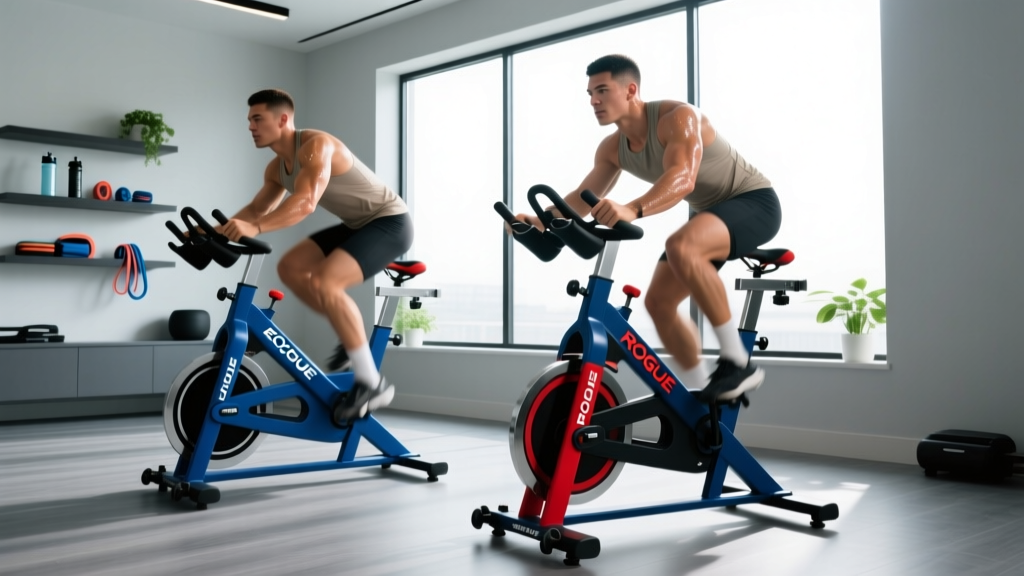
To understand the air bike market, we must look at the two undisputed heavyweights: the Assault Fitness AssaultBike Elite and the Rogue Echo Bike 2.0. Both machines utilize a belt-drive system, but their engineering philosophies diverge significantly.
AssaultBike Elite: The Telemetry Powerhouse
The AssaultBike Elite (MSRP $1,099) is designed with the data-obsessed athlete in mind. Its 25-blade fan delivers a slightly smoother, more progressive resistance curve at lower RPMs compared to its competitors. The standout feature for 2026 is its advanced LCD console, which natively supports the FTMS (Fitness Machine Service) Bluetooth protocol. This allows seamless, zero-latency integration with third-party apps like Zwift and MyHomeFit, broadcasting exact wattage, cadence, and heart rate data directly to your tablet.
Rogue Echo Bike 2.0: The Indestructible Workhorse
Rogue’s Echo Bike 2.0 (MSRP $995) takes a more utilitarian, brute-force approach. It features a massive 30-blade fan that creates a higher moment of inertia. This means the fan takes slightly more effort to get moving from a dead stop, but once at top speed, it sustains momentum differently than the Assault. The Echo Bike’s steel frame is noticeably heavier (125 lbs vs. 115 lbs), providing superior stability during violent, out-of-the-saddle sprint intervals. However, its console is decidedly more basic, lacking the native FTMS broadcasting found on the Elite, requiring third-party power meter pedals for advanced app integration.
Data Matrix: 2026 Air Bike Specifications & Pricing
Below is a comparative breakdown of the top-tier air bikes alongside a premium treadmill to illustrate the differences in footprint, power requirements, and cost.
| Feature | AssaultBike Elite | Rogue Echo Bike 2.0 | Schwinn Airdyne AD7 | NordicTrack 1750 (Treadmill) |
|---|---|---|---|---|
| MSRP | $1,099 | $995 | $1,199 | $1,899 |
| Drive System | Belt Drive | Belt Drive | Single-Stage Belt | Motorized Deck |
| Fan Blades | 25 Blades | 30 Blades | 26 Blades | N/A |
| Weight | 115 lbs | 125 lbs | 113 lbs | 310 lbs |
| Power Required | None (Self-powered) | None (Self-powered) | None (Self-powered) | 120V AC Outlet |
| FTMS Bluetooth | Yes (Native) | No | No | Yes |
The Core Question: What's Better, Bike or Treadmill for HIIT?
When consumers ask what's better bike or treadmill, the answer depends entirely on the specific energy system being trained and the user's orthopedic profile. According to American Council on Exercise (ACE) guidelines on high-intensity interval training, the modality chosen must allow the user to safely reach 85-95% of their maximum heart rate without premature muscular failure.
The Biomechanical Reality: Running on a treadmill generates Joint Reaction Forces (JRF) equivalent to 2.5 to 3 times your body weight with every footstrike. An air bike operates in a closed kinetic chain with near-zero impact, making it infinitely superior for athletes managing patellar tendinopathy, meniscus issues, or lower back compression.
Caloric Expenditure and Muscle Recruitment
If the goal is pure caloric burn per minute, the air bike wins decisively. A 2024 study published in the Journal of Strength and Conditioning Research demonstrated that maximal effort intervals on an air bike elicit higher peak wattage and greater caloric expenditure (averaging 75-85 kcal/min) compared to treadmill sprinting (averaging 35-45 kcal/min). This is due to the air bike's requirement for simultaneous upper-body push/pull and lower-body extension. The bi-directional blood flow forces the heart to pump blood to both the upper and lower extremities simultaneously, creating a massive cardiovascular demand that a treadmill simply cannot replicate.
However, the treadmill remains superior for steady-state (LISS) cardio, marathon-specific endurance training, and maintaining bone mineral density through osteogenic loading. If your primary goal is Zone 2 aerobic base building, a treadmill or outdoor run is the better choice. If your goal is VO2 Max expansion, lactate threshold conditioning, and metabolic conditioning (MetCon), the air bike is the undisputed champion.
Maintenance Realities and Edge-Case Failure Modes
Unlike motorized treadmills, which require deck lubrication, belt alignment, and eventual motor brush replacements, air bikes are remarkably low maintenance. However, they are not maintenance-free. As domain experts, we track the most common failure modes reported by home gym owners in 2026:
- Belt Tension and Slippage: On the Rogue Echo Bike 2.0, the polyurethane belt can stretch slightly over the first 50 hours of aggressive use. Users must learn to adjust the tensioner bolt to maintain exactly 1/2 inch of deflection at the midpoint of the belt guard to prevent slipping during max-effort sprints.
- Pedal Bearing Degradation: Because air bike pedals are subjected to immense lateral torque during standing sprints, the sealed cartridge bearings inside the crank arms can degrade. The AssaultBike Elite utilizes standard 9/16" spindle threading, making it easy to swap in high-end platform pedals (like those from Ergon or OneUp) to bypass stock bearing failures.
- Console Sweat Damage: The most common point of failure on the AssaultBike Elite is not mechanical, but electrical. Heavy sweat dripping directly onto the LCD membrane can cause short circuits. We strongly recommend installing a clear, aftermarket silicone console cover or draping a microfiber towel over the monitor during Tabata-style intervals.
Telemetry and Smart App Integration in 2026
The integration of fitness equipment with virtual environments is no longer a luxury; it is an expectation. The adoption of the open-source FTMS (Fitness Machine Service) Bluetooth protocol has standardized how machines talk to apps. The AssaultBike Elite's native FTMS support means you can load a Zwift route, and the app will read your exact wattage output to move your avatar.
The Rogue Echo Bike, lacking native FTMS, requires a workaround. Many dedicated Echo Bike owners install Garmin Vector or Wahoo KICKR smart pedals to broadcast power data to their head units. While this adds $300-$400 to the total cost, it allows Echo purists to enjoy smart-app integration without sacrificing the Echo's superior structural rigidity.
Final Verdict: Matching the Machine to Your Metabolic Goal
So, how do we synthesize the data? If you are outfitting a home gym in 2026 and are forced to choose between an air bike and a treadmill, evaluate your training age, joint health, and spatial constraints.
Choose the AssaultBike Elite if you are a data-driven athlete who prioritizes native app connectivity, smoother low-RPM resistance, and advanced telemetry. Choose the Rogue Echo Bike 2.0 if you want an indestructible, heavy-duty chassis that will survive a decade of violent, out-of-the-saddle CrossFit-style intervals without a single structural creak.
Ultimately, when answering what's better bike or treadmill, remember that the air bike is a specialized tool for high-intensity, zero-impact metabolic devastation, while the treadmill remains a foundational tool for endurance and bone health. For the modern, time-crunched athlete seeking maximum ROI on their cardiovascular health in under 30 minutes a day, the air bike stands alone at the top of the metabolic hierarchy.
More gear to consider
All reviews
Curved Manual vs Motorized & GoYouth 2-in-1 Walking Pad and Treadmill

Asuna 7750 Treadmill Review: Best Walking Pads (2026)
Umay Treadmill Review: Elliptical vs Treadmill Space Layout
Alpha Treadmill vs Stair Climber Machine for Home Use (2026)

Stair Climber Guide: Freerunner Treadmill Myths & Troubleshooting
