Alpha Treadmill vs Stair Climber Machine for Home Use (2026)
We compare the Alpha Treadmill against top stair climber machines for home use. Discover specs, joint impact, ceiling clearance, and 2026 pricing.

The Home Cardio Dilemma: Incline Walking vs. Stepping
Designing a home gym in 2026 requires balancing spatial constraints, acoustic limits, and biomechanical efficiency. For those targeting lower-body endurance, glute activation, and high caloric expenditure, the debate inevitably narrows down to two modalities: high-incline walking or dedicated stepping. This guide provides a rigorous head-to-head product comparison, pitting the highly rated Alpha Treadmill (specifically the Incline Series) against the market’s leading stair climber machines for home use. We will dissect motor kinetics, spatial footprints, ceiling clearance mathematics, and long-term joint health to help you make a definitive purchasing decision.
The Contenders: Alpha Treadmill vs. Dedicated Stair Climbers
Alpha Treadmill (Incline Series)
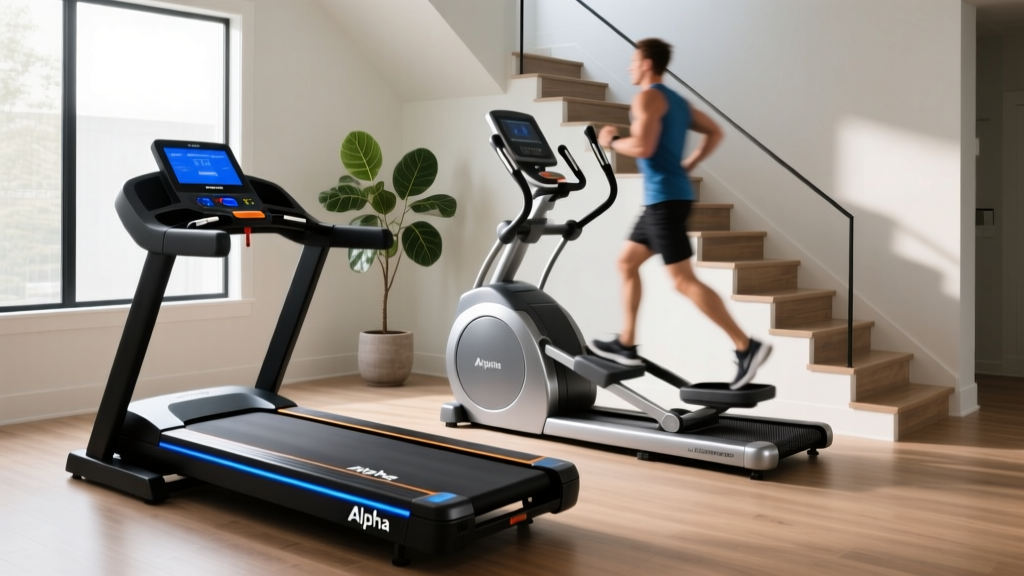
The Alpha Treadmill has carved out a niche in the premium home fitness market by mimicking mountainous terrain. Priced at an MSRP of $1,899, the current Alpha Incline model features a robust 4.0 Continuous Horsepower (CHP) motor, a 20-inch by 60-inch running deck, and a motorized incline range of 0% to 15%. Unlike standard treadmills that cap at 10%, the Alpha’s steep gradient forces the posterior chain to engage similarly to a stair stepper, but with the biomechanical continuity of a moving belt.
The Stair Climber Challengers
To provide a fair comparison, we are looking at two distinct tiers of stair climbers:
- Premium Tier: Bowflex Stair Climber ($2,499) – Features independent pedals, 17 resistance levels, a heavy-duty 482 lb weight capacity, and a rotating handlebar for core engagement.
- Budget Tier: Sunny Health & Fitness SF-S900050 ($549) – A compact, chain-driven mini-stepper with hydraulic resistance, designed for smaller apartments and casual use.
Head-to-Head Specification Matrix
Before diving into the qualitative differences, let’s examine the raw data. The following table highlights the critical specifications that dictate real-world home usability.
| Feature | Alpha Treadmill (Incline) | Bowflex Stair Climber | Sunny Health SF-S900050 |
|---|---|---|---|
| MSRP (2026) | $1,899 | $2,499 | $549 |
| Footprint (L x W) | 78' x 34' | 55' x 31' | 22' x 18' |
| Machine Weight | 245 lbs | 285 lbs | 35 lbs |
| Max User Weight | 350 lbs | 482 lbs | 330 lbs |
| Power Requirement | Dedicated 120V / 20A | Standard 120V Outlet | None (Manual/Hydraulic) |
| Min. Ceiling Height | User Height + 6 inches | User Height + 16 inches | User Height + 12 inches |
The Ceiling Clearance Trap: Spatial Realities
The most common reason stair climbers are returned or sold at a loss on the secondary market is ceiling clearance. When evaluating a stair climber machine for home use, buyers frequently measure the floor space but forget the vertical axis.
⚠ CRITICAL WARNING: Stair Climber Ceiling MathA standard stair climber pedal elevates your foot by 8 to 9 inches. At the peak of your step, your entire body is elevated. If you are 6'0' tall, your head will reach 6'9' at the top of the stride. Add a 2-inch clearance buffer for safety and overhead lighting, and you suddenly require a minimum ceiling height of 7'0' just to use the machine without ducking. For the Bowflex Stair Climber, which has a higher base step-up height, an 8-foot ceiling is the absolute minimum for a 5'10' user. Conversely, the Alpha Treadmill only requires your standard standing height plus a 6-inch buffer for arm swing and bounce, making it vastly superior for basement gyms or rooms with standard 8-foot ceilings.
Biomechanics, Caloric Expenditure, and Joint Health
How do these machines actually impact your body over a 12-week training block? According to guidelines published by the American Heart Association, achieving optimal cardiovascular health requires 150 minutes of moderate-intensity or 75 minutes of vigorous aerobic activity per week. Both machines can deliver this, but the joint kinetics differ wildly.
The Alpha Treadmill: Continuous Belt Mechanics
Walking at 3.5 mph on a 15% incline on the Alpha Treadmill yields a caloric burn comparable to jogging on a flat surface, but with significantly less ground reaction force (GRF). The moving belt pulls your foot back, engaging the hamstrings and glutes eccentrically. However, because it is a treadmill, there is still a micro-impact phase with every heel strike. For users with mild Achilles tendinopathy, the continuous dorsiflexion required on a steep incline can cause stiffness if not properly managed with post-workout stretching.
Stair Climbers: Independent Pedal Kinetics
As detailed in cardiovascular reviews by Cleveland Clinic experts, stair climbers provide a zero-impact, closed-chain kinetic exercise. Because your foot never leaves the pedal, the GRF is practically eliminated, making it the gold standard for users recovering from knee meniscus tears or managing osteoarthritis. The independent pedals of the Bowflex also force unilateral stabilization, correcting left-to-right muscular imbalances that a treadmill belt might mask.
“If your primary goal is pure glute isolation and joint preservation, the stair climber wins. But if you want functional, athletic carryover to outdoor hiking and running, the Alpha Treadmill’s incline walking mimics real-world terrain far better.”
Noise, Power Draw, and Maintenance
Home gym equipment must coexist with your living space. Here is where the engineering differences become apparent in daily life.
- Acoustic Profile: The Alpha Treadmill’s 4.0 CHP motor generates a low-frequency hum (around 65 dB at 3 mph), but the sound of your shoes striking the deck can transmit through floor joists to rooms below. The Bowflex Stair Climber uses a magnetic resistance system and a heavy-duty alternator, making the machine itself nearly silent; the only noise is the mechanical clicking of the pedal arms and your breathing. The Sunny Health hydraulic stepper, however, is notoriously squeaky after about 50 hours of use and requires frequent silicone lubrication.
- Electrical Draw: The Alpha Treadmill requires a dedicated 20-amp circuit. Plugging it into a shared 15-amp living room circuit will trip the breaker when the incline motor and drive motor engage simultaneously. The Bowflex Stair Climber is self-generating at higher cadences but requires a standard 120V plug for its console and magnetic resistance brake, drawing minimal amperage.
- Maintenance: Treadmills require annual belt lubrication, tension adjustments, and deck inspections. Stair climbers have fewer friction points but rely on complex internal cables and pulleys. If a Bowflex cable snaps out of warranty, the repair cost often exceeds $400.
Decision Framework: Which Machine Belongs in Your Home?
Do not buy based on hype; buy based on your specific physiological and architectural constraints.
Choose the Alpha Treadmill If:
- You have low basement ceilings (under 8 feet) but ample floor length.
- You are training for outdoor events like hiking, rucking, or trail running and need to condition your ankles and Achilles for continuous inclines.
- You prefer the option to do flat-zone recovery jogging or walking, which a stair climber cannot accommodate.
Choose a Premium Stair Climber (Bowflex) If:
- You have high ceilings (9+ feet) and want a smaller physical footprint.
- You suffer from lower back pain, knee issues, or joint inflammation and require strict zero-impact, closed-chain movement.
- You want to maximize caloric burn per minute in the shortest possible workout window (20-30 minutes).
Choose the Budget Stepper (Sunny Health) If:
- You are in an apartment, need to store the machine under a bed or in a closet, and have a strict budget under $600.
Frequently Asked Questions
Can the Alpha Treadmill fully replace a stair climber?
While the Alpha Treadmill’s 15% incline heavily targets the glutes and calves, it cannot replicate the deep hip flexion and vertical displacement of a true stair climber. It is an excellent substitute for cardiovascular conditioning, but not for pure vertical stepping mechanics.
Are stair climbers bad for your knees?
No. When used with proper posture (leaning slightly forward from the ankles, not bending at the waist), stair climbers are highly recommended by physical therapists for knee rehabilitation because they eliminate the heel-strike impact associated with treadmills and outdoor running.
How often should I maintain my home cardio machine?
For treadmills like the Alpha, inspect the belt alignment monthly and apply 100% silicone lubricant every 150 miles or 6 months. For stair climbers, wipe down the guide rails weekly and check the pedal cable tension every 3 months to prevent sudden slipping during high-intensity intervals.
More gear to consider
All reviews
ProForm 585 Treadmill vs Rowers: Buying Guide & Technique Mistakes

Curved Manual vs Motorized Treadmills: Octane Treadmill Guide

Under Desk Treadmill Review: Budget vs True Treadmill Running Speed

Walking Pad Setup Guide & ProForm Treadmill Troubleshooting Tips

Under-Desk Treadmill Workout Office Value Analysis 2026
