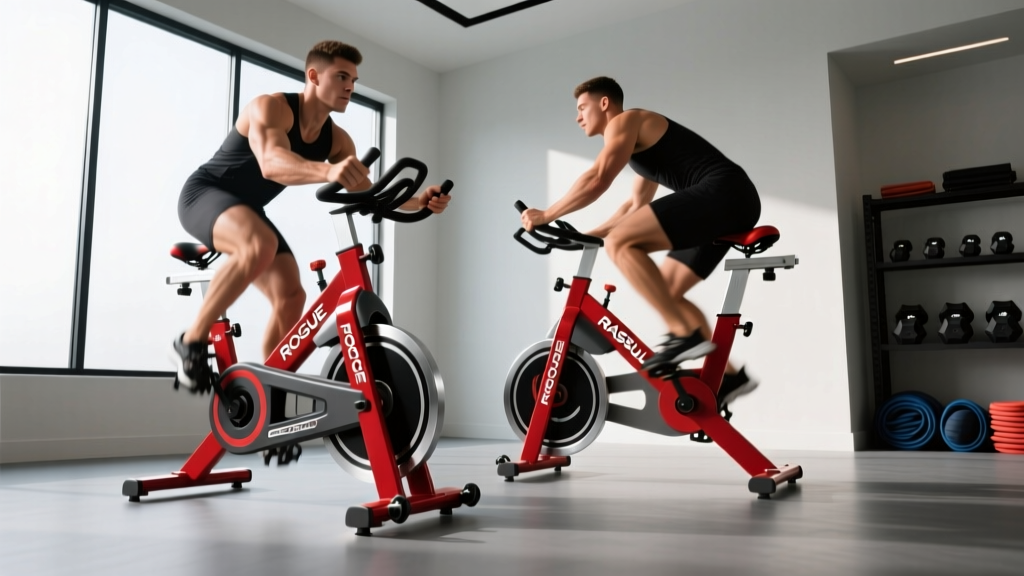
Air Bike vs Assault Bike: Budget & Lifetime Treadmill ROI
Compare Rogue Echo and Assault Bike costs against a lifetime treadmill. Discover hidden maintenance fees, ROI, and the best budget cardio choice.

The Home Gym Cardio Dilemma: Air Bikes vs. The Lifetime Treadmill
When outfitting a home gym in 2026, the cardio equipment budget often forces a stark choice: invest in a premium motorized machine or opt for manual, high-intensity alternatives. The air bike market, dominated by the Rogue Echo Gen 2 and the Assault Fitness Classic, offers a compelling argument against the traditional 'lifetime treadmill'—a term often used to describe high-end, $7,000+ motorized treadmills like the Woodway 4Front or Life Fitness Integrity Series that promise decades of use. But does the upfront cost of a lifetime treadmill actually translate to better long-term value? In this budget breakdown and value analysis, we dissect the true cost of ownership, mechanical upkeep, and caloric ROI of air bikes versus premium treadmills.
Quick ROI Summary
- Upfront Cost: Air Bikes ($999 - $1,250) vs. Lifetime Treadmills ($6,500 - $9,000)
- 5-Year Maintenance: Air Bikes ($12 - $55) vs. Treadmills ($400 - $850)
- Electrical Overhead: Air Bikes ($0) vs. Treadmills ($250+ for dedicated 20A circuit installation)
Head-to-Head Budget Breakdown: Rogue Echo vs. Assault Classic
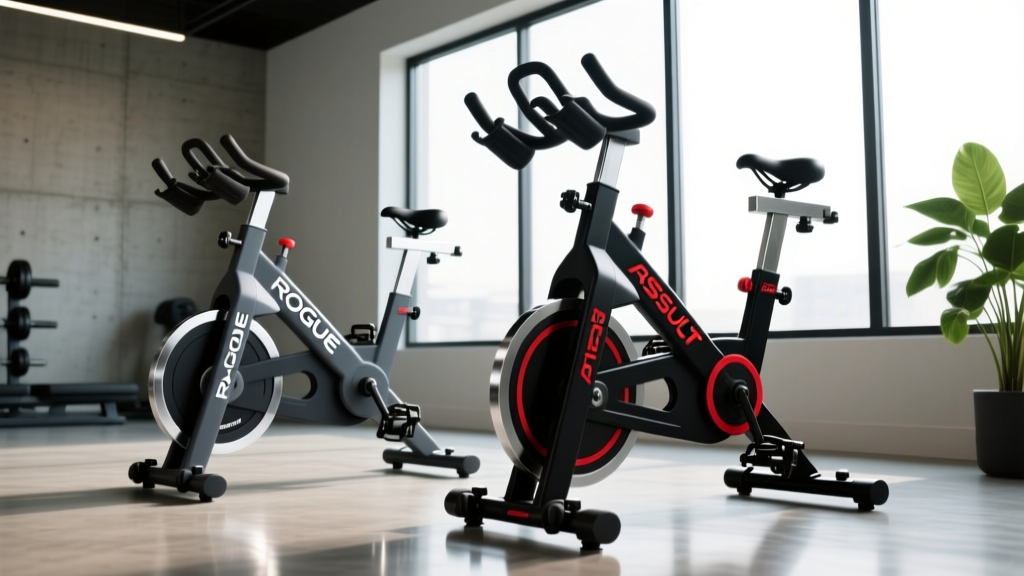
The air bike duopoly consists of the Assault Fitness Classic and the Rogue Echo Bike Gen 2. While both utilize a fan-based resistance model where wattage output scales infinitely with user effort, their mechanical architectures dictate vastly different long-term maintenance budgets.
Assault Fitness Classic: The Belt-Drive Workhorse
Retailing at approximately $999, the Assault Classic relies on a Poly-V belt drive system. Belt drives are exceptionally quiet and provide a smooth pedal stroke, making them ideal for garage gyms attached to living spaces. However, rubber belts are subject to tensile fatigue. According to Assault Fitness Classic documentation, heavy users (4+ HIIT sessions per week) may experience belt stretching or slipping after 3 to 4 years. A replacement Poly-V belt costs around $45, and the swap requires basic mechanical aptitude and a set of metric hex keys.
Rogue Echo Gen 2: The Chain-Drive Tank
Priced at $1,250, the Rogue Echo Gen 2 utilizes a heavy-duty chain drive, similar to a bicycle. As noted in the Rogue Fitness Echo Bike specifications, the chain eliminates the stretch issue entirely, offering a more direct power transfer. The trade-off is acoustic and chemical: chains are louder and require periodic lubrication with a dry PTFE bike lube (roughly $12 per bottle, lasting up to two years). Furthermore, the Echo features a 27-inch steel fan compared to the Assault's 25-inch composite fan, generating higher peak resistance but adding to the unit's overall weight and shipping cost.
Cost & Specs Matrix: The Air Bike Contenders
| Feature | Assault Classic | Rogue Echo Gen 2 |
|---|---|---|
| Base Price (2026) | $999 | $1,250 |
| Drive System | Poly-V Belt | Steel Chain |
| Fan Diameter & Material | 25-inch Composite | 27-inch Steel |
| Weight | 98 lbs | 135 lbs |
| Primary Maintenance | Belt replacement ($45) | Chain lube ($12) |
The 'Lifetime Treadmill' Myth: Depreciation & Upkeep
Many home gym owners justify spending $7,000 on a commercial-grade treadmill (like the Woodway 4Front or Life Fitness Club Series+) by labeling it a 'lifetime treadmill' investment. The logic is that a premium motor and frame will outlast cheaper $1,500 big-box store models that burn out their DC motors within three years. However, this budget analysis reveals hidden depreciation factors that severely impact the treadmill's true ROI.
Wear Items and Excluded Warranties
While the frame and motor may carry a lifetime or 10-year warranty, the running belt and deck are classified as consumable wear items. A commercial-grade slat belt replacement costs between $350 and $600. Furthermore, motorized treadmills require dedicated 20-amp electrical circuits to prevent voltage drops that can fry the motor controller board. Hiring an electrician to install a dedicated line adds an immediate $250 to $500 to your upfront budget—a hidden cost entirely avoided by manual air bikes.
'The assumption that a high-end motorized treadmill is a buy-it-for-life asset ignores the mechanical reality of friction. Every mile logged degrades the belt-to-deck interface, whereas an air bike's primary resistance mechanism—air displacement—experiences virtually zero mechanical friction degradation.'
5-Year Cost of Ownership Projection
To accurately compare the budget breakdown, we must project the 5-year cost of ownership (COO) for a user exercising 4 days a week. This model includes the base price, mandatory maintenance, electrical infrastructure, and estimated energy consumption.
- Assault Classic 5-Year COO: $999 (Base) + $45 (1 Belt Swap) + $0 (Electricity) = $1,044
- Rogue Echo Gen 2 5-Year COO: $1,250 (Base) + $24 (2 Bottles Lube) + $0 (Electricity) = $1,274
- Premium Lifetime Treadmill 5-Year COO: $7,499 (Base) + $400 (Circuit Install) + $450 (Belt/Deck Wax & Swap) + $300 (5-Yr Electricity) = $8,649
From a purely financial perspective, the air bike category retains over 85% of its functional value over five years with minimal capital injection, whereas the lifetime treadmill requires continuous micro-investments to maintain its operational baseline.
Biomechanics and Caloric ROI
Budget analysis is incomplete without evaluating the 'caloric ROI'—the amount of cardiovascular stimulus generated per minute of exercise. Air bikes are uniquely engineered for High-Intensity Interval Training (HIIT). Because the resistance scales linearly with the user's wattage output, there is no artificial speed ceiling. Mayo Clinic's research on HIIT highlights that short bursts of maximum-effort anaerobic work yield superior post-exercise oxygen consumption (EPOC) compared to steady-state aerobic work.
A 20-minute maximal effort session on a Rogue Echo can easily burn 300+ calories and trigger a massive EPOC response, matching or exceeding the metabolic output of a 45-minute steady-state jog on a lifetime treadmill. For time-poor professionals in 2026, the air bike delivers a higher physiological return on a significantly smaller financial and spatial footprint.
Spatial Economics and Resale Value Retention
Beyond direct monetary costs, home gym equipment demands a budget of square footage. In 2026, with residential real estate costs remaining high, the spatial footprint of cardio equipment is a critical value metric. A standard commercial lifetime treadmill requires a footprint of approximately 35 square feet when factoring in the mandatory 24-inch safety clearance zone behind the deck. In contrast, the Rogue Echo and Assault Classic occupy a mere 12 square feet and can be rolled into a corner or mounted on a wall bracket when not in use.
Furthermore, manual air bikes exhibit remarkably high resale value retention. Because they lack complex electronic displays, motorized incline gears, and proprietary software subscriptions, a used air bike in good condition routinely sells for 70% to 80% of its original MSRP on the secondary market. Motorized treadmills, conversely, suffer steep depreciation curves; a $7,500 treadmill often struggles to fetch $3,000 after three years due to buyer fears regarding out-of-warranty motor and controller board replacements.
Final Verdict: Where Should Your Budget Go?
If your primary goal is low-impact, steady-state zone 2 cardio while watching television, the lifetime treadmill remains the undisputed king of comfort. However, if your budget is strictly constrained and your fitness goals prioritize metabolic conditioning, VO2 max improvement, and functional power output, the air bike is the superior financial asset.
Between the two market leaders, the Assault Classic wins the pure budget category at $999, offering a quieter belt-drive experience perfect for residential spaces. Conversely, the Rogue Echo Gen 2 justifies its $1,250 price tag for heavier athletes and CrossFit affiliates who demand the indestructible nature of a chain drive and the higher peak resistance of a 27-inch steel fan. Ultimately, redirecting the $6,000 savings from skipping the lifetime treadmill into a comprehensive free-weight and functional trainer setup will yield a vastly superior home gym ecosystem.
More gear to consider
All reviews
NordicTrack A2050 Treadmill: Feature Comparison Buying Guide

2026 Market Analysis: Bike Types vs NordicTrack X9i Treadmill

ProForm 535x Treadmill Setup and Motor Horsepower Guide

What's Better for Losing Weight: Elliptical or Treadmill? 2026 Guide
Air Bike vs Assault Bike: Strength Training on Treadmill Alternatives
