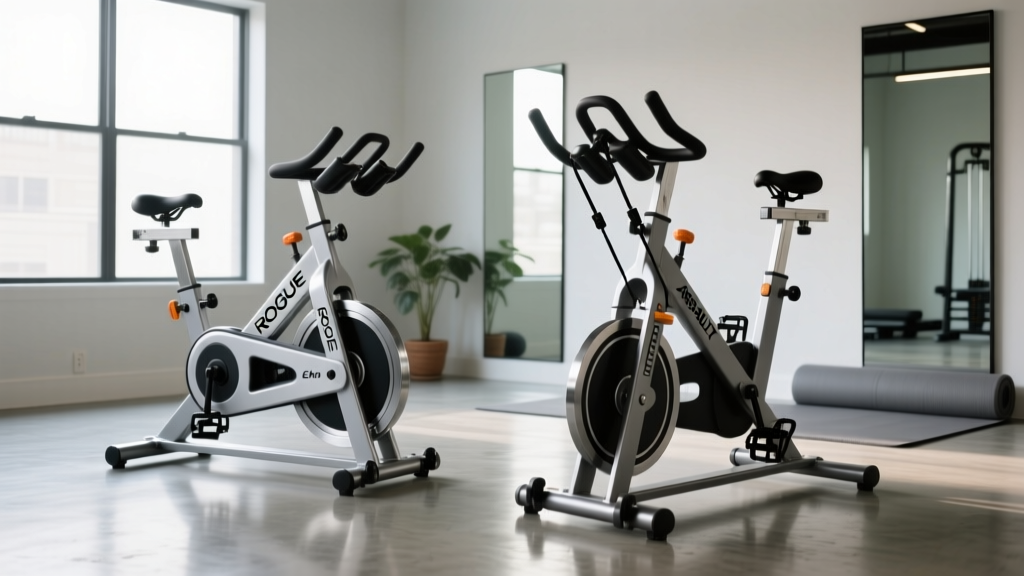
Air Bike vs Assault Bike: Value vs Fat Burning Interval Treadmill Workout
Compare Rogue Echo and AssaultBike pricing, durability, and ROI to see if an air bike beats a fat burning interval treadmill workout for home HIIT.

The HIIT Dilemma: Air Bikes vs. Treadmill Intervals
When outfitting a home gym for high-intensity cardiovascular conditioning, buyers typically face a critical crossroads. Many home gym owners default to a fat burning interval treadmill workout for their primary cardio modality, assuming a motorized belt is the safest or most effective way to achieve high-heart-rate intervals. However, when analyzing the budget breakdown, mechanical longevity, and long-term value of home fitness equipment, dual-action air bikes present a compelling counter-argument. Specifically, the battle between the Rogue Echo Bike V2 and the AssaultBike Classic (Gen 4) dominates the $1,000 price tier.
In this comprehensive value analysis, we will break down the exact costs, mechanical failure modes, and caloric ROI of these two industry-leading air bikes. More importantly, we will contrast their long-term financial value against the hidden costs of using a motorized treadmill for aggressive interval training. If you are trying to maximize your budget while achieving the same EPOC (Excess Post-exercise Oxygen Consumption) benefits of traditional sprint intervals, this guide will show you exactly where your money is best spent in 2026.
Head-to-Head: Rogue Echo V2 vs. AssaultBike Classic
Before we can compare an air bike to a treadmill, we must establish the baseline value of the two premier air bikes on the market. Both the Rogue Echo Bike V2 and the AssaultBike Classic Gen 4 hover right around the $1,000 mark, but their engineering philosophies—and subsequent maintenance costs—differ wildly.
| Feature | Rogue Echo Bike V2 | AssaultBike Classic (Gen 4) |
|---|---|---|
| Base MSRP (2026) | $995.00 | $999.00 |
| Drive System | Gates Carbon Drive Belt | Heavy-Duty Roller Chain |
| Fan Material | Aluminum Alloy | Steel |
| Out-the-Door Cost* | ~$1,150 (with wind guard & mount) | ~$1,050 (includes basic accessories) |
| Maintenance Need | Low (Belt tension checks) | Medium (Chain lube & stretch) |
| Frame Warranty | 2 Years | 3 Years |
*Out-the-door costs reflect necessary accessory upgrades for optimal home gym integration.
Budget Breakdown: The True Cost of Home HIIT
To understand the value proposition of an air bike, we must look at the 'Cost Per Interval Session.' A dedicated fat burning interval treadmill workout requires rapid acceleration and deceleration. To perform this safely and effectively, you cannot use a $600 entry-level walking pad; you need a commercial-grade or high-end residential treadmill with a minimum 3.0 Continuous Horsepower (CHP) motor, which typically costs between $2,000 and $3,500.
The Treadmill Motor Burnout Factor
Here is a non-obvious mechanical reality that most fitness bloggers ignore: Treadmill motor control boards (MCBs) hate interval training. When you spike a treadmill to 12 MPH for a sprint and then drop it to 3 MPH for recovery, the motor acts as a generator during deceleration. In sub-$2,500 treadmills, this regenerative kinetic energy creates massive heat spikes in the Pulse Width Modulation (PWM) motor controller. Over time, the capacitors on the MCB dry out or the MOSFETs short circuit. Replacing a treadmill MCB costs $250 to $450, plus labor. An air bike generates zero electronic heat and relies purely on mechanical wind resistance, completely eliminating this expensive failure point.
Therefore, while the upfront cost of a Rogue Echo or AssaultBike is roughly $1,000, the 5-year total cost of ownership is vastly lower than a treadmill used strictly for HIIT. You are effectively saving $1,000+ in upfront capital and avoiding inevitable electronic repair bills.
Maintenance & Edge Cases: Belt Drives vs. Chain Drives
When deciding between the Echo and the AssaultBike, your budget for ongoing maintenance and your tolerance for mechanical tinkering will dictate your choice. Both bikes are built like tanks, but their drivetrains require different care.
The Rogue Echo V2: The Belt Drive Advantage
Rogue utilizes a Gates Carbon Drive belt system. This is the same belt technology used on high-end commuter bicycles. It requires zero lubrication, does not stretch over time, and operates in near silence. For a home gym located in a living room or apartment, the acoustic value of the Echo Bike cannot be overstated. The primary edge case to watch for is belt tension; if the tensioner is improperly calibrated during assembly, the belt can slip during maximum-wattage standing sprints. However, adjusting the tensioner requires only an Allen wrench and takes three minutes.
The AssaultBike Classic: The Chain Drive Reality
Assault Fitness sticks to a traditional heavy-duty roller chain. This provides a highly responsive, 'gritty' feel that competitive CrossFit athletes often prefer because it mimics the mechanical engagement of a mountain bike. However, chains require regular lubrication to prevent rust and premature wear on the sprockets. Furthermore, chains naturally stretch (technically, the pins wear down, increasing the pitch). Every 12 to 18 months of heavy HIIT use, you will likely need to use a chain breaker tool to remove a link or replace the chain entirely. It is a cheap fix (under $30 for a replacement chain), but it demands a DIY mindset.
Biomechanics and Caloric ROI
Why do air bikes command such a high price compared to standard stationary cycles? The answer lies in the dual-action arm levers. By engaging the latissimus dorsi, pectorals, and deltoids simultaneously with the quadriceps and glutes, air bikes recruit a massive amount of upper-body muscle mass.
- Caloric Expenditure: Studies on dual-action air bikes show that users can hit their VO2 max and peak heart rate zones up to 30% faster than on a standard stationary bike, due to the compounded oxygen demand of the upper body.
- Joint Impact: Unlike the repetitive ground-reaction forces of a fat burning interval treadmill workout, which can aggravate patellar tendinopathy or shin splints during heavy sprint phases, air bikes offer zero-impact resistance. The resistance scales infinitely with your effort, meaning you can safely push a compromised joint to muscular failure without the jarring impact of a footstrike.
- The 'Wind Wall' Effect: Because air resistance scales with the cube of the fan speed, the harder you push, the exponentially harder the bike pushes back. This built-in governor prevents users from 'over-spinning' and forces a grinding, muscular endurance output that translates beautifully to real-world athletic conditioning.
Final Verdict: Maximizing Your Cardio ROI
If your primary goal is steady-state Zone 2 cardio or walking, a treadmill remains a worthy investment. However, if your programming revolves around high-intensity intervals, Tabata protocols, and metabolic conditioning, the value analysis heavily favors the air bike.
'When comparing the $1,000 capital expenditure of an air bike against the $2,500+ requirement for a HIIT-capable treadmill, the air bike offers superior joint safety, infinite mechanical resistance, and zero risk of motor controller failure.'
Choose the Rogue Echo Bike V2 if: You prioritize a quiet, maintenance-free experience in a shared living space and are willing to pay a slight premium for the wind-guard accessories.
Choose the AssaultBike Classic if: You prefer the tactile feedback of a chain drive, want a slightly longer frame warranty, and don't mind performing basic chain maintenance every few months.
Ultimately, swapping your traditional fat burning interval treadmill workout for 20 minutes of maximum-effort air bike sprints will not only yield identical, if not superior, cardiovascular adaptations, but it will save your home gym budget from the inevitable wear-and-tear costs of motorized cardio equipment.
More gear to consider
All reviews
Zwift Treadmill Compatibility & Air Bike vs Assault Bike Maintenance

Under-Desk Treadmills vs Treadmill Running Exercises (2026)
Merit Fitness 715T Plus Treadmill Setup & Noise Comparison

Under Desk Treadmill Width & Budget Guide: 2026 Office Value Analysis

Compact Layouts: Running Program for Treadmill & Bike Pairings
