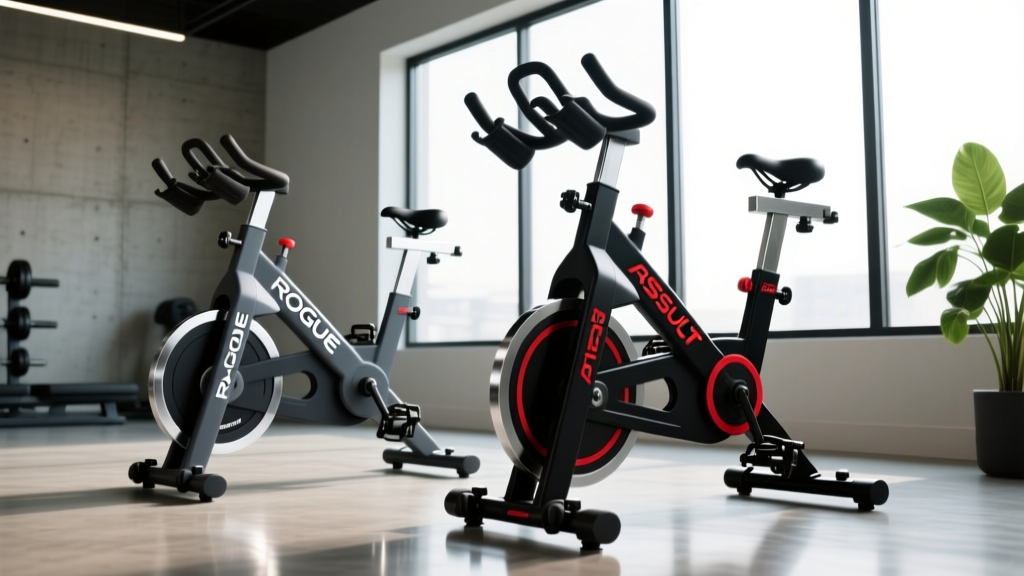
Air Bike vs Assault Bike: Strength Training on Treadmill Alternatives
Compare Rogue Echo and Assault Bike Pro. Discover how air bike conditioning stacks up against strength training on treadmill protocols for hybrid athletes.

The Hybrid Athlete's Dilemma in 2026
The fitness landscape in 2026 is dominated by the hybrid athlete—individuals who demand both elite cardiovascular endurance and raw muscular power. When building a home gym or programming for concurrent training, the debate often narrows down to two primary conditioning tools: the air bike and the manual treadmill. Specifically, athletes are constantly weighing the merits of the Rogue Echo Bike V2 against the Assault Bike Pro, while simultaneously exploring strength and conditioning protocols that incorporate resistance-based running.
For those looking to build a massive aerobic engine without sacrificing lower-body muscle mass, understanding the biomechanical differences between air resistance cycling and strength training on treadmill setups is critical. This guide breaks down the exact specifications, failure modes, and programming applications of the top air bikes on the market, and compares them directly to treadmill-based strength modalities.
Head-to-Head: Rogue Echo Bike V2 vs. Assault Bike Pro
Both the Rogue Echo and the Assault Bike utilize a massive front-mounted fan to generate wind resistance. The harder you push, the exponentially greater the resistance becomes. However, their engineering philosophies are vastly different.
Rogue Echo Bike V2: The Belt-Driven Behemoth
Priced at approximately $1,095, the Rogue Echo Bike V2 is widely considered the gold standard for durability in commercial and elite home gyms. Weighing in at a massive 125 pounds, its sheer mass eliminates the need to bolt it to the floor during high-wattage sprints. The defining feature is its polyurethane belt drive system, which translates to a remarkably smooth, whisper-quiet ride. The phantom blue powder-coat finish and reinforced steel frame can withstand thousands of hours of abuse, making it a favorite for CrossFit competitions and elite tactical training facilities.
Assault Bike Pro: The Chain-Driven Classic
Retailing around $999, the Assault Bike Pro is the original disruptor that popularized the modern air bike renaissance. It utilizes a traditional chain drive, similar to a mountain bike. This gives it a slightly more mechanical, gritty feel that many purists love. Weighing roughly 105 pounds, it is slightly lighter than the Echo, meaning aggressive standing sprints can cause minor frame oscillation if the user's form is erratic. However, its aggressive wind profile and familiar console interface keep it at the top of the market.
Expert Callout: Belt vs. Chain DriveA belt drive (Echo) requires virtually zero maintenance and operates silently, making it ideal for home gyms with sleeping family members. A chain drive (Assault) offers a more direct, instantaneous power transfer but requires regular lubrication and occasional tension adjustments. If you are tracking peak wattage output for sports science metrics, the Echo's belt provides slightly more consistent data fidelity over time.
Spec Comparison Matrix
When investing over a thousand dollars into conditioning equipment, the exact footprint and mechanical specifications dictate whether the machine will actually fit and function in your space.
| Feature | Rogue Echo Bike V2 | Assault Bike Pro | Curved Manual Treadmill |
|---|---|---|---|
| Drive System | Polyurethane Belt | Steel Chain | Slat Belt (Gravity) |
| Machine Weight | 125 lbs | 105 lbs | 280+ lbs |
| Approx. Price | $1,095 | $999 | $3,500 - $5,000 |
| Primary Muscle Focus | Quads, Calves, Chest/Back | Quads, Calves, Chest/Back | Glutes, Hamstrings, Calves |
| Noise Level | Low (Belt + Wind) | Medium (Chain + Wind) | Low (Rubber Slat Impact) |
Air Bikes vs. Strength Training on Treadmill Protocols
While air bikes are unmatched for systemic metabolic conditioning, many hybrid athletes are turning to strength training on treadmill setups to build localized muscular endurance and posterior chain power. How do these modalities compare?
The Biomechanics of the 'Deadmill' Push
A popular form of strength training on treadmill equipment is the 'deadmill' push. This involves turning off a curved manual treadmill (like the Rogue Echo Runner or AssaultRunner) and forcefully pushing the dead weight of the belt and the user's body weight using pure hip extension. This mimics a heavy sled push. Unlike the air bike, which is highly quad-dominant and relies on a seated hip-flexed position, the deadmill push forces the athlete into an upright, extended-hip posture, heavily recruiting the gluteus maximus and hamstrings. For athletes needing sprint acceleration power, the treadmill push offers a superior biomechanical transfer to the track.
Weighted Incline Walking vs. Air Bike Sprints
Another staple of strength training on treadmill routines is walking at a 15% incline while wearing a 40-pound weighted vest. This builds immense isometric strength in the calves, Achilles tendons, and spinal erectors. An air bike cannot replicate this axial loading. If your goal in 2026 is to bulletproof your lower legs and build work capacity for rucking or mountainous terrain, the weighted treadmill walk is irreplaceable. However, if your goal is to spike your heart rate to 180 BPM in under 60 seconds without imposing compressive forces on your spine, the air bike is the undisputed king.
Maintenance Realities and Failure Modes
As a domain expert, I always advise buyers to look past the marketing and focus on what breaks first. Here are the real-world failure modes for these machines:
- Assault Bike Chain Stretch: Under high-wattage interval training, the chain on the Assault Bike will stretch over time. Expect to use a chain breaker tool and replace the master link every 500 to 800 hours of intense use. Failure to monitor chain tension will result to skipped teeth on the sprocket during max-effort sprints.
- Echo Bike Belt Dust: The polyurethane belt on the Rogue Echo doesn't stretch, but it does shed micro-dust. If you keep the bike in a humid environment and don't wipe down the internal belt track every few months, the dust can turn into a paste, causing minor belt slip during standing starts.
- Console Sweat Damage: Both bikes feature LCD consoles that are highly susceptible to sweat corrosion. Always use a silicone console cover or a towel draped over the handlebars during high-exertion intervals to prevent the PCB board from shorting out.
Expert Programming: The 2026 Hybrid Protocol
To maximize the benefits of both air resistance and treadmill strength, consider this weekly integration framework designed for the intermediate-to-advanced hybrid athlete.
"Concurrent training requires managing the interference effect. By separating heavy axial loading (treadmill pushes) from high-velocity concentric-only work (air bikes), athletes can maximize cardiovascular adaptations without blunting muscular hypertrophy."
- Monday (Posterior Chain & Power): Heavy lower body lifting followed by 10 minutes of strength training on treadmill protocols (e.g., 5 sets of 20-second max-effort deadmill pushes, resting 90 seconds between sets).
- Wednesday (Aerobic Flush): 45 minutes of Zone 2 air bike work. Maintain a steady 55-65 RPM. The seated, non-impact nature of the bike will promote blood flow and recovery without adding structural fatigue to the legs.
- Friday (Lactic Threshold): Air Bike Tabata Intervals. 20 seconds of max calorie output, 10 seconds of rest, for 8 rounds. This targets the glycolytic energy system, complementing the alactic power built on the treadmill earlier in the week.
Final Verdict
If your home gym budget allows for only one conditioning tool, the Rogue Echo Bike V2 wins the air bike category due to its superior belt-drive longevity, massive footprint stability, and quiet operation. It is the ultimate low-impact, high-output engine builder.
However, if your primary athletic demands require upright hip extension, posterior chain endurance, and axial loading, you must incorporate strength training on treadmill modalities. A curved manual treadmill is a premium investment, but for field athletes, ruckers, and sprinters, the biomechanical specificity of pushing and climbing on a treadmill cannot be fully replicated from the saddle of an air bike. Evaluate your specific athletic goals, measure your available floor space, and choose the tool that bridges the gap between your current conditioning and your 2026 performance targets.
More gear to consider
All reviews
Curved vs Motorized: Top Treadmill Exercises for Abs
Elliptical vs Treadmill That Inclines and Declines: Layout

Quiet Cardio: Noise Comparison & 30 Minute Treadmill Interval Workout

How Long Do NordicTrack Treadmills Last? 2026 Bike Market Trends

NordicTrack T9 Treadmill Review vs Walking Pads (2026 Guide)
