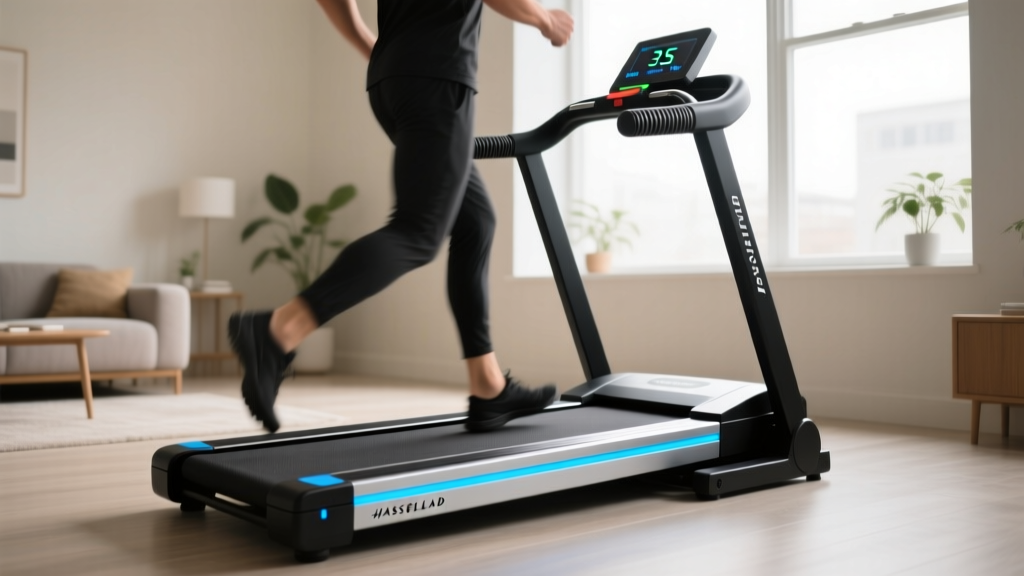
Hitting 3.5 Speed on Treadmill Walking Pads: Budget & Value Guide
Can compact walking pads handle a 3.5 speed on treadmill workouts? We break down the budget, motor limits, and true value of portable cardio gear.

When building a home gym in a small apartment or dedicating a corner of your home office to fitness, compact portable cardio equipment is often the default choice. Walking pads and under-desk treadmills have flooded the market, promising effortless step counts and seamless integration into your workday. However, a critical threshold exists in cardiovascular training: the brisk walking pace. According to the Mayo Clinic, a brisk walking pace generally falls around 3.0 to 3.5 mph, which is the minimum speed required to elevate your heart rate into the moderate-intensity zone recommended by the American Heart Association.
This brings us to a vital question for budget-conscious buyers: Can you safely and effectively sustain a 3.5 speed on treadmill walking pads without destroying the machine or compromising your biomechanics? In this comprehensive budget breakdown and value analysis, we dissect the true cost of portable cardio gear, examining motor strain, deck limitations, and long-term value to help you make an informed purchase in 2026.
The Biomechanical Reality of Hitting 3.5 speed on treadmill Compact Decks
Before analyzing the financial budget, we must address the physical budget—specifically, your stride length. At a leisurely 2.0 mph, your stride is short and contained. But when you push to a 3.5 speed on treadmill equipment, your biomechanics change drastically. Your stride lengthens, your arm swing increases, and your foot strike exerts up to 1.5 times your body weight in downward force.
Expert Insight: The 43-Inch RuleMost ultra-compact walking pads feature a running deck between 38 and 40 inches long. At 3.5 mph, an average-height adult (5'8') will naturally overstep a 40-inch deck, leading to 'edge-stepping.' This not only causes you to trip but also concentrates severe friction on the rear roller, accelerating belt degradation. For a safe 3.5 mph pace, a minimum deck length of 43 inches is mandatory.
2026 Market Budget Breakdown: Pads vs. Compact Folders
The portable cardio market is generally split into two categories: true 'walking pads' (no handrails, foldable, ultra-lightweight) and 'compact folding treadmills' (fixed or folding handrails, heavier, slightly larger footprint). Here is how the top budget contenders compare when tasked with sustaining 3.5 mph.
| Equipment Type | Example Model | Upfront Cost | Motor (CHP) | Deck Length | Safe 3.5 MPH Limit |
|---|---|---|---|---|---|
| Ultra-Compact Pad | WalkingPad R2 | $399 | 1.25 CHP | 40 inches | 20-30 min sessions |
| Hybrid Pad/Folder | UREVO Strol 2E | $269 | 2.0 Peak HP | 38 inches | Not recommended |
| Compact Folding | Sunny Health SF-T723016 | $345 | 2.5 Peak HP | 45 inches | 45-60 min sessions |
| Entry Full-Size | Horizon Fitness T101 | $599 | 2.5 CHP | 55 inches | Unlimited |
Hidden Costs: Motor Strain and Failure Modes at 3.5 MPH
When evaluating the budget of portable cardio equipment, the upfront price tag is only half the equation. The true value analysis must account for hardware longevity. Sustaining a 3.5 speed on treadmill mechanisms built for strolling introduces severe mechanical and electrical stress.
The Continuous Horsepower (CHP) Trap
Many budget walking pads advertise '2.5 HP' motors. However, this is almost always Peak HP—the maximum output the motor can hit for a few seconds before tripping the thermal breaker. What you actually need to look for is Continuous Horsepower (CHP). A 1.25 CHP motor (common in sub-$300 walking pads) is perfectly adequate for a 150 lb user walking at 2.0 mph. But when that same user pushes the machine to 3.5 mph, the amp draw spikes. The motor runs hotter, the internal fan cannot dissipate the heat fast enough, and the control board eventually fries.
Replacing a fried DC motor control board on a generic walking pad typically costs between $80 and $120, plus the hassle of sourcing parts from overseas manufacturers. This hidden repair cost instantly destroys the 'budget' appeal of a $250 walking pad if you plan to use it for vigorous 3.5 mph daily workouts.
Belt Friction and Edge Cases
At higher speeds, the coefficient of friction between the walking belt and the deck generates significant heat. Compact treadmills often lack the advanced silicone-impregnated decks found in premium models. If you are running a 3.5 mph pace on a dry, unlubricated 40-inch deck, the friction will stretch the belt, causing it to slip underfoot—a major safety hazard that frequently results in shin splints or falls.
Real-World Value Analysis: Which Portable Option Wins?
To determine the best value for your specific situation, we must map user profiles to equipment capabilities. Here is our proprietary decision framework for buyers targeting a 3.5 mph pace.
- The 'Under-Desk Stroller' (Budget: $150 - $250): If your primary goal is to stay active while answering emails at 1.5 to 2.0 mph, an ultra-compact pad like the WalkingPad C2 is excellent value. However, it fails the 3.5 mph test. Value Verdict: High for strolling, zero for brisk cardio.
- The 'Space-Constrained Cardio Enthusiast' (Budget: $300 - $450): If you strictly need to hit that 3.5 speed on treadmill equipment to get your heart rate up, but cannot fit a full-sized machine, you must compromise on the 'pad' aesthetic and buy a compact folding treadmill with a fixed handrail and a 45+ inch deck (like the Sunny Health models). Value Verdict: Moderate upfront cost, high functional value.
- The 'Longevity Investor' (Budget: $500 - $650): For daily, 60-minute sessions at 3.5 mph or higher, stepping up to an entry-level full-size compact treadmill like the Horizon T101 provides a 2.5 CHP motor and a 55-inch deck. Value Verdict: Highest cost-per-use value over a 5-year lifespan.
Expert Maintenance to Protect Your Budget Investment
If you have opted for a budget compact treadmill to achieve your 3.5 mph goals, rigorous maintenance is non-negotiable to protect your financial investment. Follow this strict protocol to prevent premature motor burnout:
- Bi-Weekly Lubrication: Budget belts are rarely pre-lubricated to factory standards. Apply 100% silicone treadmill lubricant every 30 miles of use. At 3.5 mph, you will hit this mark roughly every 8.5 hours of runtime.
- Belt Tension Checks: A belt that is too tight will choke a low-CHP motor, causing it to overheat at higher speeds. You should be able to lift the center of the belt 2 to 3 inches off the deck.
- The 80% Rule: Never exceed 80% of the machine's maximum weight capacity. If a walking pad is rated for 250 lbs, a 200 lb user will push the motor to its absolute thermal limit at 3.5 mph. Always buy a machine with a weight capacity at least 50 lbs above your actual body weight.
Final Verdict
Achieving a true, cardiovascularly beneficial 3.5 speed on treadmill equipment requires more than just pressing a button on a remote. While ultra-compact walking pads are tempting for their low price and minimal footprint, they are fundamentally engineered for strolling, not brisk cardio. For buyers serious about maintaining a 3.5 mph pace without facing recurring repair costs or biomechanical strain, investing an extra $100 to $150 into a compact folding treadmill with a continuous-duty motor and an extended deck is the only choice that delivers genuine long-term value.
More gear to consider
All reviews
Under Desk Treadmill Review: Office Picks & ProForm Treadmill Fix

Stair Climber Setup: Walking Pad vs. Treadmill Space Comparisons

Home Stair Climber Guide: Troubleshooting & Treadmill Cup Holder Mods
Curved vs Motorized Treadmills: Belt Maintenance & How to Fix a Slippery Treadmill Belt
Adidas Ultra Series T 23 Treadmill Noise Troubleshooting & Comparison
