
Hip Thrust Pads vs Angle Leg Press Machine: 2026 Budget
Compare the ROI of hip thrust machine pad options against an angle leg press machine. Our 2026 budget breakdown reveals the best value for glute growth.

The 2026 Lower Body Dilemma: Glute Isolation vs. Compound Drive
Building a comprehensive lower-body training setup requires navigating a complex web of biomechanics, spatial constraints, and financial limitations. As we analyze the fitness equipment market in 2026, a frequent debate emerges among home gym owners and boutique studio operators: should you invest in dedicated hip thrust machine pad options, or allocate your budget toward a heavy-duty angle leg press machine? Both pathways offer distinct advantages for lower body hypertrophy, but their cost-to-value ratios vary wildly depending on your specific training goals.
In this comprehensive budget breakdown, we will dissect the exact pricing, material longevity, and biomechanical ROI of barbell pads, dedicated hip thrust machines, and the traditional 45-degree sled. By the end of this guide, you will have a precise financial and functional framework to make the optimal purchasing decision for your facility.
Budget Tier 1: Barbell Pads and Bench Hip Thrusts ($20 - $80)
For those operating on a strict budget, utilizing a standard flat bench combined with a high-quality barbell pad remains the most accessible entry point for glute isolation. However, not all pads are created equal, and understanding foam density is critical for long-term value.
Material Breakdown: EVA vs. PU Foam
- EVA Foam (Ethylene-Vinyl Acetate): Commonly found in budget options like the Squat Sponge ($29.99). EVA is lightweight and initially soft, but it suffers from rapid compression fatigue. Under loads exceeding 315 lbs, 12-inch EVA pads typically lose 40% of their shock-absorbing thickness within six months of heavy use.
- PU Foam (Polyurethane): Premium options like the Dark Iron Fitness Premium Barbell Pad ($24.99) utilize high-density 60D PU foam encased in neoprene. While slightly narrower, PU foam resists permanent deformation, offering a lifespan 3x longer than EVA under heavy concentric loading.
Budget Tier 2: Dedicated Hip Thrust Machines ($450 - $1,200)
If you are moving beyond barbell setups, dedicated hip thrust machines eliminate the setup friction of dragging benches and rolling barbells. According to extensive durability testing by Garage Gym Labs, the market has bifurcated into pivot-arm designs and linear-bearing sleds.
Value Analysis of Top 2026 Models
- Fitness Gear Pro Glute Driver ($599): Features a pivot-arm design with 12-gauge steel construction. The pivot arc closely mimics the natural biomechanical hinge of the human hip. However, the fixed pivot point can feel restrictive for users over 6'2".
- Rogue Fitness Monster Glute-Builder ($1,150+): Utilizes a linear bearing system on 3x3-inch uprights. This allows for a completely vertical bar path, accommodating all torso lengths and providing a staggering 800 lb weight capacity. The premium price tag is justified by its commercial-grade longevity and zero-sway stability.
The Alternative: Investing in an Angle Leg Press Machine ($800 - $2,500)
When evaluating the overall ROI of lower body equipment, the angle leg press machine remains a foundational compound movement staple. While primarily a quadriceps builder, manipulating foot placement transforms this machine into a potent glute and hamstring developer.
Biomechanics and Glute Bias on the Sled
According to ExRx.net's biomechanical breakdown of the 45-degree sled, placing the feet high and wide on the footplate decreases the knee flexion angle while increasing hip flexion. This shift places the mechanical tension squarely on the gluteus maximus and hamstrings. While it lacks the peak concentric "squeeze" of a hip thrust at full extension, the angle leg press machine allows for massive eccentric overload, which is a primary driver of muscle hypertrophy.
'The 45-degree leg press allows athletes to load the lower body with extreme weight while completely removing axial spinal loading, making it an indispensable tool for both bodybuilders and those managing lower back fatigue.' - National Strength and Conditioning Association (NSCA) programming guidelines.
Market Pricing for Angle Leg Press Machines
- Titan Fitness 45-Degree Leg Press ($899): Offers a 1,000 lb capacity with 30mm linear bearings and a 90-degree safety catch. It provides the best value-to-weight ratio in the 2026 market.
- Body-Solid Pro Club Line Leg Press ($2,295): A commercial-grade behemoth featuring a 5-degree reclined back pad and dual-weight horns for balanced sled tracking. Built for high-traffic facilities where daily abuse is guaranteed.
2026 Cost-to-Value Comparison Matrix
To visualize the financial and spatial commitments, review the comparison matrix below:
| Equipment Type | Avg. Cost (2026) | Space Footprint | Primary Muscle Target | Maintenance Needs |
|---|---|---|---|---|
| Premium Barbell Pad + Bench | $150 - $250 | 18 sq. ft. | Gluteus Maximus (Peak Contraction) | Replace pad every 1-2 years |
| Pivot-Arm Hip Thrust Machine | $450 - $650 | 22 sq. ft. | Gluteus Maximus (Isolation) | Pivot joint lubrication |
| Linear Bearing Hip Thrust | $900 - $1,200 | 28 sq. ft. | Gluteus Maximus (Heavy Load) | Rod cleaning and greasing |
| 45-Degree Angle Leg Press | $899 - $2,300 | 32 sq. ft. (Vertical clearance needed) | Quads / Glutes (Eccentric Overload) | Sled track lubrication, cable checks |
Hidden Costs and Space Footprint Analysis
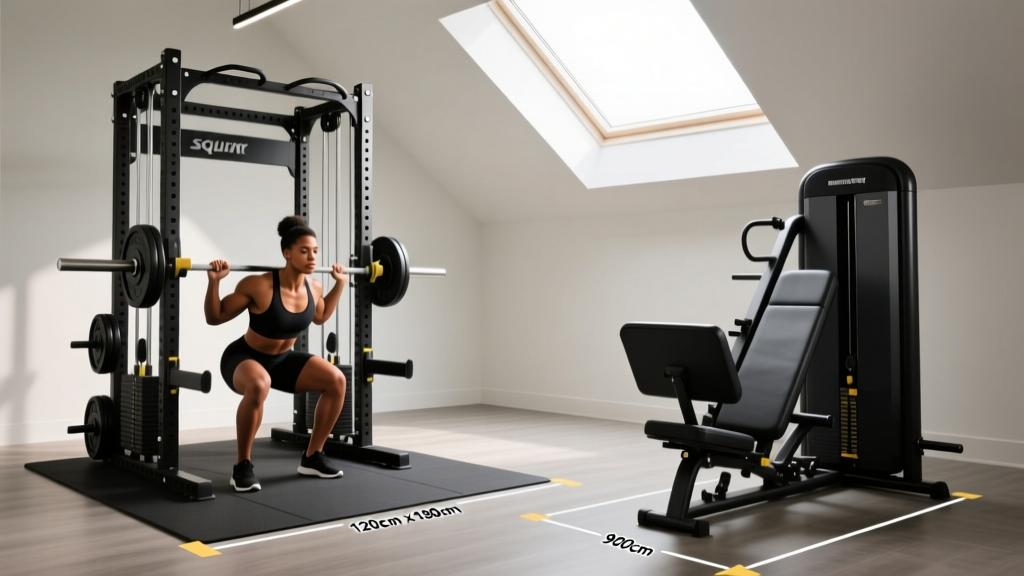
Budgeting for gym equipment extends beyond the sticker price. The angle leg press machine requires significant vertical clearance (often exceeding 72 inches in height) and a dedicated floor footprint of roughly 7 feet by 4.5 feet. Furthermore, shipping costs for a 300+ lb welded steel sled can add $150 to $300 to your final expenditure via freight LTL (Less Than Truckload) delivery.
Conversely, a dedicated hip thrust machine or a simple barbell pad setup can be integrated into existing power rack ecosystems or folded away, preserving valuable square footage for deadlift platforms or functional turf areas. According to research published in the Journal of Sports Science & Medicine regarding electromyographic (EMG) comparisons of lower body exercises, maximizing glute activation requires a mix of lengthened and shortened muscle position training. Therefore, relying solely on one machine may leave gaps in your hypertrophy programming.
Final Verdict: Where Should Your Budget Go?
Your purchasing decision should be dictated by your primary physiological goals and spatial reality.
Choose Hip Thrust Pads or Machines If:
- Your primary aesthetic or performance goal is isolated gluteus maximus hypertrophy.
- You suffer from lower back fatigue that precludes heavy barbell squats.
- You have limited ceiling height or a multi-purpose garage gym where equipment must be stowed away.
- Your budget is strictly capped under $600.
Choose the Angle Leg Press Machine If:
- You require a versatile compound movement that can target quads, hamstrings, and glutes simply by shifting foot placement.
- You want to safely train to absolute muscular failure without the need for a spotter or the risk of spinal compression.
- You are outfitting a commercial or semi-commercial space where user-friendly, high-capacity machines are mandatory for client safety and throughput.
Ultimately, the smartest 2026 budget strategy for a well-rounded lower body is a hybrid approach: invest in a mid-tier angle leg press machine for heavy, safe eccentric overload, and pair it with a high-density PU barbell pad ($25) on your existing flat bench for peak-concentration glute isolation. This combination delivers 95% of the biomechanical benefits of a $3,000 dual-machine setup at a fraction of the financial and spatial cost.
More gear to consider
All reviews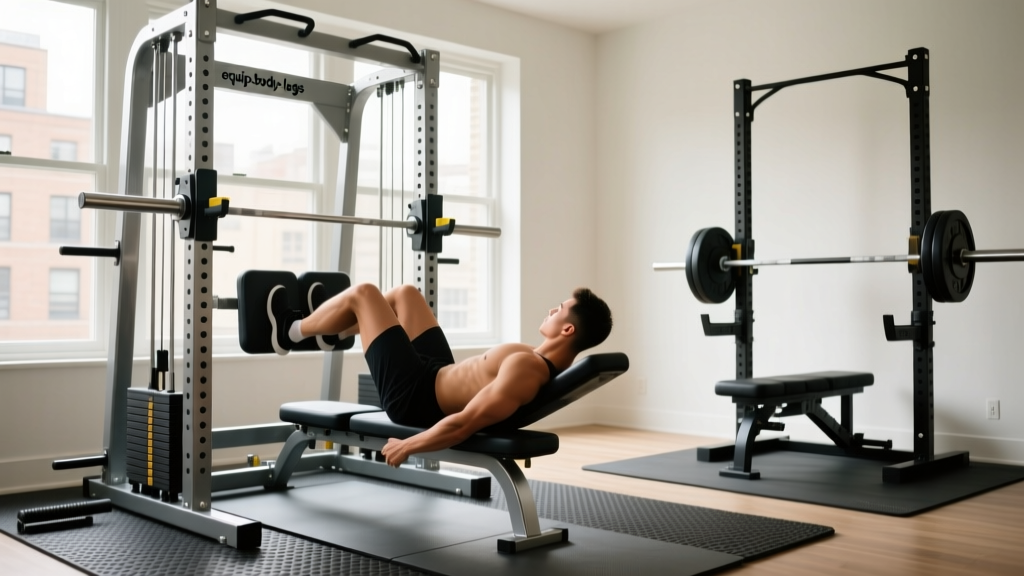
Hack Squat vs Leg Press: Setup a Leg Press at Home Without a Machine

Leg Press Machines for Home Gyms: 2026 Head-to-Head
Optimizing Gym Layouts: Squat Racks & Leg Press Workout Machines

Squat Rack & Calves Leg Press Machine: Space Layouts

Matrix Leg Press Machine vs Hack Squat: Setup & Installation
