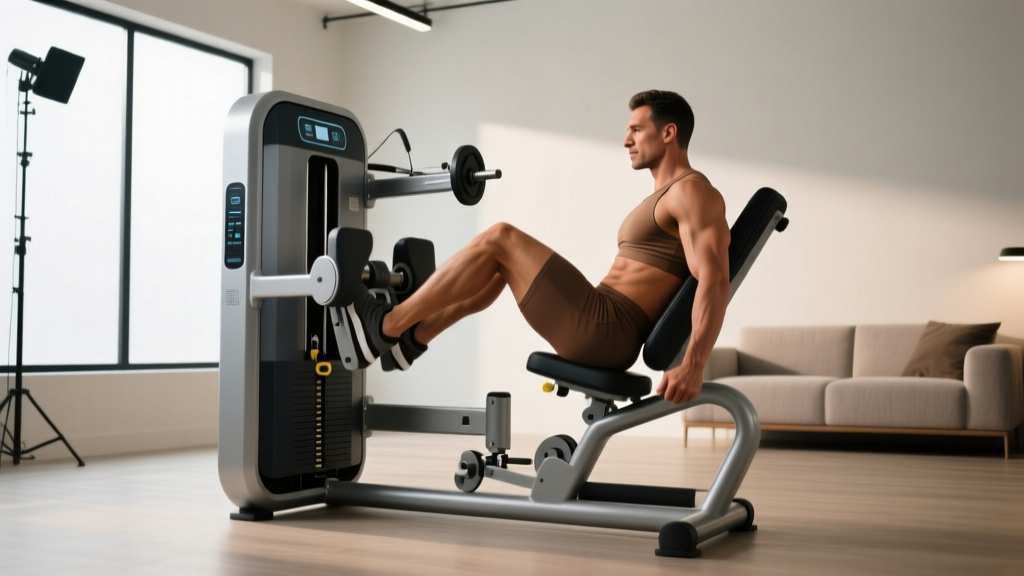
2026 Glute Machine Market Trends: Beyond the Squat Machine Leg Press
Discover 2026 glute training equipment market trends, analyzing the shift from the traditional squat machine leg press to specialized hip thrust isolators.

The 2026 Glute Training Equipment Landscape
The commercial and home gym equipment market has undergone a radical transformation over the last five years, driven largely by the 'glute economy.' As sports science and social media fitness trends converge, the demand for targeted posterior chain development has skyrocketed. According to industry data tracked by the Health & Fitness Association, specialized lower-body isolation machines have seen a 34% year-over-year growth in commercial facility acquisitions entering 2026. Gym owners and serious home-gym builders are actively rethinking their floor plans, moving away from a one-size-fits-all approach to lower body training.
At the center of this paradigm shift is a critical re-evaluation of legacy equipment. While the traditional squat machine leg press remains a foundational tool for quadriceps overload and general lower-body mass, it is no longer viewed as sufficient for maximal gluteal hypertrophy. This trend report analyzes the biomechanical limitations of legacy compound machines and outlines the specialized glute training equipment driving market sales in 2026.
The Biomechanical Ceiling of the Squat Machine Leg Press
For decades, the 45-degree linear bearing squat machine leg press was the undisputed king of the leg day floor. However, modern kinesiology has highlighted its limitations regarding gluteus maximus activation. The primary issue lies in the force vector and the stretch-shortening cycle. During a deep leg press, the lumbar spine often rounds (posterior pelvic tilt or 'buttock wink') before the hip reaches maximal flexion, limiting the deep stretch required for stretch-mediated hypertrophy in the glutes.
Furthermore, the force vector of a standard leg press is directed at a 45-degree angle, which heavily biases the quadriceps and adductors. A landmark electromyography (EMG) study published in the National Center for Biotechnology Information (NCBI) demonstrated that while squats and leg presses elicit high quad activation, horizontal force production exercises—specifically the hip thrust—yield significantly greater gluteus maximus activation at peak contraction. Consequently, facilities that rely solely on a standard squat machine leg press are failing to meet the specific programming needs of modern lifters, leading to a massive surge in demand for horizontal and specialized unilateral glute isolators.
Top Commercial & Prosumer Glute Machines Driving 2026 Sales
To capture the growing demographic of glute-focused lifters, equipment manufacturers have engineered highly specialized machines. Below is an analysis of the market leaders dominating the 2026 landscape.
1. The Hip Thrust Revolution: Nautilus Glute Drive & Prime Fitness
The hip thrust has transitioned from an awkward barbell setup to a highly engineered, cam-driven movement. The Nautilus Glute Drive (retailing between $4,800 and $5,500) utilizes a proprietary cam profile that matches the natural strength curve of the glutes, providing maximum resistance at peak contraction where the barbell version lacks tension. Meanwhile, Prime Fitness offers a plate-loaded hip thrust with adjustable starting pins, catering to the prosumer and boutique studio market at a $2,900 price point. Both feature high-density, contoured PU foam pads designed to prevent the ASIS (hip bone) bruising common with older, flat-pad iterations.
2. Spinal Unloading: Rogue Fitness Belt Squat
For lifters dealing with axial fatigue or lumbar limitations, the belt squat has become a mandatory piece of glute and hamstring equipment. The Rogue Fitness Belt Squat (approx. $3,200) uses a leverage arm and a specialized hip belt to pull the load downward, entirely bypassing the spine. This allows for massive glute and hamstring overload without the central nervous system (CNS) fatigue associated with heavy back squats or the shear force of a deep squat machine leg press.
3. Frontal Plane & Unilateral Isolators: Sorinex GHD & Kickback Machines
The gluteus medius and minimus are critical for pelvic stability and hip abduction. The Sorinex Glute Ham Developer (GHD) remains the gold standard for eccentric hamstring and glute-ham tie-in work ($1,800+). However, 2026 has seen a massive spike in specialized 45-degree cable kickback machines and seated hip abduction machines with forward-leaning torso pads, designed to bias the upper gluteal fibers and external rotators.
2026 Equipment Comparison Matrix
| Machine Type | Market Leader (Model) | Avg. Commercial Price | Footprint (L x W) | Primary Biomechanical Bias |
|---|---|---|---|---|
| Cam-Driven Hip Thrust | Nautilus Glute Drive | $5,200 | 68' x 34' | Peak Contraction Glute Max |
| Plate-Loaded Hip Thrust | Prime Fitness Thrust | $2,900 | 62' x 32' | Mid-Range Glute Tension |
| Belt Squat | Rogue Belt Squat | $3,200 | 48' x 36' | Spinal-Unloaded Glute/Ham |
| Legacy 45-Degree Press | Hammer Strength HS-4000 | $4,500 | 84' x 34' | Quad Dominant / Adductor |
| Glute Ham Developer | Sorinex GHD | $1,850 | 60' x 24' | Eccentric Ham / Glute Tie-In |
Failure Mode Analysis: The Danger of Budget 'Amazon' Thrust Benches
As the glute training trend has exploded, the market has been flooded with sub-$600 plate-loaded hip thrust benches from generic overseas manufacturers. From an equipment longevity and safety perspective, these present severe failure modes that commercial gym owners and serious home-gym builders must avoid:
- Pivot Pin Shearing: Budget models often use 10mm to 12mm steel pivot pins. Under loads exceeding 300 lbs, the lateral torque can cause these pins to bend or snap, dropping the carriage unexpectedly.
- Pad Compression & Bottoming Out: Low-density foam compresses entirely under heavy loads, transferring the force directly to the user's pelvic bones, leading to severe bruising and nerve impingement.
- Carriage Wobble: Lack of UHMW plastic guides or linear bearings results in a shaky carriage, forcing the user to stabilize the load laterally rather than focusing on the sagittal plane hip extension.
⚠️ Procurement Warning for Gym Owners
Do not attempt to save capital by purchasing unbranded, budget plate-loaded hip thrust benches for a commercial environment. The liability risk associated with pivot pin failure, combined with the high maintenance cost of replacing torn, low-grade vinyl pads, will negate any initial savings within the first 12 months of heavy use. Invest in commercial-grade linear bearing systems or cam-driven selectorized units.
Gym Owner ROI & Floor Space Allocation
Transitioning floor space away from legacy equipment requires a solid return on investment (ROI) justification. The traditional squat machine leg press occupies a massive footprint—often exceeding 80 inches in length and requiring a 5-foot safety radius for loading plates. In contrast, modern vertical-plate-loaded hip thrust machines and compact belt squats offer a 20-30% reduction in square footage requirements while commanding higher user throughput.
Furthermore, the 'glute-focused' demographic represents one of the most dedicated and high-retention segments in modern fitness clubs. By marketing a dedicated 'Posterior Chain & Glute Zone' featuring a Nautilus Glute Drive, a Rogue Belt Squat, and specialized cable kickback stations, boutique and mid-sized commercial gyms can differentiate themselves from big-box chains that still rely entirely on the standard squat rack and leg press combination. The premium membership tier justified by this specialized equipment typically yields a 6-to-8-month ROI on the capital expenditure.
Conclusion: The Future of Lower Body Training
The year 2026 marks the definitive maturation of glute-specific training equipment from niche novelty to industry standard. While the traditional squat machine leg press will always maintain a vital role in comprehensive quadriceps development and athletic power output, it is no longer the optimal tool for targeted gluteal hypertrophy. By understanding the biomechanical advantages of horizontal force vectors, spinal unloading, and cam-driven resistance curves, facility owners and home-gym enthusiasts can make highly informed, data-backed purchasing decisions that align with the demands of modern sports science.
More gear to consider
All reviews
Budget Breakdown: Cybex Leg Press Machine vs Hip Thrust Setups

Squat Rack vs Leg Press Machine for Women: Space Guide

How Much Does a Leg Press Machine Weigh Without Weights? Home Compare

Beyond the Leg Press Machine Gym Image: Sled Guide

Leg Extension & Curl Guide: Adding an Inclined Leg Press Machine
