
Troubleshooting Push-Up Boards & Titan Fitness Plate Loaded Chest Press Machine
Fix chest plateaus. We review push-up bar types and troubleshoot form mistakes on the Titan Fitness plate loaded chest press machine.

The Chest Hypertrophy Plateau: Equipment vs. Execution
Stalled chest development is rarely just a programming issue; more often than not, it is a biomechanical failure tied directly to the equipment you are using. In 2026, lifters have access to an unprecedented range of chest training tools, but the gap between bodyweight leverage devices and heavy isotonic machines is vast. When athletes fail to progress, they usually fall into one of two traps: misusing closed-chain bodyweight tools or fighting the mechanical leverage of heavy plate-loaded systems.
In this troubleshooting guide, we will dissect the most common mistakes made with push-up bars and modular boards, and then transition to heavy-load troubleshooting for the highly popular Titan Fitness plate loaded chest press machine. By understanding the specific failure modes of both ends of the equipment spectrum, you can correct your form, eliminate joint pain, and force new pectoral growth.
Push-Up Bar and Board Types: Reviews and Common Mistakes
Push-up bars and boards elevate the hands, allowing for an increased range of motion (ROM) and shifting the wrist from a 90-degree dorsiflexion angle to a neutral 0-degree grip. However, not all handles are created equal, and the wrong tool for your specific shoulder mobility can lead to severe anterior capsule strain.
Fixed Hex Bars vs. Rotating Handles
Fixed Bars (e.g., Rogue Fitness Push-Up Handles, ~$45): These provide a stable, neutral grip. They are ideal for lifters with wrist impingement who need to maintain a rigid, locked-in path.
Rotating Handles (e.g., Perfect Pushup V2, ~$30): These feature a ball-bearing base that allows the wrist to rotate naturally during the concentric phase. While they mimic the natural arc of a dumbbell press, they require immense rotator cuff stability.
The most common mistake with rotating push-up boards is allowing the handles to spin inward (internal rotation) at the bottom of the eccentric phase. If your scapular stabilizers fatigue, the handles will spin toward each other, dumping the humerus into internal rotation and placing massive shear force on the labrum. If you experience sharp anterior shoulder pain at the bottom of a rotating push-up, immediately switch to fixed hex bars to lock the movement path.
Modular Push-Up Boards
Color-coded modular boards (which dictate hand placement for upper, mid, and lower chest targeting) are popular for home gyms. However, a frequent failure mode occurs when these boards are used on low-pile carpet or hardwood floors without the provided anti-slip mats. During the eccentric lowering phase, the base can slide outward by 1 to 2 inches, unexpectedly stretching the pec tendon under load and causing micro-tears.
| Equipment Type | Best For | Wrist Angle | Common Failure Mode |
|---|---|---|---|
| Fixed Hex Bars | Heavy bodyweight, wrist pain | 0° (Neutral) | Gripping too wide, causing radial deviation |
| Rotating Handles | Hypertrophy, joint tracking | Dynamic | Internal rotation collapse at the bottom |
| Modular Boards | Targeted isolation, beginners | Varies by peg | Base sliding on smooth surfaces |
Heavy Load Troubleshooting: Titan Fitness Plate Loaded Chest Press Machine
Transitioning from bodyweight to heavy iron requires a complete shift in biomechanical awareness. The Titan Fitness plate loaded chest press machine (typically priced between $1,299 and $1,499 in 2026) is a staple in commercial and high-end home gyms. Built with 11-gauge steel and utilizing linear bearings on chrome-plated shafts, it offers a smooth, converging arc path that mimics the natural adduction of the pectoralis major. However, its plate-loaded nature introduces unique troubleshooting scenarios that selectorized machines do not.
1. Seat Height and Handle Alignment
The Titan machine features a multi-hole seat adjustment pin. The most critical mistake lifters make is setting the seat too high. When the seat is too high, the handles align with the lower sternum or upper abdomen, effectively turning the movement into a steep decline press. This shifts the load away from the sternal pecs and onto the anterior deltoids and triceps, while simultaneously increasing the risk of shoulder impingement syndrome due to the altered angle of the humeral head in the glenoid fossa.
The Fix: Sit in the machine and grasp the handles. The grips should align perfectly with your mid-nipple line (the thickest part of the sternal pec). If they are below your sternum, drop the seat down one or two pinholes.
2. Fighting the Converging Arc Path
Unlike a standard barbell bench press where the hands move in a relatively straight vertical line, the Titan Fitness plate loaded chest press machine utilizes a converging leverage arm system. As you press, the handles move closer together.
The Mistake: Lifters accustomed to barbells often try to push the handles straight up toward the ceiling, fighting the machine's natural cam and leverage arc. This causes the linear bearings to bind, resulting in a jerky, stuttering rep and excessive friction on the guide rods.
The Fix: Allow the machine to dictate the path. Focus on bringing your biceps across your torso (horizontal adduction) rather than just extending the elbows. According to biomechanical analyses of sternal pectoral exercises, horizontal adduction is the primary function of the pec major; let the converging arms facilitate this naturally.
3. Torsion and Linear Bearing Bind
Because this is a plate-loaded unit, the user is responsible for load distribution. A massive troubleshooting issue unique to plate-loaded lever arms is uneven loading. If you load three 45-pound plates on the left horn and only one 45-pound plate plus two 10s on the right, the asymmetrical weight distribution can cause torsion (twisting) on the lever arm. Over time, this will warp the linear bearings and cause the machine to squeak or stick.
The Fix: Always mirror your plate loading exactly on both sides. If you must use fractional plates, ensure the total mass and the physical width of the plates on the horns are symmetrical to maintain perfect balance on the carriage.
Expert Insight: To maintain the linear bearings on your Titan machine, wipe down the chrome guide rods with a dry microfiber cloth weekly to remove chalk dust and ambient moisture. Every six months, apply a light coat of white lithium grease to the rods to ensure the 1:1 leverage ratio remains frictionless.
Bridging the Gap: Programming Bodyweight and Machine Presses
To maximize chest hypertrophy, you must utilize both closed-chain (push-up) and open-chain/stabilized (machine) movements. The push-up bar allows the scapula to move freely along the rib cage (protraction and retraction), which is vital for serratus anterior health and overall shoulder mechanics. Conversely, the Titan machine locks the scapula against the pad, isolating the pecs by removing the stabilization requirement.
The Pre-Exhaust Troubleshooting Protocol
If you struggle to 'feel' your chest working on the heavy Titan machine, your triceps and anterior delts are likely taking over the movement. Use this troubleshooting protocol to fix your mind-muscle connection:
- Pre-Exhaust (Closed-Chain): Perform 3 sets of 15-20 reps using fixed push-up bars with a slow 3-second eccentric. Focus entirely on scapular protraction at the top of the movement.
- Heavy Overload (Open-Chain): Move immediately to the Titan Fitness plate loaded chest press machine. Because the pecs are pre-fatigued, you will need 20-30% less weight on the horns, but the pectoral fibers will be forced to initiate the concentric phase without the triceps dominating the lockout.
Troubleshooting FAQ
Why do my wrists hurt on the floor but not on push-up bars?
Floor push-ups require extreme wrist dorsiflexion (bending the hand back to 90 degrees), which compresses the carpal bones and strains the palmar fascia. Push-up bars allow a neutral, straight-wrist grip, aligning the radius and ulna directly over the metacarpals, effectively eliminating joint compression.
Is the Titan Fitness plate loaded chest press machine safe for shoulder rehab?
While the converging arc is generally safer than a fixed barbell path, plate-loaded machines require you to load and unload heavy iron plates, which can aggravate recovering shoulders. For active rehab, selectorized cable crossovers or resistance bands are preferred until the rotator cuff is fully cleared for heavy isotonic loading.
How wide should my grip be on the multi-grip push-up bars?
A common mistake is gripping the absolute widest part of the bar to 'stretch' the chest. This places the shoulder in a vulnerable, abducted position. Keep your hands just slightly wider than shoulder-width (approximately 1.5x your bi-acromial width) to maintain optimal mechanical tension on the pecs without overstretching the anterior capsule.
For more detailed specifications and leverage ratios, you can review the official Titan Fitness plate-loaded machine lineup to ensure your home gym setup matches your biomechanical needs. Mastering both the humble push-up board and the heavy plate-loaded press is the ultimate key to breaking through any chest development plateau.
More gear to consider
All reviews
Hammer Strength Chest Press Machine vs Bench Press Rack: Cost & Value

How To Choose Point: A Precision Guide for Equipment Body Chest Applications

Iso Chest Press Machine vs Bench Press Rack Spotter Arms
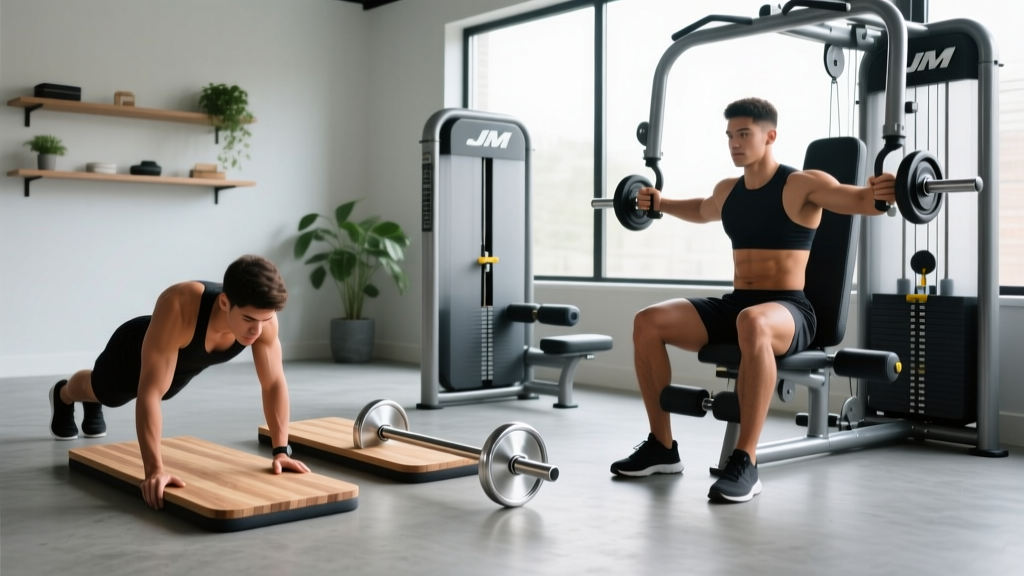
Push-Up Boards vs JM Press on Chest Press Machine: Beginner Guide

Chest Press Machine Gym Equipment Layouts: Dumbbell vs. Cable Fly
