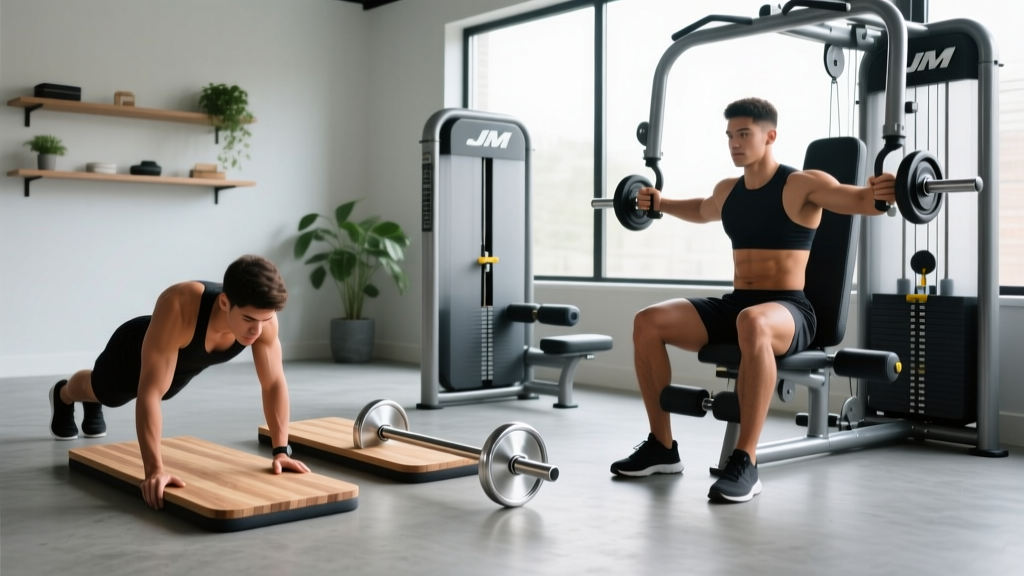
Push-Up Boards vs JM Press on Chest Press Machine: Beginner Guide
Master chest and triceps growth with our beginner guide to push-up boards, rotating bars, and the JM press on chest press machine setups.

The Beginner's Pressing Arsenal: Bodyweight vs. Machine
Building a robust chest and triceps foundation requires mastering both closed-chain bodyweight movements and open-chain machine isolations. As we navigate the fitness landscape in 2026, beginners often find themselves overwhelmed by the sheer volume of pressing equipment available. Do you start with modular push-up boards, or jump straight into selectorized machines? The answer lies in understanding the biomechanical bridge between the two.
This guide breaks down the best push-up bars and boards for home and gym use, before transitioning into a highly specific, joint-friendly triceps and upper-chest builder: the JM press on chest press machine setups. By mastering both ends of the spectrum, you will bulletproof your joints and accelerate hypertrophy without relying on a spotter.
Expert Insight: According to American Council on Exercise (ACE), combining closed-kinetic chain exercises (like push-ups) with open-kinetic chain machine work optimizes motor unit recruitment while minimizing shear force on the rotator cuff.Decoding Push-Up Bars and Modular Boards
Standard floor push-ups limit your range of motion (ROM) and force your wrists into extreme extension. Push-up bars and boards solve this by elevating your hands, allowing your chest to dip below the palm level for a deeper stretch, while keeping the wrist in a neutral, stacked position.
1. Fixed Steel Paralettes (The Durability King)
For beginners who want zero maintenance and maximum stability, fixed paralettes are ideal. The Rogue Fitness Steel Paralettes (approx. $65.00) are welded from 11-gauge steel and feature a powder-coat finish that prevents slipping. Because they do not rotate, they force you to actively engage your forearm stabilizers and control your own shoulder internal/external rotation, which is excellent for building foundational joint resilience.
2. Rotating Push-Up Bars (The Joint Saver)
If you have a history of wrist or shoulder impingement, rotating handles are non-negotiable. The Perfect Fitness Push-Up Pro V2 (approx. $19.99) utilizes a steel ball-bearing base that allows your hands to rotate naturally as you press. This mimics the natural spiral of the humerus during a pressing motion. However, the 250 lb weight capacity means heavier users or those planning to add weighted vests should look elsewhere.
3. Modular Push-Up Boards (The Gamified Approach)
Modular boards like the PUSHER Bodyweight Fitness System (approx. $79.99) use color-coded, interchangeable grips to alter the angle of your press. By swapping grips, you can target the clavicular (upper) or sternocostal (mid/lower) pectoral fibers. While excellent for home gyms, the plastic snap-in mechanisms can develop micro-wobbles over time compared to solid steel alternatives.
Step-by-Step: Mastering the Board Press
- The Setup: Place your grips slightly wider than shoulder-width. Ensure your wrists are directly stacked over the base of the grips.
- Scapular Retraction: Before descending, pinch your shoulder blades together and pull them down toward your hips. This creates a stable 'shelf' for your pecs to work from.
- The Descent: Lower yourself on a 3-second eccentric count. Your elbows should tuck at a 45-degree angle relative to your torso. Flaring them to 90 degrees places immense stress on the AC joint.
- The Stretch: Allow your chest to dip 1 to 2 inches below the handles. Feel the stretch in the pectoral fascia.
- The Press: Drive through the palms, focusing on squeezing your biceps toward your chest at the top to maximize peak contraction.
For a deeper look into the muscle activation patterns of this movement, review ExRx.net's biomechanical breakdown of the push-up.
Transitioning to Machines: The JM Press on Chest Press Machine
Once you have built a baseline of pressing strength and scapular control with boards, it is time to overload the triceps and inner chest safely. The traditional JM Press, popularized by powerlifter JM Blakley, is a barbell hybrid between a close-grip bench press and a skull crusher. However, performing it with a barbell requires a skilled spotter and immense wrist stability.
This is where adapting the JM press on chest press machine becomes a game-changer for beginners. By utilizing a selectorized dual-axis chest press (like those from Hammer Strength or Life Fitness), you remove the stabilization requirement, allowing you to safely push to muscular failure.
Machine Setup and Biomechanics
Executing the JM press on chest press machine requires a completely different setup than a standard chest press. Follow these exact measurements:
- Seat Height Adjustment: Raise the seat 2 to 3 notches (approximately 3 to 4 inches) higher than your standard pressing position. The handles should align with your upper sternum or clavicle, not your mid-chest.
- Grip Width: Use a neutral grip if your machine offers converging neutral handles. If using a standard pronated bar, choke your grip in so your hands are 14 to 16 inches apart (roughly one fist-width inside shoulder width).
- Elbow Path: Unlike a standard press where elbows flare slightly, tuck your elbows tightly to your ribcage (roughly 15 to 20 degrees from your torso).
Execution: The 2-Phase Press
The magic of the JM press lies in its shortened range of motion.
- Unrack and Tuck: Press the handles out to full extension. Keep your elbows tucked.
- The Descent: Lower the weight by bending at the elbows, allowing the upper arm to drop slightly toward the floor. Stop the movement when the handles are about 3 to 4 inches away from your upper chest. Do not let your elbows drop below the plane of your torso.
- The Lockout: Drive the weight straight up and slightly back toward your face, focusing entirely on triceps extension and upper-chest lockout.
Equipment Comparison Matrix
| Equipment Type | Primary Muscle Focus | Joint Stress Level | Cost Range (2026) | Beginner Friendliness |
|---|---|---|---|---|
| Fixed Steel Paralettes | Mid/Lower Chest, Core | Moderate (Wrist neutral) | $50 - $75 | High |
| Rotating Push-Up Bars | Full Chest, Shoulders | Low (Allows natural rotation) | $15 - $30 | Very High |
| Modular Push-Up Boards | Variable (Angle dependent) | Low to Moderate | $60 - $90 | High |
| JM Press on Chest Press Machine | Triceps, Upper Chest | Very Low (Fixed path) | Gym Membership | Moderate (Requires setup) |
Programming Your Pressing Routine
To maximize hypertrophy without overtraining the central nervous system, combine these tools into a bi-weekly upper body split.
Workout A: Bodyweight & Stretch Focus
- Warm-up: 2 sets of 10 reps on rotating push-up bars (focus on scapular movement).
- Primary Movement: Deficit Push-ups on fixed paralettes - 3 sets of 8-12 reps (Add a 10lb weight vest if bodyweight becomes too easy).
- Accessory: Push-up board isometric holds (hold the bottom stretch position for 15 seconds x 3 rounds).
Workout B: Machine Overload & Triceps Focus
- Primary Movement: JM press on chest press machine - 4 sets of 8-10 reps. Keep the tempo strict: 2 seconds down, 1 second pause, explosive up.
- Secondary Movement: Standard Machine Chest Press (neutral grip) - 3 sets of 12-15 reps for metabolic stress.
- Finisher: Cable Crossovers (high to low) - 2 sets to failure.
Common Mistakes and Troubleshooting
Mistake 1: Flaring elbows on the push-up board.
The Fix: Record your set from a lateral angle. If your elbow angle exceeds 60 degrees, consciously pull your elbows toward your ribs. Flaring shifts the load from the pectorals to the anterior deltoids, stunting chest growth.
Mistake 2: Setting the seat too low for the machine JM Press.
The Fix: If the handles align with your nipples or lower sternum, you are performing a close-grip bench press, not a JM press. The JM press specifically targets the upper chest and triceps lockout, which requires the handles to start near the clavicle. Raise the seat immediately if you feel excessive strain on your front delts.
Mistake 3: Ignoring the eccentric phase.
The Fix: Muscle damage, a key driver of hypertrophy, occurs primarily during the lengthening phase. Whether you are dipping below the push-up board or lowering the machine handles, enforce a strict 2-to-3-second negative on every single repetition.
Final Thoughts for the Beginner
You do not need to choose between bodyweight mastery and machine isolation. By utilizing push-up boards to build functional stability and deep-tissue stretch, and leveraging the JM press on chest press machine variations to safely overload the triceps and upper pecs, you create a comprehensive, injury-proof pressing foundation. Start with the basics, respect the setup measurements, and let the equipment work for your biomechanics, not against them.
More gear to consider
All reviews
Balls Home Gym Space & Budget Essentials: Smart, Scalable Strength Training for Under $500

Recovery Trends 2026: Science-Backed Innovations Reshaping Athletic and Clinical Rehabilitation

Mastering Incline Chest Press Machine Form: Push-Up Boards Reviewed

Real For World: How Functional Chest Protection Transforms Real-World Safety Across Industries

Chest Press Machine Types Compared: 2026 In-Depth Buyer Guide
