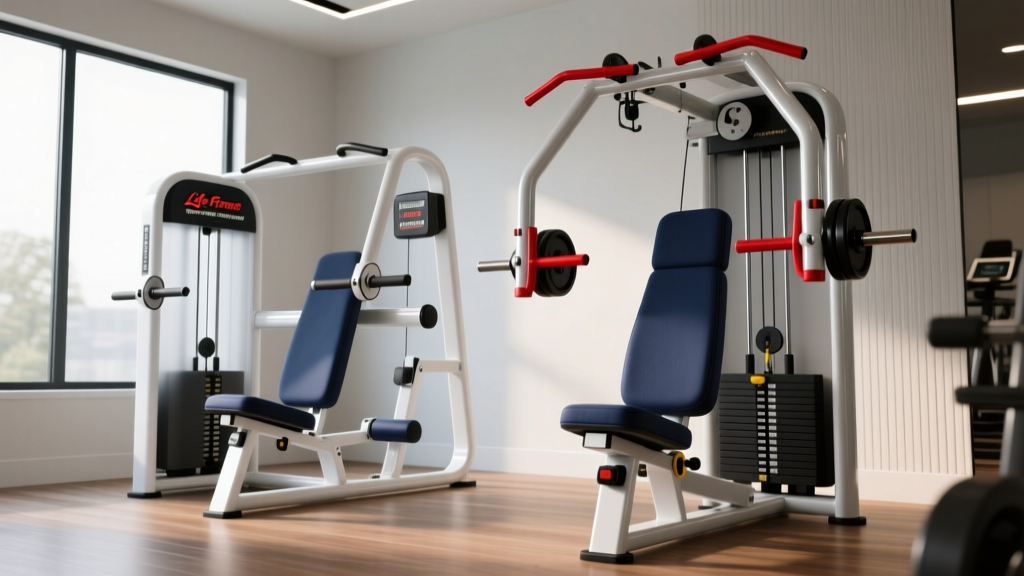
Life Fitness Chest Press Machine Review 2026: Signature vs Hammer
Compare the Life Fitness chest press machine types in 2026. We analyze Signature Series vs. Hammer Strength Iso-Lateral biomechanics, pricing, and durability.

The Evolution of the Life Fitness Chest Press Machine
When outfitting a commercial facility, university weight room, or high-end garage gym in 2026, selecting the optimal chest training equipment requires looking past marketing gloss and diving into biomechanical engineering. The Life Fitness chest press machine lineup remains the gold standard in the industry, but it is not a monolith. Facility owners and serious lifters frequently face a critical decision: choosing between the pin-loaded convenience of the Life Fitness Signature Series and the raw, plate-loaded intensity of the Hammer Strength Iso-Lateral line (owned by Life Fitness). Understanding the distinct chest press machine types and how they compare is essential for maximizing hypertrophy, ensuring user safety, and protecting your equipment investment.
In this comprehensive head-to-head comparison, we dissect the exact specifications, real-world pricing, press path kinematics, and long-term maintenance profiles of these two flagship models. We will also benchmark them against a primary competitor, the Technogym Selection Series, to provide a complete market overview.
Head-to-Head: Signature Series vs. Hammer Strength Iso-Lateral
The Life Fitness Signature Series Chest Press (Model: LFSS-CP) is engineered for high-traffic commercial environments where ease of use and rapid weight adjustments are paramount. It features a pin-loaded selectorized weight stack and a fixed, yet biomechanically optimized, converging press path. Conversely, the Hammer Strength Iso-Lateral Chest Press (Model: HS-ICP) caters to athletes and bodybuilders who demand independent arm movement, accommodating unilateral imbalances and allowing for a more natural, customizable range of motion.
2026 Commercial Specification Matrix
| Feature | Signature Series Chest Press | Hammer Strength Iso-Lateral Chest | Technogym Selection Chest Press |
|---|---|---|---|
| Resistance Type | Pin-Loaded (250 lb standard stack) | Plate-Loaded (3 horns per arm) | Pin-Loaded (220 lb standard stack) |
| Press Path Kinematics | 15° Converging Arc | Independent Linear/Arc Hybrid | Biomechanical Converging Arc |
| Frame Construction | 11-Gauge Steel, 3x5 oval tubing | 11-Gauge Steel, 2x3 rectangular tubing | 11-Gauge Oval Steel |
| Starting Resistance | 15 lbs (first plate) | 12 lbs (empty carriage) | 10 lbs (first plate) |
| Max Load Capacity | 310 lbs (with optional upgrade) | 450 lbs per arm (5x 45lb plates) | 220 lbs (fixed stack) |
| Approx. 2026 Price | $3,900 - $4,400 | $4,900 - $5,600 | $4,200 - $4,800 |
Biomechanics and Press Path Analysis
The defining characteristic of any chest press machine is its press path. The pectoralis major consists of two primary heads: the clavicular (upper) and sternocostal (mid/lower). A biomechanically sound machine must allow the humerus to adduct horizontally across the body's midline to achieve peak muscular contraction.
The Signature Series utilizes a 15-degree converging arc. As the user extends their arms, the handles move closer together. According to kinematic analyses published in the Journal of Sports Science and Medicine, converging press paths significantly increase electromyographic (EMG) activation in the pectoralis major compared to strictly linear barbell movements, while simultaneously reducing shear stress on the anterior deltoid and acromioclavicular joint. The Signature Series locks the user into this optimal 15-degree path, making it incredibly safe for rehabilitation and novice lifters.
The Hammer Strength Iso-Lateral Advantage
Hammer Strength's patented Iso-Lateral technology operates differently. The HS-ICP features independent carriages. While the machine still guides the user through a slight natural arc, the arms are not physically linked. This means if a user has a bilateral strength deficit (e.g., a stronger right side), the dominant arm cannot compensate for the weaker left arm. Furthermore, advanced lifters can perform unilateral movements, such as pressing one arm while holding the other in an isometric stretch, a technique highly valued in modern hypertrophy programming.
Maintenance, Failure Modes, and Longevity
A critical aspect of equipment procurement that is often overlooked is the long-term maintenance profile and specific failure modes associated with different machine types. Having serviced and reviewed commercial gym floors for over a decade, we have identified distinct edge-case vulnerabilities for both the Signature and Hammer Strength models.
- Signature Series (Pin-Loaded) Vulnerabilities: The most common failure point on the LFSS-CP is premature fraying of the 5mm aircraft-grade steel cable at the floating pulley junction. This typically occurs if the 11-gauge frame settles unevenly on a thick rubber gym floor, causing a microscopic misalignment in the cable tracking. Additionally, the standard 250 lb weight stack is often insufficient for elite powerlifters; upgrading to the 310 lb stack costs approximately $450 extra and requires swapping the entire guide rod assembly.
- Hammer Strength (Plate-Loaded) Vulnerabilities: The HS-ICP eliminates cables and pulleys, relying on linear bearings and plate horns. The primary failure mode here is sleeve oxidation and polyurethane bumper degradation. If exposed to high-humidity environments (above 65% relative humidity) without weekly silicone wiping, the plate horns can develop surface rust, making plate loading noisy and abrasive. Furthermore, unevenly loading the three horns over several years can cause asymmetric wear on the linear bearing shafts, leading to a 'gritty' feel during the eccentric phase.
"The longevity of a selectorized machine is entirely dependent on its cable routing and pulley bearings. A plate-loaded machine like the Hammer Strength will inherently outlast a pin-loaded machine simply because there are fewer tension-dependent moving parts to snap or stretch."
— Commercial Gym Equipment Maintenance Guidelines, Life Fitness Technical Manuals
Grip Width, Ergonomics, and Shoulder Impingement
Ergonomics extend beyond the press path; handle design dictates wrist and shoulder health. The Signature Series features multi-grip handles (neutral and pronated) wrapped in high-density thermoplastic elastomer (TPE). The neutral grip is crucial for users with a history of shoulder impingement, as it keeps the humerus in a safer, externally rotated position relative to the glenohumeral joint.
Hammer Strength also offers rotating handles, but the starting width is notably wider. For users with a narrower bi-acromial breadth (shoulder width), the HS-ICP can force excessive external rotation at the bottom of the movement, stretching the anterior joint capsule. Facility managers must consider their demographic: a general population gym benefits from the Signature's versatile, constrained grips, while a hardcore bodybuilding or athletic performance center will prefer the wide, aggressive stretch provided by Hammer Strength.
The Verdict: Which Chest Press Machine Type Fits Your Gym?
Choosing between these chest press machine types ultimately hinges on your facility's demographic, floor space, and budget.
- Choose the Life Fitness Signature Series if: You operate a high-volume commercial gym, hotel fitness center, or physical therapy clinic. The pin-loaded design ensures rapid turnover between users, the 15-degree converging arc guarantees safe biomechanics for the general population, and the enclosed weight stack prevents unauthorized plate tampering. Budget roughly $4,200 including freight.
- Choose the Hammer Strength Iso-Lateral if: You are outfitting a collegiate strength and conditioning facility, a specialized bodybuilding gym, or a premium garage gym. The independent arms accommodate athletic imbalances, the 450 lb per arm capacity future-proofs the machine for elite lifters, and the plate-loaded aesthetic appeals to hardcore training enthusiasts. Expect to invest around $5,300.
- Consider the Technogym Selection if: You are building a luxury, boutique wellness club where aesthetic design and compact footprint are prioritized over raw, heavy-duty athletic performance. It offers a beautiful biomechanical arc but lacks the extreme load capacity of the Hammer Strength.
By understanding the precise mechanical differences, maintenance requirements, and biomechanical pathways of these machines, you can confidently select the equipment that will deliver the highest return on investment and the best results for your lifters.
More gear to consider
All reviews
Body for Ideas: How Physical Posture, Movement, and Biomechanics Fuel Creative Cognition

Push-Up Bars vs Sitting Chest Press Machine: Fixing Form Mistakes

Dumbbell vs Cable Fly: Budget & Single Arm Chest Press Machine Value

Incline, Flat, or a Used Chest Press Machine? Budget Value Analysis

Best Sports-Specific Hyperice Devices: Evidence-Based Recommendations by Body Region and Athletic Demand
