
Hammer Strength Chest Press Machine vs Bench Press Rack: Cost & Value
Compare the true cost of a bench press rack and safety spotter arms against a Hammer Strength chest press machine. Expert budget breakdown and value analysis.

The debate between the Hammer Strength Iso-Lateral Chest Press and the traditional barbell bench press centers on your specific training goals. For pure maximal strength and stabilizer recruitment, the barbell bench press remains the gold standard. However, for targeted pectoral hypertrophy, joint safety, and solo training without a spotter, the Hammer Strength chest press is superior. This guide is designed for home gym builders, commercial facility owners, and hypertrophy-focused lifters evaluating equipment investments and rack space value in 2026.
Key Takeaways
- Barbell Bench Press: Best for raw strength, central nervous system adaptation, and powerlifting specificity.
- Hammer Strength Iso-Lateral: Best for muscle isolation, symmetrical development, and safe solo training.
- Space Value: Hammer Strength machines require a dedicated 4x4 foot footprint but eliminate the need for a spotter.
Biomechanics and Muscle Activation
The primary mechanical difference between these two modalities lies in the movement path. The barbell bench press forces the hands to remain fixed at a set width, which can place excessive shear stress on the anterior deltoids and acromioclavicular joints at the bottom of the movement.
Conversely, the Hammer Strength Iso-Lateral Chest Press utilizes a 15-degree converging angle. This design allows the handles to move closer together as you press, perfectly matching the natural anatomical function of the pectoralis major.
Definition: Iso-Lateral Biomechanics
Iso-Lateral Biomechanics refers to a specialized mechanical design allowing completely independent movement of each limb. This engineering ensures the dominant side cannot compensate for the weaker side during bilateral exercises like chest presses, maximizing symmetrical muscle development and correcting structural imbalances over time.
Definition: Converging Range of Motion
A converging range of motion describes an exercise path where the resistance handles move closer together at the peak of the muscular contraction. This specific biomechanical trajectory perfectly mimics the natural anatomical function of the pectoralis major muscle, allowing for a significantly deeper peak contraction than fixed-path machines.
According to research published in the Journal of Sports Science and Medicine, machine-based converging presses elicit equal or greater electromyography (EMG) activity in the upper pectoral fibers compared to free weights, largely due to the removal of stabilization demands.
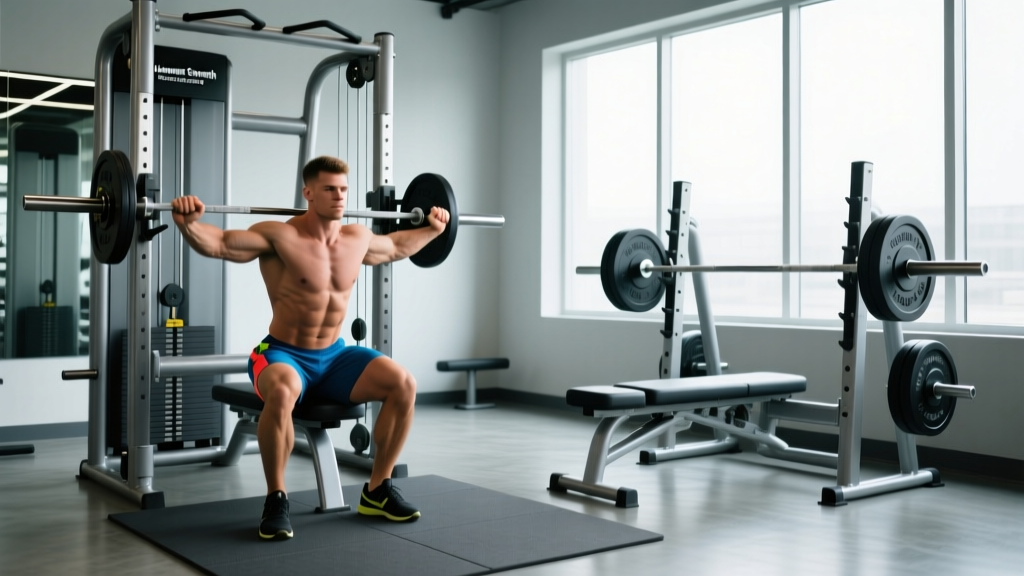
Stabilizer Recruitment vs. Prime Mover Isolation
The barbell bench press requires significant stabilization from the rotator cuff, serratus anterior, and core musculature. This makes it highly functional for athletic carryover. The Hammer Strength machine removes this stabilization requirement, allowing the lifter to push closer to absolute muscular failure safely.
Safety, Spotting, and Solo Training
Training to failure is a proven driver of hypertrophy, but doing so on a flat barbell bench without a spotter carries a high risk of cervical or thoracic injury if the barbell rolls or drops.
The Hammer Strength Iso-Lateral Chest Press features a 1000 lb weight capacity and independent weight horns. If a lifter fails a repetition, they can simply release the handles or let one side down independently without risking being crushed. This makes it the undisputed champion for high-intensity solo training sessions.
Equipment Cost and Rack Space Value
When building a gym in 2026, floor space and capital expenditure are critical factors. A standard Olympic barbell and flat bench setup costs roughly $800 USD and integrates seamlessly into a standard power rack.
A commercial-grade Hammer Strength Iso-Lateral Chest Press typically ranges from $3,500 to $5,500 USD on the secondary market and requires a dedicated 4x4 foot footprint. However, it provides immediate utility without requiring additional safety arms or spotter personnel.
Decision Framework: Which Should You Buy?
| Factor | Barbell Bench Press | Hammer Strength Chest Press |
|---|---|---|
| Primary Goal | Maximal strength, Powerlifting | Hypertrophy, Bodybuilding |
| Solo Safety | Low (Requires safety pins/spotter) | High (Independent release) |
| Footprint | Integrates into existing rack | Standalone 4x4 foot space |
| Learning Curve | High (Requires technique mastery) | Low (Fixed guided path) |
| Avg. Cost (USD) | $800 - $1,200 | $3,500 - $5,500 |
Frequently Asked Questions
Is Hammer Strength chest press as good as bench press?
It depends on the metric. For building raw, functional pushing power and competing in the International Powerlifting Federation, the barbell bench press is mandatory. For maximizing chest muscle size and safely training to failure without a spotter, the Hammer Strength chest press is equally effective and often superior.
Hammer Strength vs barbell bench for muscle growth?
A 12-week hypertrophy study demonstrates that both modalities build muscle effectively when volume is equated. However, the Hammer Strength machine allows for greater isolation of the pectoralis major because the lifter does not need to expend energy stabilizing the load, leading to higher quality repetitions near failure.
Can I replace bench press with Hammer Strength?
Yes, if your goal is strictly physique development or general fitness. If you are an athlete requiring horizontal pushing power that transfers to sports, or a powerlifter, you cannot entirely replace the barbell bench press, as the machine does not train the necessary stabilizer muscles.
Conclusion
Choosing between the Hammer Strength Iso-Lateral Chest Press and the traditional barbell bench press requires aligning your equipment with your primary training objective. The barbell builds raw, stabilized strength, while the Hammer Strength machine delivers unparalleled isolation and solo-training safety for hypertrophy. To finalize your setup, measure your available floor space and allocate your budget accordingly: buy a power rack and barbell for powerlifting, or invest in the Hammer Strength machine for dedicated bodybuilding.
More gear to consider
All reviews
Plate Loaded Incline Chest Press Machine & Fly Equipment Trends

Budget Breakdown: How to Use Chest Press Machine & Pec Deck

Chest Press Machine Weight Guide: Types & 2026 Comparison
Incline, Decline, Flat Bench vs Chest Press Machine Maintenance

Chest Press Machine Types Compared: 2026 In-Depth Buyer Guide
