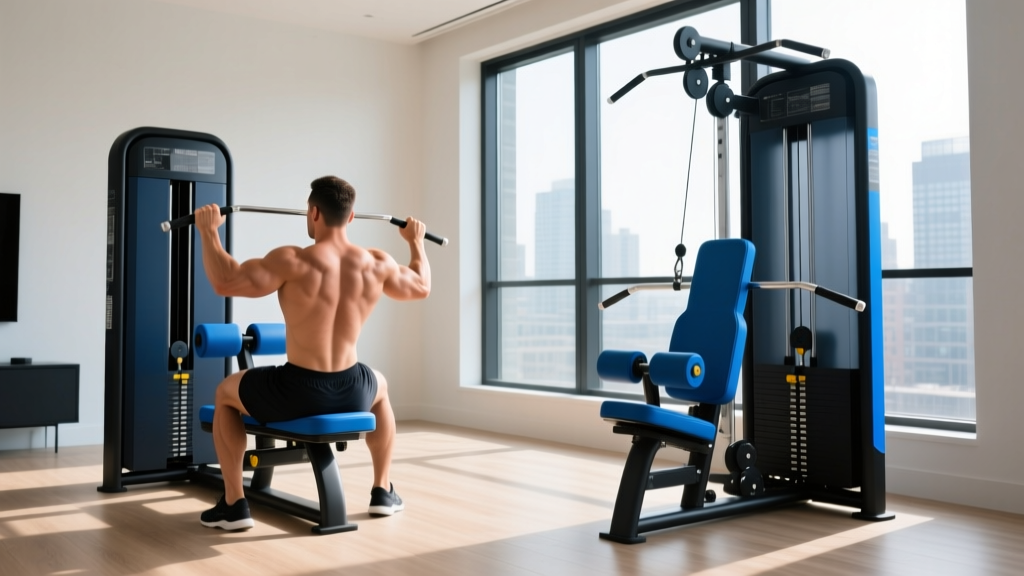
Rogue Lat Pulldown Machine Layouts & Chest Supported Row Options
Optimize your home gym layout by comparing the Rogue lat pulldown machine footprint with the best space-saving chest supported row options.

The Footprint Dilemma: Cable Stacks vs. Plate-Loaded Rows
Designing a high-performance home gym in a limited square footage environment requires ruthless spatial efficiency. When building a complete back-training arsenal, most lifters prioritize a vertical pulling movement and a horizontal row. The rogue lat pulldown machine (specifically the Monster Lat Pulldown/Low Row) is widely considered the gold standard for cable-based back training in 2026. However, its functional footprint and required user clearance often dictate the layout of the entire room.
If you want to maximize hypertrophy and strict isolation, relying solely on a seated cable low row is a biomechanical compromise. You need strict torso stabilization, which brings us to chest supported row machine options. But how do you fit a dedicated chest-supported row station into a garage gym already dominated by an 84-inch cable tower? This guide breaks down exact measurements, clearance requirements, and layout matrices to seamlessly integrate both pieces of equipment without turning your gym into an obstacle course.
Analyzing the Rogue Lat Pulldown Machine Footprint
Before integrating secondary equipment, we must establish the spatial anchor. According to the official Rogue Fitness specifications, the Monster Lat Pulldown/Low Row is a beast of engineering, but it demands respect in your floor plan.
📐 Rogue Monster Pulldown Spatial Data:- Base Frame Footprint: 22.5" (Depth) x 36" (Width)
- Functional Depth (with seat & low row): 53"
- Height: 84" (Requires standard 8-foot ceiling clearance)
- Weight Stack: 250 lbs or 350 lbs (Selectorized)
- Minimum User Clearance: 48" in front of the seat for full lat depression and knee clearance.
While the physical steel only occupies about 5.6 square feet, the functional footprint—including the seat track and the space required for a user to perform kneeling cable crunches or wide-grip pulldowns—pushes the total dedicated zone to roughly 18 square feet. This leaves a specific geometric puzzle for placing your chest supported row machine options.
Top Chest Supported Row Machine Options for Tight Spaces
To complement the Rogue pulldown, you need a horizontal pull that eliminates lower-back momentum. Based on 2026 market availability and spatial efficiency, here are the top three configurations.
1. The Zero-Footprint Route: Rack-Integrated Attachments
If your Rogue pulldown is placed adjacent to a power rack, the most space-efficient chest supported row machine option is a rack attachment. The Rep Fitness PR-4000 Chest Supported Row Attachment (approx. $299) or the Rogue Monster Chest Supported Row Attachment (approx. $450) mounts directly to your existing uprights.
- Pros: Zero additional floor space required; adjustable pad heights; easily removable to free up the rack for squats.
- Cons: Ties up your power rack; limits simultaneous use if you share the gym with a training partner.
- Clearance Needed: 36" in front of the rack for the user's body angle.
2. The Compact Standalone: Titan Fitness Plate-Loaded Chest Row
For those who want a dedicated station without the $3,000+ price tag of commercial selectorized machines, the Titan Fitness Plate-Loaded Chest Supported Row ($499) is a staple. It utilizes a pivot-arm design that mimics the arc of a high-end Hammer Strength machine.
- Base Footprint: 45" (L) x 32" (W)
- Failure Mode Warning: Many home gym owners place this flush against a wall. You must account for Olympic plate diameter. A standard 45lb bumper plate is 17.5" in diameter. You need at least 20" of lateral clearance on both sides of the machine to load and unload plates safely without scraping your drywall.
3. The Premium Selectorized: Prime Fitness ProMaxx Chest Row
If budget is secondary to space and convenience, the Prime Fitness ProMaxx Chest Supported Row ($3,800+) offers dual independent converging arms and a selectorized stack. While its footprint (54" x 34") is similar to the plate-loaded options, it eliminates the need for lateral plate-loading clearance, allowing you to push the machine much closer to side walls or corners.
Layout Matrix: Integrating Rows with the Rogue Pulldown
How do these machines interact in a standard 12x12 or 10x20 garage gym? Below is a spatial integration matrix to help you plan your 2026 gym layout.
| Equipment Configuration | Total Functional Zone | Wall Placement Strategy | Best For... |
|---|---|---|---|
| Rogue Pulldown + Rack Attachment | ~28 sq ft (Combined) | Rack and Pulldown on same wall, 6ft apart. | Single-car garages; minimalist layouts. |
| Rogue Pulldown + Plate-Loaded Row | ~32 sq ft (Separate) | Opposing walls or 90-degree L-shape corner. | Lifters who prefer dedicated stations and plate loading. |
| Rogue Pulldown + Selectorized Row | ~26 sq ft (Separate) | Side-by-side with shared central user clearance. | Premium home gyms; partner training setups. |
Biomechanics and Space: Why You Might Need Both
Why go through the spatial hassle of adding a chest supported row machine when the Rogue lat pulldown machine already features a low-row cable attachment? The answer lies in strict isolation and spinal erector fatigue.
According to biomechanical analyses documented by ExRx and strength conditioning literature, seated cable rows require significant isometric contraction of the spinal erectors to maintain an upright torso. If you are performing heavy barbell deadlifts or bent-over rows earlier in your week, your lower back may become the limiting factor in your horizontal pulling volume. A chest-supported pad completely removes the axial loading and stabilization requirement from the lower back, allowing you to take the rhomboids, mid-traps, and lats to true muscular failure safely. Sacrificing 10 square feet of floor space for this level of targeted hypertrophy is a highly efficient trade-off for intermediate and advanced lifters.
⚠️ Layout Warning: The "Dead Zone" TrapDo not place your Rogue pulldown in a corner facing outward, and then place a plate-loaded chest row directly behind it. The user clearance for the pulldown (48") and the loading clearance for the row (20" per side) will create an overlapping "dead zone" of nearly 40 square feet where no other equipment can be placed. Always anchor heavy machines to the perimeter walls facing inward.
Actionable Garage Gym Floor Plans
To finalize your space optimization, consider these two proven layouts for integrating the Rogue pulldown and a chest row:
The "Shared Corridor" L-Layout
Place the Rogue lat pulldown machine on the back wall, slightly off-center. Place a standalone chest supported row machine on the adjacent side wall, angled so the user faces the center of the room. By angling the machines at roughly 45 degrees toward each other, the 48-inch user clearance zones overlap into a single shared corridor. This saves approximately 15% of your total floor space compared to placing them on opposing walls.
The "Rack-Integrated" Perimeter Layout
Push your power rack against the side wall. Mount the chest supported row attachment to the rear uprights of the rack. Place the Rogue pulldown on the same side wall, 6 feet away. This keeps all back-training equipment on a single linear plane, leaving the entire center of the garage completely open for Olympic lifting, sled pushes, or mobility work.
Frequently Asked Questions
Can I bolt the Rogue Lat Pulldown to the floor to save space?
The Rogue Monster Lat Pulldown is incredibly heavy (over 600 lbs with the weight stack) and features a wide stabilizer base. While it doesn't strictly require floor bolting for stability during standard use, bolting it prevents "walking" during heavy kneeling cable exercises. However, bolting does not reduce its physical footprint or user clearance requirements.
What is the ceiling height requirement for these layouts?
The Rogue pulldown stands at 84 inches (7 feet). If you are installing overhead storage racks or garage door tracks, ensure you have at least 88 inches of clearance to allow for assembly, maintenance access to the top pulley, and the installation of optional top-mounted lat bars.
Are folding wall-mounted chest rows a viable space-saving option?
As of 2026, true folding chest-supported rows that maintain biomechanical integrity and safety are rare and often suffer from hinge-play (wobbling during heavy sets). Rack-mounted attachments remain the superior choice for space-saving horizontal pulls over wall-folding novelty units.
More gear to consider
All reviews
Equip vs Treadmill: A Real-World Comparison for Home Fitness Investment

Best Back Massager Gun for Home Gym Recovery 2026

Hyperextension Bench Mistakes & Better Back Workouts with Dumbbells

Chest Supported Row and Lat Pulldown Machine Exercise Space Guide

Space-Saving Chest Supported Row & Lat Pulldown Low Row Machine