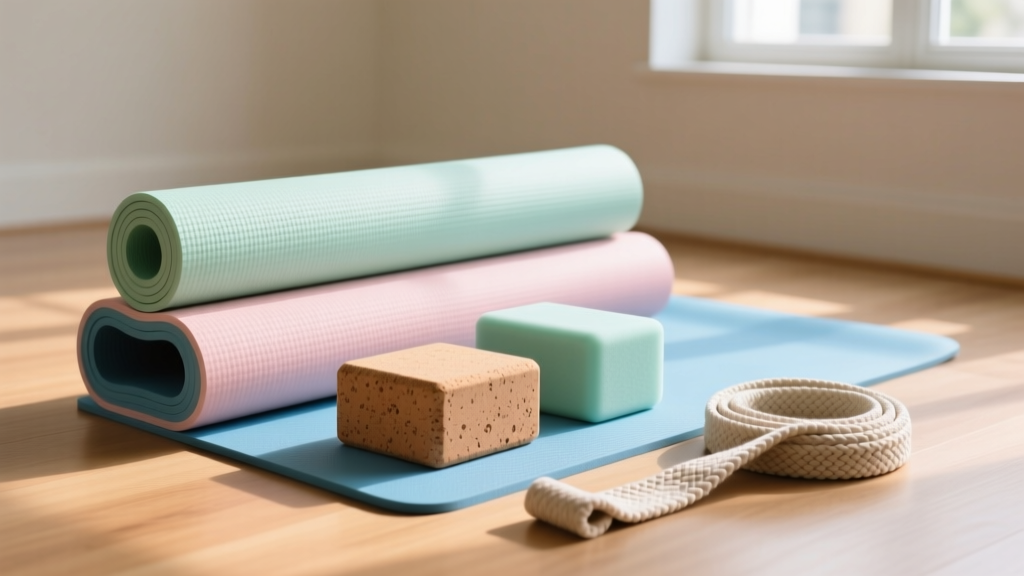
Yoga Block, Strap & EVA Yoga Mat Budget Guide 2026
Discover the true cost-per-use of yoga blocks, straps, and EVA yoga mats. Our 2026 budget breakdown reveals which props offer the best long-term value.

The True Cost of Yoga Props: Beyond the Sticker Price
Building a functional home yoga practice requires more than just open floor space; it demands the right structural support. When beginners set out to purchase their first set of props, they often fall into the trap of prioritizing aesthetics over material science, ultimately overspending on gear that degrades within months. In 2026, the market is saturated with ultra-cheap, low-density foam accessories that fail under consistent biomechanical load. To make a smart investment, we must look beyond the initial price tag and evaluate the cost-per-use, material density, and failure modes of essential gear.
This comprehensive budget breakdown focuses on the holy trinity of beginner and intermediate yoga props: blocks, straps, and the foundational EVA yoga mat. By analyzing exact material specifications, hardware longevity, and real-world degradation timelines, this guide will help you build a starter kit that offers genuine value without compromising your alignment or safety.
The Baseline: Evaluating the EVA Yoga Mat
While blocks and straps are the primary focus of this guide, they are used upon a foundation. For budget-conscious practitioners, that foundation is almost always an EVA foam mat. Ethylene-Vinyl Acetate (EVA) is a closed-cell foam that provides decent initial cushioning and is lightweight, making it the undisputed king of the sub-$30 category.
Material Science and Failure Modes
When evaluating a standard yoga mat EVA construction, density is the most critical metric. Most budget mats on the market sit at a density of 60 to 80 kg/m³. While this feels plush in the showroom, it suffers from a high 'compression set'—meaning the foam does not fully rebound after sustained pressure. If you practice Pigeon Pose or low lunges daily, a low-density EVA mat will develop permanent knee and heel divots within 3 to 6 months.
- Budget EVA (60-80 kg/m³): Priced between $15 and $22. Expected lifespan of 4-6 months with daily use. High compression set.
- High-Density EVA (100-120 kg/m³): Priced between $25 and $35. Offers significantly better joint support and a lifespan of 12-18 months.
- The Upgrade Path (TPE or PVC): If your budget allows for $60+, transitioning to TPE (Thermoplastic Elastomer) or PVC (like the Manduka PROlite) eliminates the compression set issue entirely, offering a 5-to-10-year lifespan.
Expert Insight: Never compromise on mat density for the sake of saving $10. A degraded EVA mat alters your micro-alignments in standing poses, forcing your stabilizing muscles to overcompensate and potentially leading to ankle or knee strain over time.
Yoga Blocks: Material Matrix & Value Analysis
According to alignment principles outlined by Yoga Journal, using blocks is not a sign of inflexibility; it is a vital tool for bringing the floor closer to you, ensuring proper spinal alignment and preventing overstretching. The standard block dimension is 9" x 6" x 4", but the material composition drastically alters the price, weight, and tactile feedback.
The 2026 Block Material Comparison Matrix
| Material | Avg. Price (2026) | Weight (Per Block) | Durability & Grip | Best For |
|---|---|---|---|---|
| Standard EVA Foam | $8 - $12 | 4.5 oz | Low durability, slippery when sweaty | Travel, restorative yoga, strict budgets |
| High-Density EVA | $14 - $18 | 8.2 oz | Medium durability, textured grip | Beginners needing lightweight support |
| Natural Cork | $20 - $26 | 1.8 lbs | Exceptional durability, naturally antimicrobial, high grip | Iyengar, Ashtanga, hot yoga, long-term value |
| Bamboo / Wood | $28 - $35 | 2.2 lbs | Indestructible, zero grip (slippery with sweat) | Studio owners, extreme stability needs |
The Value Verdict on Blocks
If you are strictly capping your budget, a pair of high-density EVA blocks ($28 total) is the most logical entry point. However, from a pure value perspective, Cork blocks are the undisputed winners. A $22 cork block will easily outlast a decade of daily practice. Furthermore, cork's natural tackiness means your hands won't slip in Downward Dog or Half Moon Pose, a common failure mode of smooth EVA foam blocks when exposed to humidity or sweat.
Yoga Straps: Hardware, Weave, and Longevity
The American Council on Exercise (ACE) highlights that assisted stretching with props like yoga straps can significantly improve hamstring and shoulder flexibility by allowing the nervous system to safely adapt to new ranges of motion. Yet, straps are often treated as an afterthought, leading to frustrating hardware failures mid-stretch.
Sizing and Material: Cotton vs. Nylon
Straps generally come in 8-foot and 10-foot lengths. Unless you are over 6 feet tall or have exceptionally broad shoulders, an 8-foot strap is the optimal choice; a 10-foot strap creates excess tail that drags on the mat and tangles during transitions.
- Cotton Weave ($12 - $16): The gold standard for value. Cotton absorbs moisture, providing a tactile grip that prevents the strap from sliding through your fingers during intense hamstring stretches. It is soft on the hands and won't cause friction burns.
- Nylon Weave ($8 - $11): Highly durable and resistant to fraying, but notoriously slick. When your hands sweat, nylon straps tend to slide through hardware, breaking your focus and compromising the stretch.
The Hardware Dilemma: D-Ring vs. Cinch vs. Quick-Release
The hardware at the end of the strap dictates its usability and lifespan.
- D-Ring (Metal): The traditional choice. High-quality zinc-alloy D-rings ($14-$18) offer infinite adjustability and will never break. However, cheap plastic D-rings (often found on sub-$10 Amazon bundles) will snap under the tension of a deep shoulder opener. Always opt for metal.
- Cinch Buckle: Made of plastic or metal, this creates a fixed loop. While easier for beginners to set up quickly, the plastic teeth wear down over time, causing the strap to slip. Metal cinches solve this but add unnecessary weight.
- Quick-Release Clip: A newer innovation for 2026. These allow you to snap the strap into a loop instantly. They are excellent for restorative bindings but introduce a mechanical point of failure that traditional D-rings lack.
Value Pick: An 8-foot unbleached cotton strap with heavy-duty metal D-rings (approx. $14). This combination offers the best grip, zero mechanical failure points, and a lifetime of use.
The 2026 Starter Bundle: Cost-Per-Use Breakdown
To truly understand value, we must calculate the cost-per-use (CPU) over a standard 2-year practice cycle. Assume a dedicated practitioner trains 3 times a week (156 sessions per year, or 312 sessions over two years).
Budget Bundle (The 'Replace-It-Soon' Kit)
- Low-Density EVA Mat ($18) - Replaced every 6 months (4 mats over 2 years = $72)
- Standard EVA Blocks, Pair ($16)
- Nylon Strap with Plastic Cinch ($9)
- Total 2-Year Cost: $97.00
- Cost-Per-Use: $0.31 per session
- Hidden Cost: Frustration with slipping straps and joint pain from compressed mats.
Smart Value Bundle (The 'Buy-It-For-Life' Kit)
- High-Density EVA or Entry TPE Mat ($45) - Lasts 2+ years ($45)
- Natural Cork Blocks, Pair ($42)
- 8ft Cotton Strap with Metal D-Rings ($14)
- Total 2-Year Cost: $101.00
- Cost-Per-Use: $0.32 per session
- Hidden Benefit: Superior grip, perfect alignment, and zero hardware failures. Furthermore, at the end of year 2, the cork blocks and cotton strap still have 90% of their usable lifespan remaining, effectively dropping the CPU to near zero in subsequent years.
The Information Gain: Why the 'Smart' Bundle is Actually Cheaper
While the upfront cost difference is a mere $4, the Smart Value Bundle's cost-per-use plummets in years 3 through 10. The cork blocks and cotton strap will easily last a decade. If you practice for 5 years (780 sessions), the blocks and strap from the Smart Bundle cost you exactly $0.07 per session over that timeframe, compared to replacing cheap EVA foam blocks every 18 months due to edge-chipping and permanent indentation.
Edge Cases: When to Abandon EVA Entirely
While an EVA yoga mat and EVA blocks are excellent for strict budgets, there are specific edge cases where you must bypass EVA entirely to protect your body:
- Hypermobile Practitioners: If you have joint hypermobility (e.g., Ehlers-Danlos Syndrome), the slight 'squish' of EVA blocks can create micro-instabilities in your wrists during weight-bearing poses like Crow or Handstand. You must use rigid Cork or Bamboo blocks to provide a solid, unyielding base.
- Hot Yoga / Bikram: In rooms heated to 105°F with 40% humidity, standard EVA foam becomes dangerously slick and can emit a strong chemical off-gassing odor. Cork blocks naturally absorb sweat, increasing their grip, while a closed-cell PVC or textured TPE mat is mandatory for safety.
- Heavy-Duty Restorative Props: If you are using blocks to support the full weight of your sacrum in Bridge Pose, low-density EVA blocks will compress and shift. High-density cork ensures the prop stays exactly where you placed it.
Frequently Asked Questions (FAQ)
Can I use a towel instead of a yoga strap?
While a bath towel can serve as a makeshift strap for gentle stretching, it lacks the structural integrity required for deep tension. Towels stretch, bunch up, and cannot be securely locked into a loop for shoulder openers or binding poses. A $14 cotton D-ring strap provides consistent, non-elastic tension that is vital for neurological adaptation in flexibility training.
Is it worth buying a yoga block set with a carrying case?
Generally, no. Many budget brands inflate the price of their EVA block sets by $3 to $5 to include a thin, mesh carrying bag. Unless you are walking more than a mile to your studio, this accessory is unnecessary. Block straps exist, but simply carrying your blocks by hand or sliding them into a standard gym duffel is a better use of your budget.
How do I clean cork blocks and cotton straps?
Never submerge cork or cotton in a washing machine. For cork blocks, wipe them down with a damp cloth and a drop of mild dish soap, then let them air dry completely to prevent mold. For cotton straps, spot clean with a mild detergent or hand-wash in a basin of cold water, laying them flat to dry. Avoid harsh chemicals, as they break down the natural fibers and degrade the metal D-rings over time.
More gear to consider
All reviews
Exercise Ball Size Guide & NBR vs TPE Yoga Mat Budget Breakdown

Setup: Gaiam Classic Solid 5mm Yoga Mat & Foam Roller Selection

Block & Strap Buying Guide: Budgets + How to Wash Jade Yoga Mat
Mobility Zone Setup: Foam Roller Density & Yoga Mat Dimensions
Medicine Ball Weight Selection Guide: Budgeting Beyond Yoga Mat Cost
