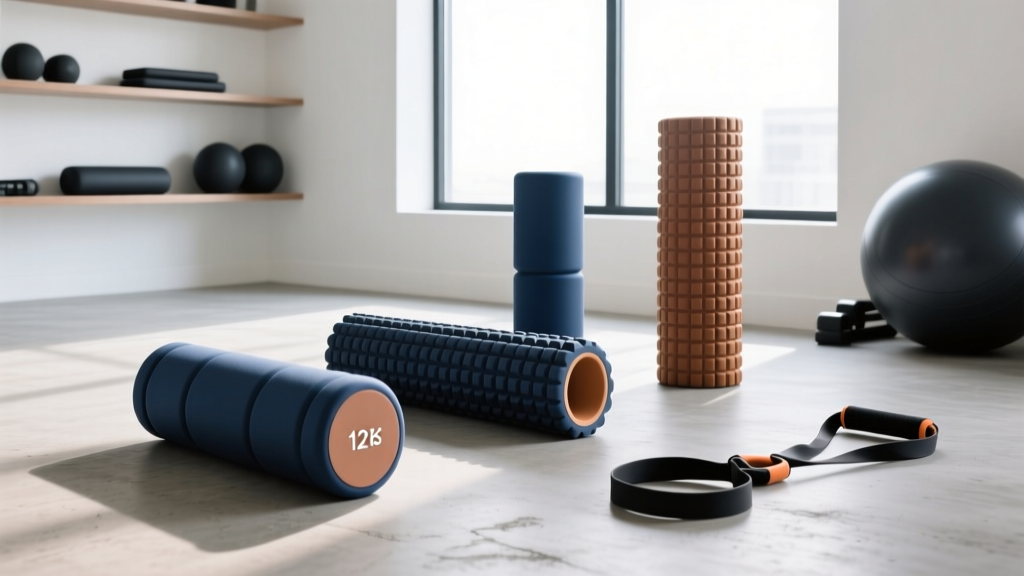
What to Use Instead of a Yoga Mat: Foam Roller Size & Density
Discover what to use instead of a yoga mat for active recovery. Our 2026 guide compares foam roller density, sizes, and materials for optimal mobility.

Rethinking the Floor: Why Ditch the Traditional Yoga Mat?
When athletes and physical therapy clients ask me what to use instead of a yoga mat for their evening mobility and recovery routines, my answer is rarely another mat. Standard 4mm to 6mm PVC or TPE yoga mats are engineered for static friction and light cushioning during asanas. They are fundamentally inadequate for the deep-tissue myofascial release, active joint mobilization, and load-bearing floor work required in modern recovery protocols. According to the National Academy of Sports Medicine (NASM), effective self-myofascial release (SMR) requires precise pressure application that thin yoga mats simply cannot facilitate or support.
Upgrading your floor kit means shifting from passive stretching on a thin mat to targeted, load-bearing foam rolling. But making this transition requires a highly specific understanding of foam roller density and size selection. Choosing the wrong density can lead to nerve impingement, while the wrong size can render your thoracic extensions useless. This 2026 buying guide breaks down the exact material science, dimensional physics, and flooring alternatives you need to build a professional-grade recovery station.
The Science of Compression: Foam Roller Density Selection
Density is the most critical variable in foam roller selection. It dictates the pounds-per-square-inch (PSI) of pressure applied to your fascia and trigger points. In 2026, manufacturers primarily use three material bases, each with distinct cellular structures and Shore C hardness ratings.
1. Soft / Low-Density (EVA Foam)
Soft rollers are typically made from Ethylene-Vinyl Acetate (EVA) and register between 30 to 40 on the Shore C hardness scale. They are designed for beginners, acute injury rehabilitation, or highly sensitive areas like the cervical spine and lateral femoral cutaneous nerve pathways.
- Pros: Forgiving on acute trigger points; excellent for elderly populations or post-operative lymphatic drainage.
- Cons: High degradation rate. The open-cell structure of cheap EVA compresses and suffers 'cell-wall collapse' after 6 to 9 months of daily use, turning into a useless, squishy tube.
- 2026 Price Range: $15 - $25
2. Medium-Density (EPP & Standard EVA Blends)
Expanded Polypropylene (EPP) is the gold standard for medium-density rollers. Unlike EVA, EPP is a closed-cell bead structure fused under high-pressure steam. It registers between 45 to 55 Shore C. It provides the 'sweet spot' of myofascial release: enough firmness to break up fascial adhesions, but enough yield to avoid triggering the stretch reflex (which causes muscles to guard and tighten).
- Pros: Exceptional longevity (3+ years of daily use without deformation); lightweight; ideal for IT band and glute medius work.
- Cons: Lacks the aggressive edge needed for deep calf or plantar fascia release.
- 2026 Price Range: $28 - $45
3. Firm / High-Density (Hollow Core & Polyurethane)
High-density rollers feature an ABS (Acrylonitrile Butadiene Styrene) plastic hollow core wrapped in a thin layer of high-density Polyurethane (PU) or textured EVA. These register at 60+ Shore C. They are designed for elite athletes, heavy lifters, and deep-tissue trigger point therapy.
- Pros: Zero compression under heavy body weight; aggressive grid patterns mimic a massage therapist's thumb; hollow core allows for storage and structural rigidity.
- Cons: Can cause bruising or nerve impingement if used incorrectly on bony prominences.
- 2026 Price Range: $40 - $85 (Vibrating models push $120+)
If you are testing a roller in a store, perform the pinch test. Press your thumb into the foam as hard as you can. If your thumb bottoms out and touches the core (or the opposite side), the roller is too soft for deep tissue work. You want a material that resists the final 20% of your thumb's travel.
Dimensional Physics: Sizing Your Roller for Specific Outcomes
Selecting the right density is only half the battle. The length and diameter of your foam roller dictate your leverage, spinal clearance, and the surface area of the treatment. Research published by the National Institutes of Health (NIH) highlights that improper roller sizing can lead to compensatory movement patterns, negating the benefits of the myofascial release.
Diameter: 4-inch vs. 6-inch vs. 8-inch
The diameter of the roller determines how far your body is elevated from the floor, which directly impacts joint angles and leverage.
| Diameter | Radius / Elevation | Best Use Case | Biomechanical Warning |
|---|---|---|---|
| 4-inch | 2 inches | Targeted work (calves, forearms, neck); travel. | Too low for full thoracic extensions; limits scapular retraction. |
| 6-inch | 3 inches | The versatile standard. IT bands, quads, lats, and full back. | None. This is the optimal biomechanical height for most adults. |
| 8-inch | 4 inches | Pediatric use, or specialized Pilates spinal articulation. | Too high for standard SMR; causes balance issues and lumbar hyperextension. |
Length: Matching the Tool to the Tissue
- 36-inch x 6-inch (The Full-Back Standard): Essential for thoracic extensions and longitudinal latissimus dorsi releases. The 36-inch length ensures your head and pelvis are fully supported when lying vertically along the roller, opening the chest cavity without straining the cervical spine.
- 18-inch x 6-inch (The Unilateral Specialist): Perfect for single-leg work (hamstrings, calves) and lateral movements. It is easier to store and maneuver around the hip capsule.
- 12-inch x 4-inch (The Sniper): Used exclusively for pinpoint trigger point therapy on the TFL, piriformis, or plantar fascia. Do not use this for general back rolling.
Flooring Upgrades: What to Use Instead of a Yoga Mat Under Your Roller
If you are retiring your thin yoga mat, you still need a protective barrier between your roller and the hardwood or concrete floor. Rolling directly on hard floors damages the roller's outer skin and creates deafening acoustic vibration. So, what to use instead of a yoga mat for your new foam rolling station?
The 2026 Flooring Matrix- High-Density Interlocking EVA Tiles (14mm+): The best overall choice. They absorb acoustic shock, protect the roller, and provide enough firmness that the roller doesn't sink in. ($2.50 - $4.00 per sq ft)
- Cork Mobility Mats (5mm - 8mm): Excellent for grip and sustainability. Cork doesn't compress as easily as TPE, providing a stable base for kneeling roller work. ($60 - $120 per mat)
- Firm PU (Polyurethane) Travel Mats: If you must have a rollable mat, choose a 3mm PU mat. It offers superior grip for your hands during plank-to-roll transitions, unlike slippery PVC. ($80 - $150)
Edge Cases and Failure Modes in Foam Rolling
Even with the perfect density and size, improper application leads to failure modes that the American Council on Exercise (ACE) frequently warns against in their continuing education modules.
Failure Mode 1: The Lumbar Hyperextension Trap
Using a 6-inch firm roller horizontally across the lower back (lumbar spine) is a catastrophic error. The lumbar spine lacks the rib-cage structural support of the thoracic spine. Pressing a hard, 6-inch cylinder into the lumbar region forces the spine into hyperextension, potentially aggravating facet joints and spinal discs. Solution: Only use a roller vertically (parallel to the spine) for the lower back, or switch to a 4-inch soft EVA roller for gentle massage.
Failure Mode 2: Nerve Impingement on the IT Band
The Iliotibial (IT) band is not a muscle; it is a thick band of fascia. Rolling it aggressively with a high-density hollow-core roller does not 'break it up'—it compresses the underlying vastus lateralis and can irritate the lateral femoral cutaneous nerve. Solution: Use a medium-density EPP roller and focus on the TFL (tensor fasciae latae) and gluteus medius at the top of the hip, which actually control the tension of the IT band.
Final Verdict: Building Your 2026 Recovery Kit
Answering the question of what to use instead of a yoga mat is about upgrading from passive floor space to an active recovery ecosystem. For 90% of home gym users, the ultimate setup consists of a 36x6-inch medium-density EPP roller for full-body versatility, paired with a 12x4-inch high-density EVA roller for targeted trigger points, all placed atop a 14mm interlocking EVA tile floor. This combination provides the exact biomechanical leverage, tissue-specific pressure, and joint protection that a traditional 4mm yoga mat could never achieve.
More gear to consider
All reviews
Speed vs Weighted Jump Ropes on an Oversized Yoga Mat

Loop vs Tube Bands: Space Layouts & Lululemon Foldable Yoga Mat
Yoga Block & Strap Buying Guide + How to Clean Manduka Yoga Mat

Expert Battle Rope Sizing Guide & How to Clean Cork Yoga Mat

Pilates Accessories Guide: Yogitoes Yoga Mat Towel Review
