
Space-Saving Yoga Block & Strap Guide For Pendelton Yoga Mat
Optimize your home studio layout. Discover how to choose and store yoga blocks and straps to perfectly complement your Pendelton yoga mat in small spaces.

Designing the Micro-Studio: The Spatial Challenge of Yoga Props
As urban living spaces shrink and home wellness routines become permanent fixtures in 2026, the architecture of the micro-studio has evolved. Designing a functional yoga corner in a compact apartment requires intentional spatial planning, especially when your centerpiece is a visually striking Pendelton yoga mat. Known for their heritage-inspired geometric motifs and premium natural rubber or wool-blend constructions, these mats demand a curated aesthetic. However, the true bottleneck in small-space studio design isn't the mat itself—it is the accumulation and storage of essential accessories like yoga blocks and straps.
Most buying guides evaluate blocks and straps solely on grip or tension. From a space optimization perspective, however, we must evaluate them on their volumetric footprint, stackability, vertical storage potential, and visual weight. This guide provides a spatial-first buying framework for selecting yoga blocks and straps that integrate seamlessly into tight floor plans while honoring the bold aesthetic of your Pendelton yoga mat.
The Spatial Footprint: Selecting Blocks for Tight Floor Plans
The standard yoga block measures 9 inches long, 6 inches wide, and 4 inches high, yielding a volume of 216 cubic inches. In a 5x5 foot studio clearance zone, leaving these blocks on the floor creates visual clutter and tripping hazards. Therefore, your material choice directly dictates your storage options.
Cork vs. EVA Foam vs. Bamboo: A Density Analysis
When designing floating shelves or narrow vertical cubbies, the density and weight of the block determine the safety and feasibility of the storage mount.
- Cork Blocks (e.g., Hugger Mugger Standard Cork): Weighing approximately 1.5 to 2 lbs each, cork blocks possess a high density (roughly 15 lbs per cubic foot). This weight allows them to remain stable on narrow, 10-inch deep floating shelves without toppling. Their rigid edges allow for perfect flush-stacking in corners. According to Hugger Mugger's block specifications, natural cork also resists the compression warping that plagues softer materials when stored vertically.
- EVA Foam Blocks (e.g., Manduka Recycled Foam): Weighing under 0.5 lbs, foam blocks are notoriously difficult to store on open, narrow shelving. A slight draft or accidental brush can knock them off. They require contained storage, such as woven baskets or deep cubbies (minimum 14 inches deep), which eats into valuable square footage.
- Bamboo Blocks: While aesthetically pleasing and matching the earthy tones of a Pendelton yoga mat, bamboo is rigid and slippery. Stacking them vertically on a shelf without a lip or guard rail is a spatial hazard.
Strap Ergonomics and Vertical Storage Integration
Yoga straps take up negligible floor space but present a unique challenge in vertical organization. The hardware attached to the strap dictates its 'coiled diameter,' which in turn determines what type of wall hook or pegboard system you can utilize.
D-Ring vs. Cinch Buckles: The Coiled Diameter Test
When selecting a strap, refer to the Manduka strap collection for industry-standard dimensions. Most premium straps are 1.5 inches wide and come in 8-foot or 10-foot lengths.
- Cinch Buckle Straps: The plastic or metal cinch mechanism is bulky. When coiled, these straps form a diameter of roughly 5 to 6 inches. They cannot be hung on standard 2-inch pegboard hooks and often require specialized, deep-cradle wall mounts or drawer storage.
- D-Ring Straps: The dual metal D-rings lay relatively flat. When folded and rolled tightly, an 8-foot D-ring strap achieves a compact coil diameter of about 3 inches. This allows you to hang them on shallow wall hooks, slide them into wall-mounted mail organizers, or loop them over the edges of your floating shelves.
Aesthetic Note: To maintain the premium look of your Pendelton yoga mat setup, opt for unbleached cotton or charcoal-colored D-ring straps. Avoid neon nylon straps, which introduce visual noise and disrupt the grounded, earthy layout of a heritage-styled studio corner.
Layout Matrix: Staging Your Pendelton Yoga Mat & Props
Integrating your accessories into your daily flow requires understanding the spatial envelope of your practice. A standard Pendelton yoga mat measures 72 inches by 24 inches. The American Council on Exercise (ACE) recommends a minimum clearance of 2 feet on all sides of a mat for safe limb extension. Below is a spatial matrix for prop staging based on your available room dimensions.
| Studio Footprint | Mat Placement | Block & Strap Storage Strategy |
|---|---|---|
| 4x8 ft (Alcove) | Wall-flush, leaving 2ft clearance at the foot. | Over-door hanging organizers for straps; under-mat rolling storage for blocks (requires 5mm+ mat thickness to hide). |
| 5x5 ft (Corner) | Diagonal orientation to maximize limb reach. | Corner-mounted triangular shelving (12-inch depth) to stack cork blocks; straps looped on wall hooks behind the mat's head. |
| 6x6 ft (Dedicated Room) | Centered, allowing 360-degree movement. | Freestanding minimalist wood valet or low-profile floor tray placed at the top-left edge of the mat. |
Vertical Storage Frameworks & Studio Flow
To keep the floor entirely clear for your Pendelton yoga mat, vertical space must be weaponized. Here are the exact specifications for building or buying a prop station in a compact room:
The French Cleat Pegboard System
Standard pegboards (1/4-inch hardboard) are often too flimsy to hold multiple cork blocks and heavy cotton straps without warping. Instead, install a French cleat system with a 3/4-inch plywood backing.
- Hook Spacing: Place heavy-duty steel hooks exactly 8 inches apart to accommodate the 9-inch length of a cork block resting horizontally on two hooks.
- Strap Rails: Mount a 12-inch wooden dowel horizontally 6 inches above the block hooks. Slide your D-ring straps over the dowel for a uniform, gallery-style display that complements the mat's geometric patterns.
Concealed Furniture Integration
If your yoga space doubles as a living room or office, visible props can disrupt the room's design language. Look for storage ottomans or entryway benches with interior dimensions of at least 10 inches deep x 12 inches wide. This specific dimension allows two 9x6x4 cork blocks to lay flat side-by-side, with coiled straps tucked into the remaining 2-inch gap, completely hiding your gear while providing seating.
"The goal of spatial optimization isn't just to hide equipment; it's to reduce the friction of starting your practice. If your blocks and straps are stored in a way that requires three steps to retrieve, your layout has failed. Props should be staged within a single arm's reach of the top corner of your mat."
Expert Troubleshooting: Wear, Tear, and Spatial Degradation
Improper storage in small, unventilated spaces leads to rapid material degradation. Understanding these failure modes will save you money and preserve your studio's aesthetic.
Cork Flaking and Humidity
In small apartments, yoga practice rapidly increases ambient humidity. If cork blocks are stored tightly wedged into a non-ventilated plastic bin, trapped moisture causes the cork to dry out unevenly and flake, leaving debris on your Pendelton yoga mat. Solution: Always store cork on open, wire, or slatted wood shelving to allow 360-degree air circulation.
Foam Compression Warping
If you must use EVA foam blocks and choose to store them in a narrow vertical cubby, never stack more than three high. The bottom block will bear the weight and, over 6 to 8 months, suffer permanent compression warping on the 4-inch edge, ruining its structural integrity for balancing poses. Solution: Store foam blocks horizontally in a single layer on a shelf.
Strap Buckle Rust
Metal D-rings on cotton straps are prone to surface rust if hung in a bathroom-adjacent studio or a room with poor HVAC flow. Rust will quickly transfer to the light-colored borders of a Pendelton yoga mat. Solution: Invest in straps with marine-grade stainless steel D-rings or anodized aluminum hardware, and avoid hanging them on exposed brick walls which retain ambient moisture.
Final Verdict: Curating the Compact Studio
Equipping a small-space studio is an exercise in restraint and precision. By selecting dense, stackable cork blocks and low-profile D-ring cotton straps, you eliminate floor clutter and create a streamlined vertical storage system. More importantly, by choosing natural materials and muted earth tones, you ensure that your accessories act as subtle, supportive anchors rather than visual distractions, allowing the intricate, heritage-inspired design of your Pendelton yoga mat to remain the undeniable focal point of your daily practice.
More gear to consider
All reviews
Manduka GRP Adapt Yoga Mat 5mm Jump Rope Setup Walkthrough

Pilates Accessories Guide: Market Trends & Clean Yoga Mat Spray
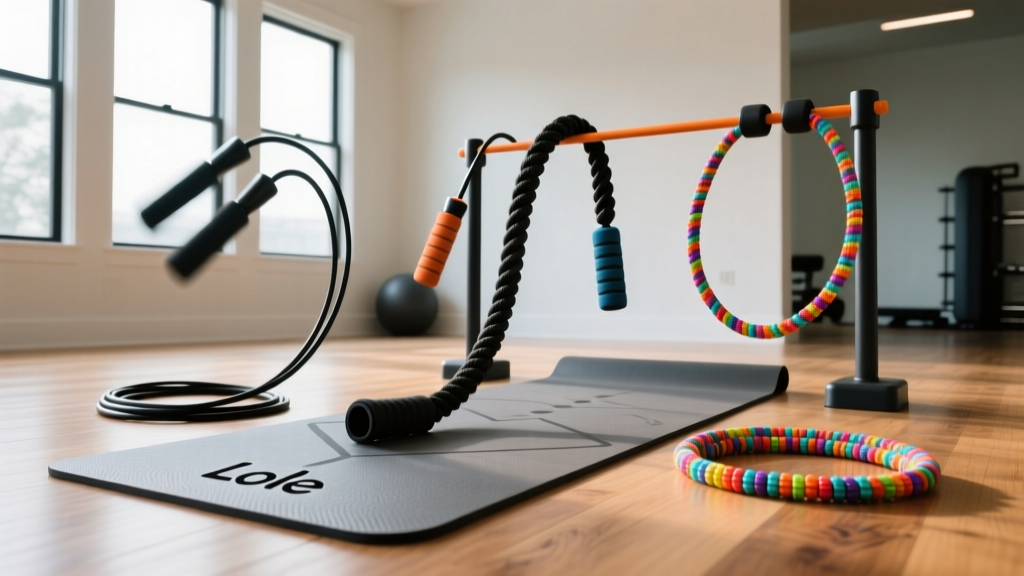
Jump Rope Setup: Speed, Beaded Ropes & Lole Yoga Mat Costco Hacks

Beyond the Gaiam Yoga Mat Review: Block & Strap Buying Guide

Medicine Ball Weight Guide: Pairing With a Standard Yoga Mat
