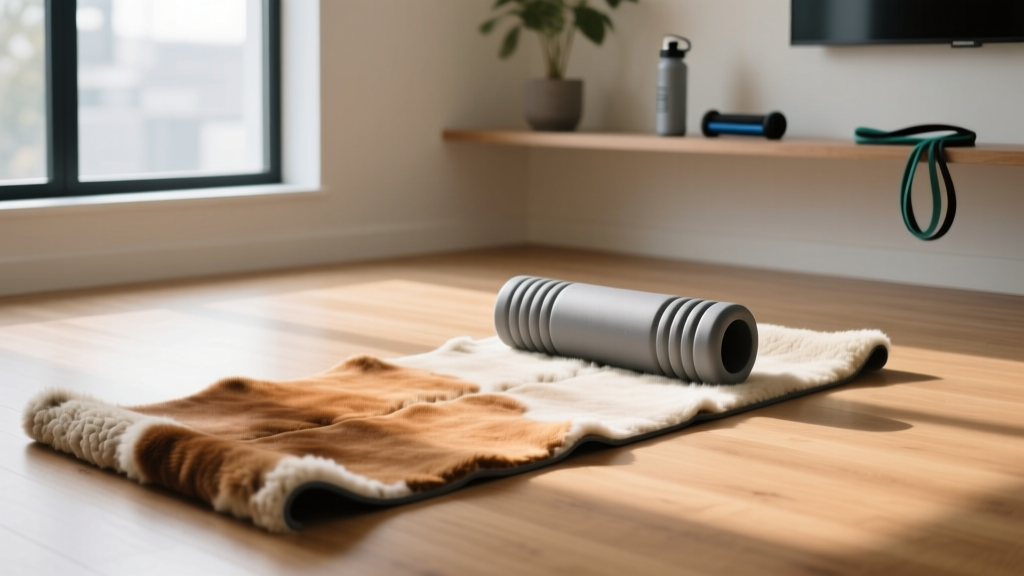
Sheepskin Yoga Mat Setup & Foam Roller Selection Walkthrough
Master your home recovery space. This walkthrough covers sheepskin yoga mat installation, care, and precise foam roller density and size selection.

Setting up a dedicated somatic recovery and mobility zone requires more than just throwing a standard PVC mat on the floor. As the home-wellness market has evolved through 2026, practitioners are increasingly upgrading to premium natural materials and clinical-grade myofascial tools. When integrating a luxurious sheepskin yoga mat with targeted foam rolling equipment, 'installation' becomes a deliberate process of environmental calibration, material science, and biomechanical planning.
This comprehensive walkthrough will guide you through the exact setup of your recovery space, focusing heavily on the critical subtopic of foam roller density and size selection to ensure your new equipment works in perfect synergy.
Phase 1: Site Selection and Sheepskin Mat Installation
Unlike synthetic TPE or rubber mats, a genuine sheepskin yoga mat (typically priced between $160 and $290 for medical-grade Merino) is a natural, breathable textile that requires specific environmental controls. Proper installation ensures the leather backing grips correctly and the fleece maintains its natural lanolin.
Step 1: Environmental Calibration
Before unrolling your mat, assess the room's microclimate. Sheepskin is highly sensitive to direct ultraviolet light and artificial heat sources. Install your mat in a zone that avoids direct afternoon sun exposure and is at least four feet away from HVAC vents or radiators. Prolonged heat exposure will dry out the leather hide, leading to micro-tears and a loss of natural floor grip.
Step 2: The Acclimation and Shedding Period
When you first unbox a premium sheepskin mat, expect a moderate shedding phase. This is not a defect; it is the natural release of loose fibers from the tanning process.
- Days 1-7: Take the mat outside and give it a vigorous shake daily. Use a specialized wire-bristle sheepskin brush to gently comb the fleece in the direction of the hair grain.
- Days 8-14: Shedding will reduce by approximately 80%. You can now move the mat to its permanent indoor installation site.
Step 3: Floor Coupling
The suede or leather backing of a high-quality sheepskin mat provides exceptional natural traction on hardwood and bamboo floors. However, dust acts as a ball bearing, destroying this grip. Before laying the mat down, use a slightly damp microfiber cloth to wipe the installation footprint. Lay the mat down and press firmly along the edges to engage the hide with the floor surface.
Phase 2: Foam Roller Density and Size Selection
With the foundation laid, the next critical phase of your setup is selecting the correct foam roller. Using the wrong density can either fail to penetrate deep fascial adhesions or cause acute nerve compression. According to a comprehensive meta-analysis published by the National Center for Biotechnology Information (NCBI), the efficacy of self-myofascial release (SMR) is heavily dependent on applying the correct mechanical load to the tissue, which is dictated by your roller's material density.
Decoding Foam Density Metrics
Foam rollers are primarily constructed from two types of foam: EVA (Ethylene-Vinyl Acetate) and EPP (Expanded Polypropylene). Understanding the Indentation Load Deflection (ILD) and density (measured in pounds per cubic foot, or lbs/ft³) is crucial for matching the tool to your pain tolerance and tissue density.
| Material / Type | Density (lbs/ft³) | Firmness Level | Best Use Case | Deformation Rate |
|---|---|---|---|---|
| White EVA Foam | 1.0 - 1.5 | Soft | Beginners, acute injury rehab, Pilates spinal support | High (flattens after 3-6 months) |
| Black/Blue EVA Foam | 2.0 - 2.5 | Medium | General fitness, daily warm-ups, moderate trigger point work | Medium (lasts 1-2 years) |
| Solid EPP Foam | 3.0 - 4.5 | Firm | Deep tissue work, dense muscle groups (quads, glutes), athletes | Very Low (retains shape for years) |
| Hollow-Core (ABS + EVA) | N/A (Variable wrap) | Extra Firm / Grid | Targeted knot disruption, mimicking massage therapist thumbs | Low (core is rigid plastic) |
Expert Insight: If you are transitioning from a soft white roller to a firm EPP roller, do not jump straight into deep spinal or cervical work. The sudden increase in mechanical pressure can trigger a stretch reflex, causing the muscle to tense up rather than release.
Dimensional Selection: 12", 24", and 36"
Size dictates biomechanical utility. Your recovery zone should ideally house at least two different sizes to cover all movement planes.
- The 36-Inch Roller (The Anchor): This is non-negotiable for thoracic extension and full-body longitudinal alignment. A 36-inch roller allows you to lie vertically with your spine fully supported from the sacrum to the occipital bone. This is essential for counteracting the kyphotic posture developed during desk work.
- The 24-Inch Roller (The Workhorse): Ideal for targeting the latissimus dorsi, IT bands, and calves. It provides enough surface area to maintain balance while rolling laterally, but is compact enough to store in a closet or under a bed.
- The 12-Inch Roller (The Scalpel): Used for highly isolated work. Because it requires more balance, it is best utilized for targeting the tensor fasciae latae (TFL), piriformis, and the peroneal muscles on the outside of the lower leg.
Phase 3: Spatial Integration and Protective Workflows
Integrating hard myofascial tools with a delicate sheepskin mat requires a specific workflow to prevent damaging the fleece. The friction generated by dragging a textured hollow-core roller across Merino wool will cause severe matting and tearing.
⚠️ CRITICAL SETUP WARNING: Never perform active rolling directly on the sheepskin surface. The abrasive nature of EVA/EPP textures will permanently felt the wool fibers. Instead, designate a 'hard zone' adjacent to the mat for rolling, or use a secondary, thin travel mat (like a 2mm TPE foldable mat) as a protective barrier over the sheepskin when using high-friction tools.According to Healthline's guidelines on foam rolling, proper technique involves slow, controlled movements—roughly one inch per second. When setting up your space, ensure you have at least a 4-foot clearance radius around your mat to allow for the full extension of your limbs while utilizing the 36-inch roller on the adjacent hard floor.
Phase 4: Long-Term Maintenance and Edge Cases
A properly installed recovery zone requires ongoing maintenance to preserve the integrity of both natural and synthetic materials.
Sheepskin Mat Care Protocol
Unlike synthetic mats that can be sprayed with harsh chemical disinfectants, sheepskin relies on its natural lanolin for antimicrobial resistance.
- Daily: Air out the mat by folding it fleece-to-fleece and leaving it in a well-ventilated area for 15 minutes post-practice.
- Monthly: Spot clean the leather backing with a damp cloth. If the fleece becomes matted from sweat, use a specialized wool wash (like Eucalan) and cold water, never machine wash or tumble dry. For more detailed cleaning methodologies, refer to the Yoga Journal's mat care archives.
Foam Roller Failure Modes
Inspect your EVA rollers every six months for 'permanent compression set.' If the foam no longer rebounds to its original cylindrical shape and feels flat on one side, it has lost its structural ILD and must be replaced. EPP rollers rarely deform but can develop micro-fractures if left in freezing temperatures (e.g., in a car trunk during winter) and then subjected to heavy body weight.
Frequently Asked Questions
Can I use a sheepskin mat for hot yoga?
No. Sheepskin is highly absorbent and insulating. In a hot yoga environment (95°F+ with high humidity), the mat will become saturated, heavy, and the leather backing may degrade or develop mildew. Reserve sheepskin for restorative, Yin, or somatic floor work.
Which foam roller density is best for sciatica relief?
For sciatica and piriformis syndrome, avoid firm EPP rollers directly on the glutes, as this can compress the sciatic nerve against the pelvis. Use a medium-density EVA roller (approx. 2.0 lbs/ft³) or a 12-inch soft roller to gently release the surrounding musculature without aggravating the nerve root.
How do I store the setup when not in use?
Roll the sheepskin mat with the fleece facing inward to protect it from dust and UV light. Store it in a breathable cotton canvas bag—never in a sealed plastic bin, which traps moisture and ruins the hide. Stand your foam rollers vertically in a corner or mount them on a specialized wall rack to prevent flat-spotting.
More gear to consider
All reviews
How to Use a Yoga Mat Strap to Size Speed, Weighted & Beaded Ropes

BOSU vs Stability Ball: Space Layouts & Gaiam Essentials Yoga Mat

Medicine Ball Weight Selection vs Traditional Yoga Mat: Core Face-Off

Guns Equip Weights Essentials: A Field-Tested Guide to Load Distribution, Gear Selection, and Real-World Performance

Medicine Ball Weight Selection & Yoga Mat Cleaning Solution Guide
