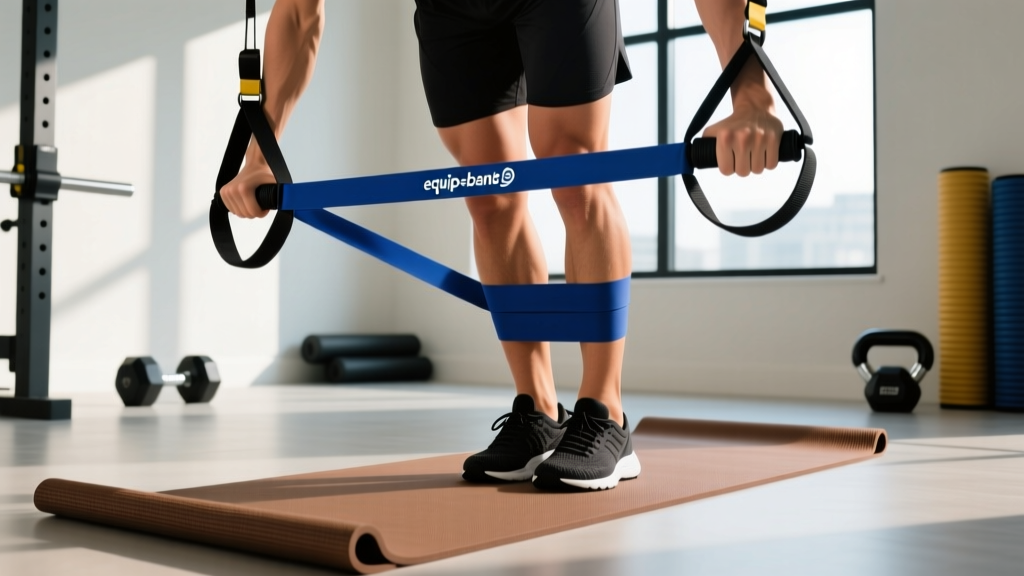
Pull-Up Assist Band Sizing: Pairing with Ideal Yoga Mat Thickness
Master pull-up assist band sizing and selection. Discover resistance curves, pricing, and how to pair bands with the ideal yoga mat thickness for your home gym.

The Complete Pull-Up Station: Bands, Biomechanics, and Floor Dynamics
Mastering the pull-up is a universal fitness milestone, but the bridge between your first dead-hang and your first unassisted rep is rarely a straight line. Enter the pull-up assist band. Unlike static weight stacks, continuous loop bands provide accommodating resistance, offering maximum assistance at the bottom of the movement (where you are weakest) and tapering off at the top (where you are strongest). However, building a truly functional home gym pulling station requires more than just hanging rubber from a rig. It requires a holistic approach to your floor space, specifically factoring in yoga mat thickness for the inevitable accessory work, mobility drills, and safe dismounts that accompany serious pull-up training.
In this 2026 comprehensive guide, we break down the exact science of pull-up assist band sizing, material degradation, and how to pair your vertical pulling setup with the correct floor interface.
The Biomechanics of Pull-Up Assist Band Sizing
The most common mistake lifters make is buying a single, overly thick band that turns the pull-up into a trampoline launch. Proper sizing requires understanding the resistance curve. Standard continuous loop bands are universally 41 inches (104 cm) in circumference and 4.5mm thick. The variable is the width, which dictates the poundage of assistance.
According to principles outlined by the American Council on Exercise (ACE), variable resistance tools alter the strength curve, meaning a band rated for '50 lbs of assistance' only provides that exact load at a specific percentage of elongation. At the bottom of a standard pull-up, a 41-inch band is stretched to roughly 150% of its resting length, delivering peak upward force.
Standard Band Sizing & Resistance Matrix
| Band Color (Industry Std) | Width | Resistance Range | Ideal User Profile |
|---|---|---|---|
| Red | 1/4" (6.4mm) | 15 - 35 lbs | Advanced athletes needing a slight warm-up stimulus or micro-loading. |
| Black | 1/2" (12.7mm) | 30 - 65 lbs | Intermediate lifters bridging the gap to their first unassisted reps. |
| Purple | 3/4" (19.0mm) | 40 - 80 lbs | Novices building initial lat strength and grip endurance. |
| Green | 1" (25.4mm) | 50 - 125 lbs | Heavier athletes or those focusing on deep mobility and stretching. |
| Blue | 1 1/4" (31.7mm) | 65 - 175 lbs | Rehabilitation, extreme assistance, or heavy anchor-point resistance. |
Never rely on a single band. As your strength increases, the jump from a 1-inch Green band to a 3/4-inch Purple band represents a massive 40+ lb drop in assistance. The optimal strategy is to purchase two bands (e.g., a Black and a Purple). You can use them together for heavy assistance, or isolate them as you progress, saving you money and providing a smoother strength curve.
Material Science: Latex vs. Synthetic and Failure Modes
The vast majority of premium assist bands on the market, including the industry-standard Rogue Monster Bands, are manufactured from 100% natural layered latex. This layered process (dipping a mold repeatedly) creates a continuous loop with no glued seams, which is vital for safety.
However, natural latex is highly susceptible to specific failure modes:
- Ozone Degradation: Exposure to UV light and ozone causes the rubber polymers to break down, leading to 'dry rot.' A band left on an outdoor pull-up rig will snap within weeks.
- Lathe Tearing (Micro-Fissures): Inspect the inner edge of the band. If you see microscopic horizontal lines, the structural integrity is compromised. A snapping 1-inch band under 120 lbs of tension generates enough kinetic energy to cause severe welts or eye injuries.
- Oil Breakdown: Contact with petroleum-based cleaning agents or certain massage oils will melt the outer latex layers, turning them gummy and weak.
The Ground Game: Why Yoga Mat Thickness Matters for Band Work
While your eyes are fixed on the pull-up bar, your training ecosystem extends to the floor. When you dismount a heavy band-assisted pull-up, or when you transition into banded pull-aparts, face-pulls, and kneeling mobility drills, the floor interface becomes critical. This is where understanding yoga mat thickness transitions from a comfort preference to a biomechanical necessity.
How you anchor your bands and position your body on the floor dictates the type of mat you need beneath your pull-up rig:
Floor Interface Comparison Matrix
| Yoga Mat Thickness | Best For (Band Accessory Work) | Drawbacks & Edge Cases |
|---|---|---|
| 3mm (Standard) | Standing banded pull-aparts, overhead tricep extensions. Provides maximum proprioceptive feedback and ankle stability. | Insufficient cushioning for kneeling banded stretches or high-impact dismounts from the bar. |
| 5mm - 6mm (Mid-Range) | The 'Goldilocks' zone for home gyms. Protects knees during kneeling banded lat prayers and cushions barefoot landings. | Can compress unevenly under heavy lateral loads, slightly reducing stability for single-leg banded work. |
| 8mm+ (Extra Thick) | Heavy joint protection for rehabilitation and deep static stretching. | Danger: Too squishy for dynamic band transitions. The foam absorbs kinetic energy, making you prone to ankle rolls during standing band rows. |
For a dedicated pull-up station, we recommend a high-density 5mm TPE or natural rubber mat. It absorbs the shock of your dismounts while remaining firm enough to anchor your feet securely when performing standing banded rows or pull-aparts immediately after your vertical pulling sets.
2026 Market Pricing & Top Brand Recommendations
The market has stabilized in 2026, with clear tiers of quality. Avoid Amazon white-label multipacks; the latex consistency is notoriously poor, and width-to-resistance ratios are often inaccurate.
- Rogue Fitness (Monster Bands): The gold standard. Priced between $18.50 (Red) and $42.50 (Blue). Exceptional quality control and accurate resistance curves.
- Serious Steel Assisted Pull-Up Bands: A highly durable alternative, often bundled with a door anchor. Pricing ranges from $16.00 to $38.00. Excellent for home users who also want to anchor bands to doors for tricep pushdowns.
- WODFitters: Budget-friendly but reliable. Their 1/2" Black band usually retails around $19.99. Slightly stiffer off the stretch than Rogue, but highly durable.
Step-by-Step Selection Protocol
To select the exact band sizing you need, follow this testing protocol outlined by strength conditioning experts at ExRx.net and adapted for variable resistance:
- Establish Your Baseline: Test your maximum unassisted pull-ups. If it is zero, proceed to step 2.
- Calculate the Deficit: Assume a target of 10 unassisted reps. Use a lat pulldown machine to find the weight you can pull for 10 reps with strict form. Subtract that weight from your total body weight. (Example: 180 lb athlete pulls 120 lbs for 10 reps. Deficit = 60 lbs).
- Select the Band: Based on the 60 lb deficit, you need a band that provides roughly 60 lbs of assistance at the bottom of the movement. In this case, the Purple (3/4") or Black (1/2") band is your starting point.
- Factor in the Floor: Ensure your training space is equipped with a 5mm mat to handle the kneeling mobility work required to keep your lats and thoracic spine healthy as volume increases.
Frequently Asked Questions
Can I combine two different sized bands?
Yes. Looping a 1/4" Red band and a 1/2" Black band together over the pull-up bar and under your foot will combine their resistance curves. This is highly recommended for micro-loading your progression rather than making a massive jump to a single thicker band.
How do I clean my pull-up assist bands?
Wipe them down with a damp cloth and mild dish soap. Never use bleach, alcohol, or gym-grade antibacterial sprays containing harsh solvents, as these strip the natural moisture from the latex and accelerate micro-fissures.
Does the band assist more at the top or bottom?
The band provides maximum assistance at the bottom (when fully stretched) and minimal assistance at the top (when closest to its resting 41-inch length). This perfectly mimics the natural strength curve of the human latissimus dorsi.
More gear to consider
All reviews
Pull Up Assist Band Sizing & Essential Oil Yoga Mat Cleaner Review

Jump Rope Types: Speed, Weighted, Beaded & Louis Vuitton Yoga Mat

Foam Roller Density & Size Guide: Crochet Yoga Mat Strap Pairings

How to Select Yoga Mat Accessories: Blocks & Straps Guide
Small Space Pilates Accessories & Resistance Bands Workout Equipment
