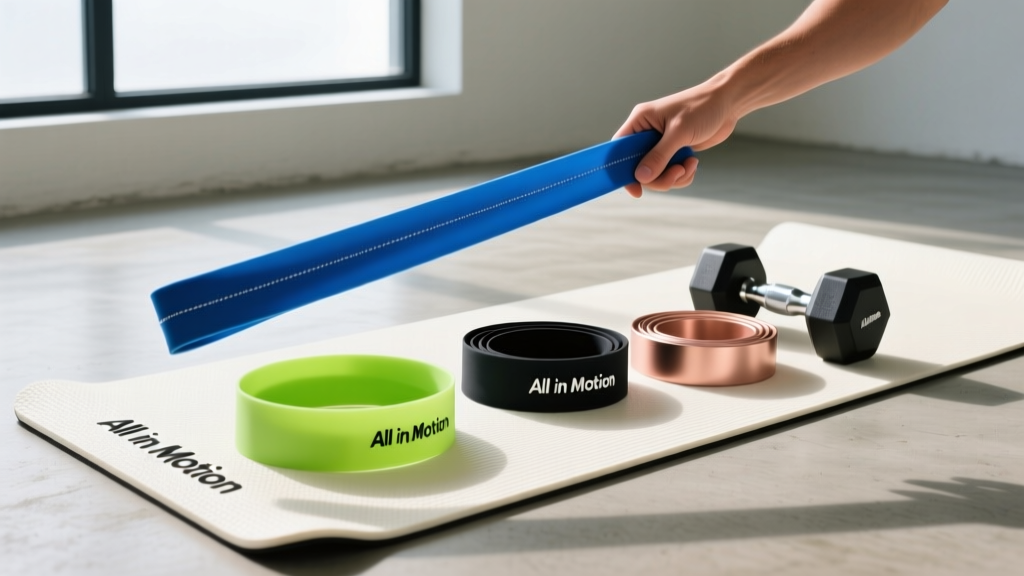
2026 Pull-Up Band Sizing & All in Motion Yoga Mats
Master pull-up assist band sizing with our 2026 comparison chart. Plus, see why pairing them with All in Motion yoga mats creates the ultimate home gym.

The Foundation of Home Gym Mastery: Tension and Grounding
Building a resilient, joint-friendly home gym in 2026 requires more than just hanging a bar on your wall. It requires a precise understanding of variable resistance and a safe, ergonomic foundation for your dismounts and mobility work. This comprehensive guide tackles two critical, often overlooked components of the modern calisthenics setup: dialing in your exact pull-up assist band sizing, and selecting the right grounding surface—specifically analyzing the highly rated All in Motion yoga mats from Target's proprietary fitness line.
Whether you are chasing your first unassisted pull-up or using bands for advanced mobility flows, pairing the correct elastomer tension with a high-density mat prevents micro-traumas to your joints and maximizes your force output.
Expert Insight: According to research published by the National Institutes of Health (NIH), elastic resistance provides a non-linear tension curve that closely mimics the natural strength curve of human muscle bellies, making it superior to static counterweights for joint rehabilitation and hypertrophy.The Physics of Pull-Up Assist Bands: Understanding Tension Curves
Pull-up assist bands (typically 41-inch continuous loops) are manufactured from layered natural latex. Unlike cable machines, the resistance a band provides is not static; it is proportional to its elongation. A band rated for '50-120 lbs' does not provide 120 lbs of assistance when you first step into it. It provides roughly 50 lbs at a slight stretch (when your feet are near the floor) and peaks at 120 lbs when stretched to roughly double its resting length (82 inches).
The Danger of Over-Elongation
The most common failure mode in band training is 'snapback' caused by exceeding the 300% elongation threshold. When a 41-inch band is stretched beyond 123 inches, the molecular chains in the latex begin to micro-tear. This not only drastically reduces the lifespan of the band but creates a severe safety hazard. Always select a band that provides your required assistance at a maximum of 200% elongation.
2026 Pull-Up Assist Band Sizing & Comparison Matrix
Below is the industry-standard sizing chart based on premium natural latex manufacturers like Rogue Fitness and WODFitters. Use this matrix to select your primary assistance band based on your current body weight and maximum unassisted pull-up deficit.
| Color / Width | Tension Range | Best For (User Profile) | Avg. Price (2026) |
|---|---|---|---|
| Red / Green (1/2 inch) | 15 - 35 lbs | Warm-ups, mobility, users needing <20% bodyweight assistance | $12 - $18 |
| Black / Blue (1-1/8 inch) | 50 - 120 lbs | Beginners, users 130-160 lbs needing moderate assistance | $22 - $28 |
| Purple (1-3/4 inch) | 80 - 200 lbs | Heavy athletes (180+ lbs), learning muscle-up transitions | $30 - $38 |
| Green (2.5 inch) | 120 - 275 lbs | Rehab, elderly mobility, heavy users (220+ lbs) first learning | $40 - $50 |
Step-by-Step Selection Framework
Do not guess your band size. Use this precise framework to calculate your exact needs:
- Calculate Your Deficit: If you weigh 180 lbs and can only perform a partial pull-up (lifting 100 lbs of your body weight), your deficit is 80 lbs.
- Apply the 20% Over-Assistance Rule: For strict hypertrophy and form correction, add 20% to your deficit to ensure perfect scapular retraction at the top of the movement. (80 lbs + 16 lbs = 96 lbs required assistance).
- Select the Band: Based on the matrix above, a Purple (1-3/4 inch) band peaking at 200 lbs but providing ~95 lbs at your specific height and arm reach is the optimal choice.
- Plan for Progression: Purchase a band one size down (e.g., the Black/Blue 50-120 lb band) to use as your strength increases over the next 8-12 weeks.
Grounding Your Setup: Why All in Motion Yoga Mats Matter
When performing band-assisted pull-ups, your dismount and subsequent floor-based mobility work require a stable, shock-absorbing surface. Stepping off a pull-up bar onto hard concrete or thin laminate flooring sends severe compressive forces through your calcaneus (heel bone) and lumbar spine. This is where All in Motion yoga mats have disrupted the 2026 market, offering premium material science at big-box prices.
All in Motion Alignment Mat (5mm TPE)
Constructed from eco-friendly Thermoplastic Elastomer (TPE), this mat features a closed-cell surface that repels sweat and prevents the harboring of bacteria—crucial when you are dragging heavy, chalk-covered resistance bands across your floor. The 5mm thickness provides the exact balance of ground feedback for standing banded stretches and cushioning for kneeling dismounts.
- Dimensions: 72 x 24 inches (Accommodates tall athletes)
- Material: Dual-layer TPE (Non-toxic, PVC-free)
- Price: ~$39.00
- Best Use: Banded hamstring stretches, shoulder dislocates, and balance work.
All in Motion Extra Thick Mat (15mm NBR)
For users focusing heavily on rehabilitation or those with sensitive knees, the 15mm Nitrile Butadiene Rubber (NBR) mat is a necessity. NBR is significantly denser than standard PVC foam, meaning it won't bottom out when you drop from a high box jump or a banded pull-up.
Warning: Never use an NBR mat for high-friction band anchoring. The softer surface can grip the latex band too tightly during floor slides, causing premature wear on the band's outer layer. Use the TPE Alignment mat for heavy band friction.Pairing Bands and Mats: The Ultimate Mobility Routine
According to the Mayo Clinic, incorporating elastic resistance into daily mobility routines significantly improves joint capsule health and tendon stiffness. Here is how to combine your new band and All in Motion mat:
- Banded Psoas Release: Anchor a Red (1/2 inch) band to a low rig. Lie supine on your All in Motion TPE mat, loop the band around one foot, and allow the tension to gently pull the knee toward the chest while the opposite leg remains flat on the mat's alignment lines.
- Scapular Retraction Flows: Kneel on the 15mm NBR mat to protect your patellas. Wrap a Black (1-1/8 inch) band around a sturdy pole and perform slow, controlled scapular retractions, utilizing the mat's grip to prevent your toes from slipping.
Expert Troubleshooting & Maintenance
To ensure your gear survives the rigors of a 2026 home gym, follow these strict maintenance protocols:
Latex Band Care
Natural latex is highly susceptible to UV degradation and ozone exposure. Never store your pull-up assist bands near a window or in a garage that experiences high heat. Once a month, wipe the bands down with a damp cloth and a drop of mild dish soap, then air dry in the shade. Avoid silicone-based lubricants, as they break down the molecular bonds of natural rubber.
Mat Hygiene
The closed-cell TPE of the All in Motion Alignment mat can be sanitized with a 50/50 mix of water and white vinegar. Do not use harsh chemical cleaners like bleach or ammonia, which will dry out the TPE and cause edge-curling over time.
Frequently Asked Questions
Can I stack multiple pull-up bands for more assistance?
Yes, stacking a Red and a Black band is a common technique for heavy athletes. However, ensure both bands are of the exact same length (41 inches) to prevent the shorter band from reaching its maximum elongation and snapping before the longer band engages fully.
Are All in Motion mats durable enough for heavy weightlifting?
While the 15mm NBR mat is excellent for bodyweight and band work, it is not recommended for dropping heavy dumbbells or kettlebells. For heavy free-weight drops, you should invest in specialized 3/4-inch horse stall mats.
How long should a premium pull-up assist band last?
With proper care and avoidance of over-elongation, a high-quality natural latex band from a reputable manufacturer should last between 18 to 24 months of regular, high-intensity use before showing signs of structural micro-tearing.
More gear to consider
All reviews
ProSourceFit Extra Thick Yoga and Pilates Mat: Ball Size Guide

Reebok Yoga Mat Care & The Ultimate Block and Strap Buying Guide
Resistance Band Set Buying Guide & Arch Yoga Mat Pairing
Exercise Ball Size Guide & Buying Tips: Manduka Yoga Mat GRP

Best Yoga Blocks & Straps for a Free People Yoga Mat (2026)
