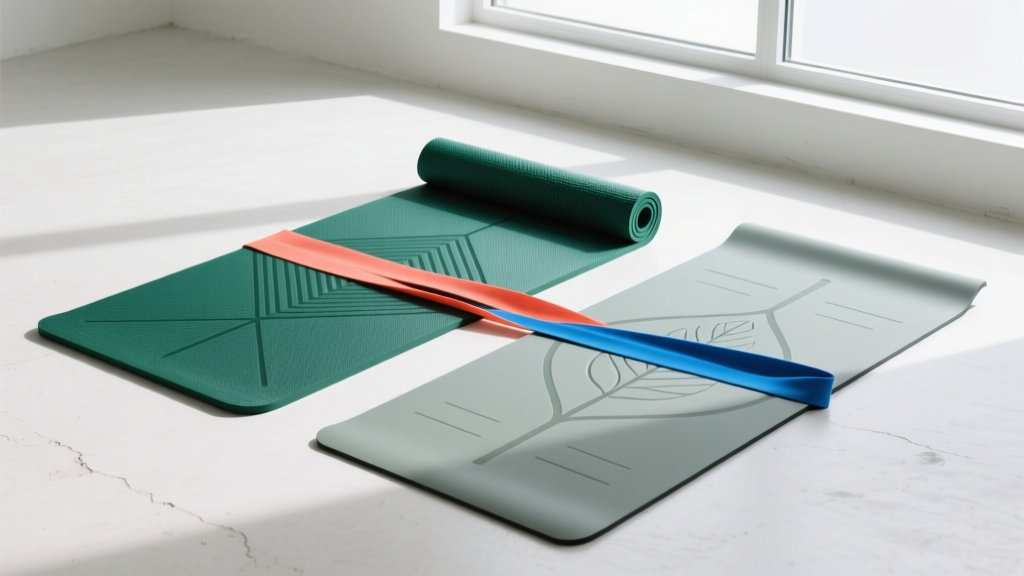
Pilates Mat vs Yoga Mat: Grip, Thickness & Material Compared
Discover the critical differences in a pilates mat vs yoga mat comparison. We analyze thickness, materials, and grip to help you choose the right gear.

The Core Divide: Why You Cannot Interchange Them
When outfitting a home studio or packing for a studio class, the debate of pilates mat vs yoga mat often boils down to a fundamental misunderstanding of biomechanics. While they look like interchangeable rectangles of foam, their engineering serves entirely different physiological demands. In 2026, the market has bifurcated sharply: yoga mats prioritize proprioceptive feedback and surface traction, while Pilates mats prioritize spinal cushioning and high-density shock absorption.
Using a thick Pilates mat for standing yoga balances creates a 'trampoline effect,' destabilizing the ankle's lateral ligaments. Conversely, performing Pilates 'Roll-Ups' or the 'Teaser' on a thin yoga mat leads to rapid vertebral bruising against the floor. Below, we break down the exact metrics of thickness, material polymers, and grip technologies to help you make an informed purchase.
Quick Decision Framework:- Choose a Yoga Mat if: Your practice involves standing balances, vinyasa flows, hot yoga, or you need a lightweight, travel-friendly option (3mm - 6mm thickness).
- Choose a Pilates Mat if: Your routine involves heavy floor work, spinal articulation, core rolling, or you have sensitive knees and tailbones (10mm - 15mm thickness).
Thickness & Density Metrics: The 'Bottoming Out' Effect
Thickness is the most obvious differentiator, but density is the hidden metric that dictates performance. A cheap 15mm mat made of low-density EVA foam will compress to 2mm under the weight of a human spine, entirely defeating its purpose. This phenomenon is known in materials science as 'bottoming out.'
Yoga Mat Dimensions (3mm to 6mm)
Yoga requires a firm connection to the ground. When you enter Warrior III (Virabhadrasana III), your foot's mechanoreceptors need to feel the floor to engage the Golgi tendon organs and stabilize the ankle. Standard yoga mats range from 3mm (1/8 inch) to 6mm (1/4 inch). The 5mm threshold is widely considered the 'Goldilocks' zone for joint protection without sacrificing balance.
Pilates Mat Dimensions (10mm to 15mm)
Pilates involves repeated spinal flexion and extension against gravity. High-quality Pilates mats range from 10mm (3/8 inch) to 15mm (5/8 inch). However, to prevent bottoming out, premium Pilates mats utilize high-density NBR (Nitrile Butadiene Rubber) or tightly compressed TPE (Thermoplastic Elastomer), which maintain their structural integrity even under concentrated point-loads like the sacrum or occipital bone.
Material Showdown: Polymers and Performance
The chemical composition of your mat dictates its weight, environmental impact, and lifespan. According to industry manufacturing standards, the leading yoga mat brands have largely moved toward natural rubber and polyurethane, while top Pilates equipment manufacturers favor advanced TPE blends and high-density NBR.
| Material | Primary Use | Weight (per m²) | Lifespan | Failure Mode |
|---|---|---|---|---|
| PVC (Polyvinyl Chloride) | Yoga / General | 2.5 - 3.5 kg | 10+ Years | Plasticizer migration causing brittleness over time. |
| Natural Rubber | Yoga (Hot/Vinyasa) | 3.5 - 5.0 kg | 3 - 5 Years | UV degradation and oxidation leading to flaking. |
| PU (Polyurethane) | Yoga (Premium) | 3.0 - 4.5 kg | 5 - 7 Years | Absorbs oils and lotions, leaving permanent dark spots. |
| NBR (Nitrile Butadiene) | Pilates / Rehab | 1.5 - 2.5 kg | 2 - 4 Years | Surface tearing from high-friction pivoting movements. |
| TPE (Thermoplastic Elastomer) | Pilates / Hybrid | 1.0 - 2.0 kg | 3 - 5 Years | Warping if stored rolled tightly in high heat. |
Grip & Traction: Surface Tension and Sweat Management
Grip is not a monolithic feature; it is divided into dry grip (static friction) and wet grip (kinetic friction under sweat). The way a mat handles moisture is dictated by its cellular structure.
Open-Cell vs. Closed-Cell Engineering
Yoga Mats (Often Open-Cell): Premium natural rubber and PU yoga mats utilize an open-cell structure. As you sweat during a Vinyasa flow, the moisture is absorbed into the microscopic pores of the mat, actually increasing the surface tackiness. This prevents your hands from sliding in Downward Dog. However, this same porosity means the mat absorbs bacteria, dead skin, and oils, requiring rigorous enzymatic cleaning to prevent odor buildup.
Pilates Mats (Strictly Closed-Cell): Because Pilates involves lying supine or prone and sweating directly onto the mat from the torso and back, closed-cell NBR and TPE are mandatory. Closed-cell materials repel moisture, preventing sweat from seeping into the core of the mat. While this makes them highly hygienic and easy to wipe down with antimicrobial sprays, it means they offer very little wet grip. If you attempt a sweaty yoga flow on a closed-cell Pilates mat, your hands will slip dangerously.
"The friction coefficient required for a yoga mat is vastly different from a Pilates mat. In Pilates, we want the mat to allow slight gliding for exercises like the 'Hundred' or leg circles to prevent joint torque, whereas in yoga, we demand absolute lockdown for the wrists and feet."
— Biomechanical principles outlined in Yoga Journal's equipment guides.
2026 Head-to-Head Product Matchups
To illustrate these differences, we tested the current market leaders across both disciplines, evaluating their exact specifications and real-world performance.
Matchup 1: The Heavy-Duty Standards
- Yoga Contender: Manduka PRO Yoga Mat (6mm, PVC, Closed-Cell). Price: ~$140. Verdict: Exceptionally durable with a lifetime guarantee, but requires a 'break-in' period (or a sea-salt scrub) to remove the factory film and achieve optimal dry grip. Heavy at 7.5 lbs.
- Pilates Contender: Balanced Body Contour Mat (15mm, TPE/NBR Blend, Closed-Cell). Price: ~$89. Verdict: Features ergonomic contouring for the spine and neck. The high-density TPE prevents bottoming out during shoulder stands, but the 4.5 lb weight and 15mm bulk make it impossible to carry to a studio without a dedicated shoulder sling.
Matchup 2: The Premium Grip Specialists
- Yoga Contender: Liforme Original (4.2mm, Natural Rubber/PU, Open-Cell). Price: ~$160. Verdict: Unmatched wet grip. The 'AlignForMe' engraved markers provide tactile feedback for foot placement. Fails rapidly if left in the trunk of a hot car or exposed to direct sunlight due to rubber oxidation.
- Pilates Contender: Merrithew High Density Pilates Mat (15mm, High-Density Foam, Closed-Cell). Price: ~$75. Verdict: The industry standard for commercial Pilates studios. It utilizes a textured, non-slip surface that grips the floor exceptionally well, preventing the mat from sliding during aggressive reformer-style floor work, though the surface itself remains relatively slick for sweaty hands.
Care, Maintenance, and Avoiding Premature Failure
Regardless of whether you choose a Pilates mat or a yoga mat, improper maintenance is the leading cause of premature failure in 2026's advanced polymer gear.
- Never Use Essential Oils on Natural Rubber: Tea tree, lavender, and eucalyptus oils act as solvents that break down the lipid bonds in natural rubber yoga mats, causing them to rot and flake within months.
- Avoid Alkaline Cleaners on PU: Polyurethane yoga mats are highly sensitive to pH. Use only neutral pH (7.0) mat washes. Standard household surface cleaners will strip the top-grip layer.
- Store Pilates Mats Flat or Loosely Rolled: High-density 15mm NBR mats, if rolled tightly and secured with a strap for months, will develop permanent 'memory creases' that create uneven pressure points on the spine.
The Final Verdict
The pilates mat vs yoga mat decision should never be based on aesthetics or brand loyalty, but strictly on the biomechanical demands of your practice. If your routine is grounded in spinal articulation, core conditioning, and prolonged floor work, invest the $80-$100 in a 15mm high-density TPE or NBR Pilates mat to protect your vertebrae. If your practice demands standing balance, inversion stability, and sweat-inducing flows, a 4mm to 6mm open-cell rubber or PU yoga mat ($120-$160) is non-negotiable for your safety and performance.
More gear to consider
All reviews
Resistance Band Sets: Levels, Types & Nike Mastery Yoga Mat Pairings

Yoga Blocks, Straps & Typical Yoga Mat Thickness: Value Guide
Mobility Zone Setup: Foam Roller Density & Yoga Mat Dimensions

Jump Rope Types Guide: Speed, Beaded, Weighted & Gaiam Yoga Mat

Loop Band vs Tube Band: Care, Longevity & Manduka Yoga Mat Safety
