
Medicine Ball Weight Selection vs Traditional Yoga Mat: Core Face-Off
Compare medicine ball weight selection against traditional yoga mat core workouts. Discover which gear builds better strength, stability, and abs in 2026.

When building a functional home gym or upgrading your studio routine, the debate often narrows down to foundational gear. On one side, you have the ubiquitous traditional yoga mat, the bedrock of bodyweight core training, Pilates, and stability work. On the other, you have the dynamic, resistance-driven world of weighted spheres. But how do you choose between mastering bodyweight leverage on a mat and progressing through a structured medicine ball weight selection guide to build explosive rotational power?
As we navigate the 2026 fitness landscape, core training has evolved beyond endless crunches. According to Harvard Health, a strong core is the linchpin for functional movement, injury prevention, and athletic power transfer. Yet, the tools we use to build that core dictate our results. In this head-to-head comparison, we break down the biomechanical advantages, financial investments, and practical applications of medicine balls versus traditional mat work.
The Quick Verdict
Choose a Medicine Ball if: Your goal is rotational power, explosive strength, and progressive overload for the obliques and rectus abdominis.
Choose a Traditional Yoga Mat if: Your focus is on deep spinal stabilization, isometric holds, Pilates-based micro-movements, and joint-friendly floor work.
Medicine Ball Weight Selection Guide: Finding Your Ideal Load
Unlike dumbbells, medicine balls rely on momentum, deceleration, and multi-planar movement. Selecting the wrong weight is the most common failure mode in med ball training. A ball that is too heavy destroys your rotational velocity and compromises your lumbar spine; a ball that is too light fails to trigger the fast-twitch muscle fibers required for power development.
The 2026 Weight Selection Matrix
The National Strength and Conditioning Association (NSCA) emphasizes that medicine ball training should prioritize movement speed and control over sheer load. Below is a practical decision framework for selecting your starting weight based on your current strength baseline and training goal.
| Fitness Level | Rotational Power (Woodchoppers, Throws) | Core Flexion (Sit-ups, V-Ups) | Recommended Model & Price |
|---|---|---|---|
| Beginner | 4 lbs – 8 lbs | 6 lbs – 10 lbs | Yes4All Soft Shell ($35 - $45) |
| Intermediate | 10 lbs – 15 lbs | 12 lbs – 20 lbs | Rogue Leather Med Ball ($75 - $95) |
| Advanced | 16 lbs – 25 lbs | 20 lbs – 30 lbs | Dynamax Soft Wall Ball ($115 - $145) |
Edge Cases and Failure Modes
When performing high-velocity slams, never use a traditional leather medicine ball. The lack of bounce and hard surface can cause severe rebound injuries to the face or wrists. Instead, transition to a rubber slam ball (like the TRX Slam Ball, $55 for 20 lbs) designed to absorb kinetic energy upon impact. Conversely, for slow, controlled core flexions like weighted Russian twists, the tactile grip of a leather Rogue ball provides superior control compared to slippery PVC alternatives.
The Traditional Yoga Mat: Limits and Advantages for Core Work
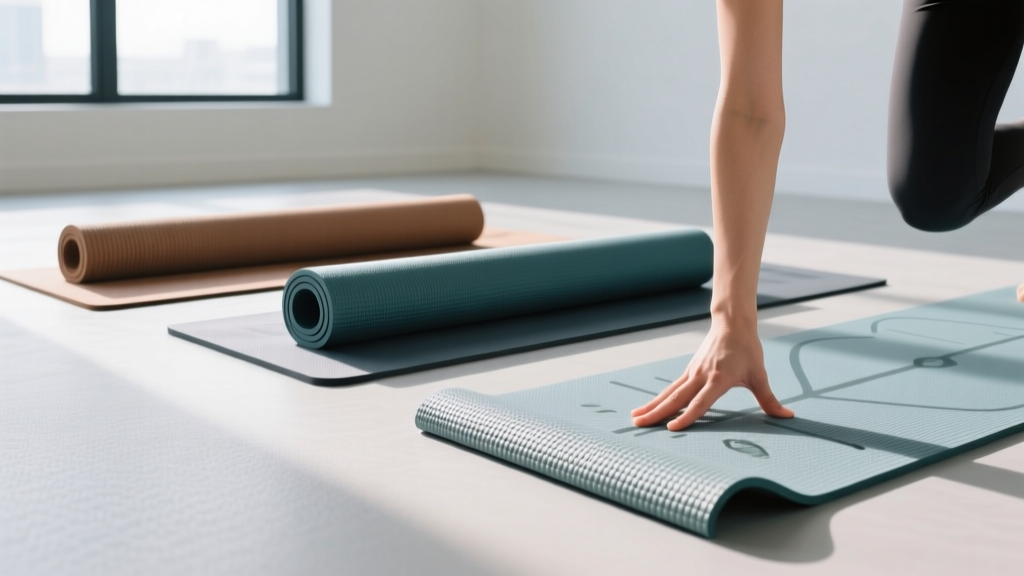
While a medicine ball provides the external load, the surface you train on dictates your joint health and spinal alignment. A high-quality traditional yoga mat is not just a place to stretch; it is a critical piece of feedback equipment for your nervous system.
Why Density Matters More Than Thickness
A common misconception in 2026 is that thicker equals better. However, a 15mm foam mat will absorb the kinetic feedback needed for balance and core stabilization. For core work, you need high-density resistance. The Manduka PRO (6mm, $92) utilizes a dense PVC matrix that protects the sacrum and tailbone during hollow-body holds and boat poses without sacrificing the ground-feedback required for micro-adjustments.
- Advantage 1: Isometric Endurance. Mat-based routines excel at building time-under-tension. Exercises like the plank, dead bug, and bird-dog require a stable, slightly cushioned surface to prevent elbow and knee bursitis.
- Advantage 2: Spinal Articulation. Pilates roll-ups and spinal waves require a surface that allows the vertebrae to articulate smoothly. A textured traditional yoga mat prevents the skin from sticking, allowing for fluid movement.
- Limitation 1: The Progressive Overload Ceiling. According to Mayo Clinic guidelines on fitness progression, muscles eventually adapt to bodyweight resistance. Once you can hold a plank for 120 seconds, a mat alone cannot provide the stimulus needed for further hypertrophy.
Head-to-Head Gear Comparison Matrix
How do these two foundational tools stack up against each other when evaluating overall utility for core development?
| Feature | Medicine Ball (10-20 lbs) | Traditional Yoga Mat (High-Density) |
|---|---|---|
| Hypertrophy Potential | High (Progressive Overload) | Low-Medium (Endurance Focus) |
| Rotational Power | Excellent | N/A |
| Joint Impact / Comfort | Low (Standing/Kneeling) | High (Spinal Protection) |
| Space Requirement | High (Needs clearance for throws) | Low (Rolls up to 6-inch cylinder) |
| Financial Investment | $45 - $145 per ball | $50 - $120 (One-time purchase) |
Real-World Programming: Integrating Both Into Your Routine
The most effective 2026 core programs do not force a binary choice between these tools; they synthesize them. The traditional yoga mat provides the necessary friction and cushioning for floor-based medicine ball exercises.
"The magic happens at the intersection of stability and load. Performing a weighted dead bug with a 12-pound medicine ball while lying on a high-density mat forces the transverse abdominis to fire maximally to prevent lumbar extension, all while protecting the sacrum from the hard floor."
Sample Hybrid Core Circuit
- Medicine Ball Slam (Standing): 3 sets of 12 reps. Use a 20lb TRX Slam Ball. Focus on maximal downward velocity. (No mat required).
- Weighted Russian Twist (Seated): 3 sets of 20 reps. Sit on your traditional yoga mat, lean back 45 degrees, and rotate a 15lb Rogue Leather Med Ball from hip to hip. The mat prevents your sitz bones from slipping on hardwood floors.
- Hollow Body Hold (Bodyweight): 3 sets to failure. Drop the ball. Utilize the mat's cushioning to protect your lower spine as you press your lumbar region into the floor.
FAQ: Bridging the Gap Between Mat and Med Ball
Can I use a traditional yoga mat for medicine ball slams?
No. High-velocity slams will degrade the closed-cell surface of a premium mat like the Lululemon The Mat ($88) or Manduka PRO. The repetitive impact can cause micro-tears in the PVC or polyurethane top layer. Always perform slams on bare rubber flooring or concrete.
How do I know when to upgrade my medicine ball weight?
Apply the 'Velocity Rule.' If you are performing rotational throws and the ball's speed noticeably decreases on the last 3 reps of a 10-rep set, the weight is appropriate for power training. If you can easily complete 15 reps without a drop in speed or form, it is time to move up to the next weight increment (usually a 4lb to 5lb jump).
Is a thick Pilates mat better than a traditional yoga mat for core work?
It depends on the exercise. A 15mm Pilates mat is superior for spinal articulation and kneeling work. However, for advanced core stability work like side planks or bird-dogs, the excessive squish of a thick mat creates an unstable base, forcing your ankle and knee stabilizers to compensate rather than isolating the core. A dense 5mm to 6mm traditional yoga mat remains the gold standard for overall core stability training.
More gear to consider
All reviews
Jump Rope Types: Speed vs Weighted for Your Lululemon Green Yoga Mat

Loop Band vs Tube Band Comparison: 2026 Trends & Rescuing a Stained Lululemon Yoga Mat

What Length Yoga Mat Do I Need? Jump Rope Types & Setup Guide
Yoga Mat Grip & Material: Can I Use Dawn to Clean My Yoga Mat?

Beyond the Viral Animal Print Yoga Mat: Foam Roller Density Guide
