
Exercise Ball Size Guide & Polyvinyl Chloride Yoga Mat Care
Master your core setup with our exercise ball size guide and buying tips, plus essential longevity care for your polyvinyl chloride yoga mat.

The Biomechanics of Sizing: Finding Your Perfect Exercise Ball
Selecting the correct exercise ball is not merely a matter of comfort; it is a fundamental biomechanical requirement for effective core stabilization and injury prevention. When utilizing a stability ball for seated exercises, pelvic tilts, or weighted crunches, your hips and knees must form a precise 90-degree angle. If the ball is too large, you risk lumbar hyperextension; if it is too small, you place excessive shear force on the patellofemoral joint in your knees.
As of 2026, manufacturing standards have largely consolidated around five primary diameter sizes. However, it is crucial to account for compression variance. A ball rated at 65 cm will compress by 2 to 4 inches under the weight of an average adult. Therefore, purchasing a ball that allows for a slightly deeper squat position when fully inflated is often recommended by physical therapists.
Standard Exercise Ball Sizing Chart
| User Height | Recommended Ball Diameter | Optimal Use Case |
|---|---|---|
| Under 5'0' (152 cm) | 45 cm | Desk chair replacement, light Pilates |
| 5'1' to 5'8' (155 - 173 cm) | 55 cm | Standard core workouts, yoga stretches |
| 5'9' to 6'2' (175 - 188 cm) | 65 cm | Heavy lifting, hamstring curls, wall squats |
| 6'3' to 6'7' (190 - 201 cm) | 75 cm | Advanced stability training, tall-user desk seating |
| Over 6'8' (203+ cm) | 85 cm | Specialized physical therapy, deep range-of-motion work |
Buying Tips: Burst Ratings, Certifications, and Material Density
Not all exercise balls are created equal, and the price disparity in the 2026 market—ranging from $12 generic imports to $55 clinical-grade models—reflects critical differences in material engineering. When reviewing buying tips, the most vital metric is the burst rating.
- Standard PVC Balls (Up to 300 lbs): These are typically found in big-box stores. If punctured under load, they will pop instantly, posing a severe fall risk.
- Anti-Burst / Slow-Deflate Balls (600 - 1,100 lbs): Made from thicker, multi-layered PVC. If pierced by a sharp object, the ball slowly deflates rather than exploding. Brands like Gaiam and Trideer dominate this mid-tier market.
- Clinical-Grade Burst-Resistant Balls (Up to 2,200+ lbs): Models like the TheraBand Stability Ball utilize specialized高密度 (high-density) elastomers. These are designed for dynamic athletic training, where dropping heavy dumbbells onto the ball creates massive transient spike loads.
When purchasing, look for the GS Mark (Geprüfte Sicherheit) or CE certification on the packaging, which indicates the ball has passed rigorous European static and dynamic load testing. According to Mayo Clinic's fitness guidelines, ensuring your equipment is rated for your body weight plus any external resistance is non-negotiable for safe core training.
Exercise Ball Longevity: Inflation, Storage, and Environmental Factors
The lifespan of an exercise ball is heavily dictated by how it is inflated and stored. The most common failure mode in the first 48 hours of ownership is over-inflation leading to seam rupture.
- The 24-Hour Inflation Rule: PVC material is stiff when first unboxed. Inflate the ball to 80% capacity and let it sit at room temperature (68°F - 72°F) for 24 hours. This allows the polymer chains to stretch and acclimate. Top it off to 100% the next day.
- Temperature Fluctuations: Air expands and contracts with temperature changes. If you keep your ball in a garage that drops to 40°F at night and heats up to 80°F during the day, the internal pressure fluctuations will weaken the seams over time. Store your ball indoors.
- Surface Friction: Repeatedly rolling the ball across rough concrete or textured tile will cause micro-abrasions on the contact patch, eventually leading to slow leaks. Always use your ball on a smooth surface or paired with a protective mat.
Polyvinyl Chloride Yoga Mat Care: Preventing Plasticizer Degradation
When pairing your stability ball with groundwork, the surface you choose matters immensely. The polyvinyl chloride yoga mat remains the industry standard for durability, joint cushioning, and grip. However, PVC is a closed-cell material that relies on chemical plasticizers to maintain its flexibility and spongy texture. Improper maintenance will strip these plasticizers, leaving you with a brittle, cracking mat that offers zero shock absorption.
According to Yoga Journal's comprehensive gear guides, closed-cell PVC mats do not absorb sweat, making them highly hygienic. But this same surface requires specific chemical care to ensure longevity.
What Destroys a PVC Mat?
WARNING: Avoid Essential Oils and Citrus CleanersMany online DIY cleaning recipes suggest using tea tree oil, eucalyptus, or lemon juice to sanitize yoga mats. These compounds are highly acidic and act as natural solvents. When applied to a polyvinyl chloride yoga mat, they rapidly break down the surface plasticizers, resulting in a sticky, degraded texture that cannot be reversed.
The Optimal 2026 PVC Cleaning Protocol
To sanitize your mat without compromising its structural integrity, use a neutral pH solution. Mix 1 part distilled white vinegar to 10 parts distilled water in a spray bottle. Add a single drop of mild, unscented dish soap (like Dawn Free & Clear).
- Post-Workout: Lightly mist the mat and wipe it down with a microfiber cloth. Do not soak the mat.
- Deep Cleaning (Monthly): Lay the mat flat in a bathtub. Run lukewarm water over it and gently agitate with a soft cloth and a teaspoon of mild dish soap. Rinse thoroughly and hang to air dry.
- Drying: Never put a PVC mat in the washing machine, and never expose it to direct sunlight. UV radiation accelerates the oxidation of PVC, causing the edges to curl and the material to flake.
The 2026 Gear Replacement Checklist
Even with meticulous care, fitness accessories have a finite lifespan. Pushing gear past its safe operational limits invites injury. Use this checklist to evaluate your core and groundwork equipment:
- Exercise Ball: Replace if you notice deep scratches, a visibly stretched 'equator' seam, or if it requires inflation more than once a month (indicating a micro-leak in the valve).
- Polyvinyl Chloride Yoga Mat: Replace if the surface feels permanently sticky, if the edges are curling upward despite being stored flat, or if you can see the inner foam core through worn-down traction ridges.
- Pump & Valve Pins: Keep the metal inflation pin clean and free of rust. A jagged or rusty pin will tear the internal rubber gasket of your exercise ball's valve, rendering it useless.
By treating your stability equipment as precision biomechanical tools rather than disposable toys, you protect your joints and ensure your core training remains safe, effective, and consistent for years to come. For more insights on functional movement and joint health, refer to the American Council on Exercise (ACE) fitness library.
More gear to consider
All reviews
Manduka GRP Adapt Yoga Mat 5mm Jump Rope Setup Walkthrough

Medicine Ball Weight Selection Guide & Bala Yoga Mat Scrunchie
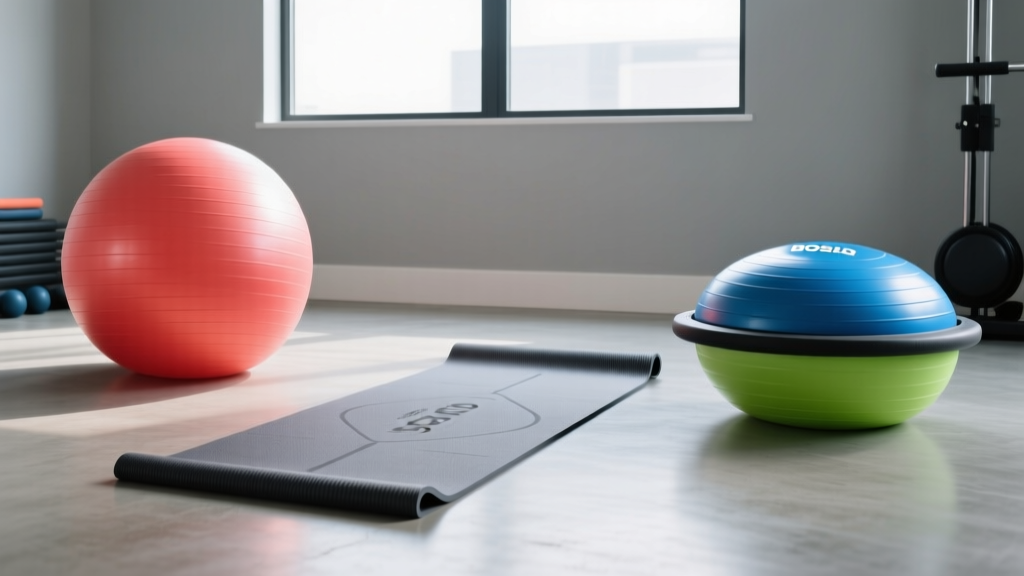
Yoga Mat Sizes & Space: Stability Ball vs BOSU Ball 2026 Trends

Pull-Up Assist Band Sizing & The Difference Between Yoga Mats

Manduka Yoga Mat Towels: Material, Thickness & Grip Guide 2026
