Battle Rope Sizing Guide & Best Bag with Yoga Mat Strap
Maximize your home gym ROI with our 2026 battle rope length and thickness guide, plus transport tips using a versatile bag with yoga mat strap.

The True Cost of Battle Ropes: Budget vs. Value Analysis
When outfitting a home gym or building a portable outdoor conditioning kit, battle ropes offer an unmatched return on investment for full-body metabolic output. However, the market is flooded with subpar options that degrade within weeks. According to metabolic conditioning guidelines published by the American Council on Exercise (ACE), high-intensity rope intervals can burn up to 10 calories per minute, but this requires equipment that maintains its kinetic integrity over thousands of slams. In 2026, a premium 50-foot Poly Dacron rope costs between $90 and $140, while budget nylon alternatives sell for $35 to $50. The true value analysis reveals that budget ropes suffer from core-separation and outer-sleeve fraying within 90 days of heavy use, making the premium tier the only logical financial choice for serious athletes.
Battle Rope Length Guide: Spatial Economics & Wave Physics
The length of your battle rope dictates the wave physics, the required floor space, and the overall price point. Wave propagation requires a minimum amount of slack to generate the reciprocal alternating waves necessary for shoulder stabilization and core engagement. If a rope is too short, the user is forced to increase frequency (speed) while sacrificing amplitude (height), shifting the stimulus entirely to the forearms and eliminating the posterior chain engagement.
| Rope Length | Required Clearance | Wave Physics & Use Case | Avg. 2026 Cost (1.5" Poly Dac) |
|---|---|---|---|
| 30 Feet | 15 Feet | High frequency, low amplitude. Ideal for apartments and HIIT tabata sprints. | $65 - $80 |
| 40 Feet | 20 Feet | Moderate amplitude. Good for standard garages; limits heavy slam mobility. | $85 - $105 |
| 50 Feet | 25+ Feet | Maximum amplitude and whip effect. The gold standard for power slams and full-body undulations. | $110 - $140 |
Expert Insight: Always measure from your anchor point to your starting stance, then add 5 feet of slack for the user's forward and backward movement during dynamic lunges. A 50-foot rope requires a minimum 25-foot clear path to function correctly.
Thickness Breakdown: Grip Fatigue & Cost Per Foot
Rope thickness directly impacts grip endurance, overall weight, and material costs. The standard diameters are 1.5-inch, 2-inch, and 2.5-inch. Understanding the physiological demand of each thickness is critical for your budget breakdown.
1.5-Inch Diameter (The Endurance Standard)
Weighing approximately 16 to 18 pounds for a 50-foot length, the 1.5-inch rope is the most versatile. It allows for longer workout durations (15-30 seconds per interval) before grip failure occurs. It is also the most budget-friendly, costing roughly $2.20 to $2.80 per linear foot. This is the recommended starting point for 85% of home gym owners.
2-Inch Diameter (The Strength & Power Tier)
A 50-foot 2-inch rope weighs between 25 and 28 pounds. The increased mass requires significantly more force to accelerate and decelerate, making it ideal for heavy slams and strength-focused circuits. However, grip fatigue will typically set in around the 12-second mark for untrained users. Budget accordingly: the material volume increases the cost to roughly $3.50 per linear foot ($150+ total).
2.5-Inch Diameter (The Strongman Niche)
Reserved for elite grip athletes and strongman competitors, these ropes can exceed 35 pounds. They are incredibly expensive (often over $250) and require specialized anchoring hardware due to the immense kinetic force generated during slams.
Material ROI: Poly Dacron vs. Manila vs. Nylon
The National Strength and Conditioning Association (NSCA) emphasizes the importance of equipment durability in high-velocity plyometric and conditioning drills. Material selection is where budget buyers make the most costly mistakes.
⚠️ Warning: The Manila Rope TrapManila hemp is a traditional climbing material, but it is a terrible choice for indoor battle ropes. It sheds microscopic fibers, creates a massive dust hazard in enclosed spaces, and absorbs sweat and moisture, leading to rot and foul odors. Furthermore, manila ropes are stiff, requiring excessive energy just to bend the rope, which alters the natural wave physics. Always avoid manila for indoor home gyms.
Poly Dacron (The Winner): This is a braided blend featuring a polyester inner core for tensile strength and a Dacron outer sleeve for abrasion resistance. It is virtually lint-free, weather-resistant, and maintains its flexibility in cold garages. While it carries a 30% price premium over cheap nylon, its 10-year lifespan makes it the undisputed value champion.
Transporting Heavy Gear: Why You Need a Bag with Yoga Mat Strap
Because a 50-foot 2-inch battle rope weighs nearly 30 pounds and coils into a bulky 18-inch cylinder, transporting it to outdoor parks or commercial gyms presents a unique logistical challenge. You cannot simply throw it in a standard drawstring sack. Furthermore, outdoor conditioning sessions usually require a ground mat for post-rope core work, stretching, or joint-friendly cool-downs.
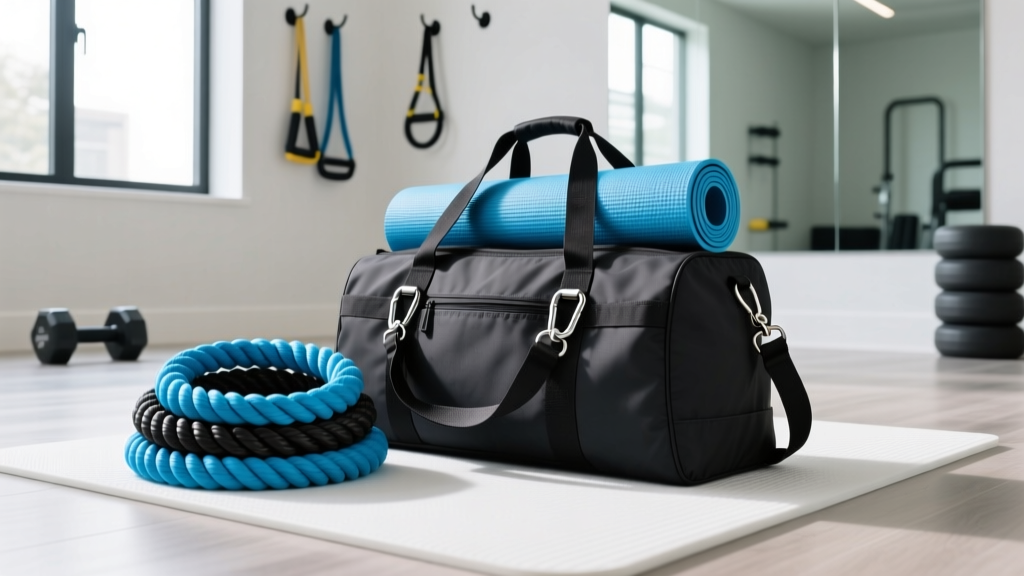
This is where investing in a heavy-duty canvas duffel or a specialized bag with yoga mat strap becomes essential for your gear ecosystem. A high-quality bag with yoga mat strap features a reinforced main compartment capable of supporting the dense 30-pound dead-weight of a coiled Poly Dacron rope, alongside heavy-duty tree-anchor straps and carabiners. The exterior bag with yoga mat strap allows you to securely bungee or buckle a 6mm TPE recovery mat to the outside of the bag. This keeps the main compartment free for the heavy rope, ensuring balanced weight distribution across your shoulder while keeping your hands free to carry water and chalk.
When evaluating transport bags in 2026, look for YKK zippers, 1000D Cordura nylon, and a dedicated bag with yoga mat strap system that utilizes dual quick-release buckles rather than cheap elastic loops, which will snap under the torque of a swinging 30-pound rope coil.
Complete 2026 Budget Breakdown: Building Your Kit
To build a professional-grade, portable battle rope kit without overspending, follow this itemized budget breakdown:
- Premium 50ft 1.5" Poly Dacron Rope: $115 (Avoid $40 nylon alternatives)
- Heavy-Duty Tree Anchor Strap (2-inch Nylon Webbing): $18 (Protects tree bark and rope ends)
- Heavy Canvas Duffel / Bag with Yoga Mat Strap: $65 - $95 (Crucial for outdoor transport)
- High-Density 6mm Yoga/Recovery Mat: $35 (For outdoor ground work)
- Heat Shrink Tubing & Electrical Tape (Maintenance Kit): $12
Total Estimated Investment: $245 - $275. This kit will easily outlast a $500 smart-mirror or subscription-based fitness app, offering unlimited, un-tethered metabolic conditioning for years.
Expert Troubleshooting: Preventing Fraying & Anchor Failures
The most common failure point on any battle rope is the end-cap. Manufacturers typically use cheap heat-shrink tubing to seal the braided ends. After 500 heavy slams against concrete or hardwood, this plastic cracks, allowing the inner polyester core to separate from the Dacron sleeve. Once the core is exposed, the rope is ruined.
The Fix: Before your first workout, remove the factory heat-shrink tubing. Wrap the last 3 inches of the rope tightly with friction tape, then apply a layer of self-amalgamating silicone tape, finishing with a heavy-duty stainless steel hose clamp. This $5 DIY upgrade adds years to the rope's lifespan.
Additionally, never wrap the rope directly around a rough concrete pillar or a sharp metal fence post. The abrasion will slice through the Dacron sleeve in a single session. Always use a dedicated nylon anchor strap or a heavy-duty chain link with a carabiner to isolate the rope from abrasive surfaces.
Final Verdict on Value
Battle ropes remain one of the most cost-effective conditioning tools on the market. By prioritizing Poly Dacron materials, selecting the correct 50-foot length for proper wave physics, and utilizing a versatile bag with yoga mat strap for seamless outdoor transport, you secure a lifetime of elite metabolic training for under $300. Skip the budget nylon traps, protect your rope ends, and let the kinetic energy do the work.
More gear to consider
All reviews
Loop vs Tube Bands: Space Layouts & Light Pink Yoga Mat Pairings

Jump Rope Troubleshooting: Why a Free Yoga Mat Ruins Speed Ropes

Home Studio Setup: Mat Grip Guide & How to Deep Clean Yoga Mat

Yoga Mat Materials & Grip: Choosing the Best Yoga Mat Cleaner

Yoga Block, Strap & EVA Yoga Mat Budget Guide 2026
