Wood Treadmill Layouts: Upright, Recumbent, and Spin Bikes
Optimize your home gym space. Learn how to pair a wood treadmill with the right upright, recumbent, or spin bike using exact dimensions and layouts.

The Spatial Challenge: Integrating Premium Cardio in 2026
As biophilic design and warm aesthetics continue to dominate home gym trends in 2026, the wood treadmill has emerged as a highly sought-after centerpiece. Whether you are investing in a manual wood-slat curved treadmill (like the Woodway Curve or AssaultRunner Elite) or a high-end motorized model featuring premium wood-finish side rails, these machines offer unparalleled durability and visual appeal. However, they also demand significant floor space. Pairing a wood treadmill with a secondary cardio machine—specifically a stationary bike—requires meticulous spatial planning to ensure safe clearance, optimal traffic flow, and ergonomic usability.
According to safety guidelines highlighted by the American Council on Exercise (ACE), improper equipment spacing is a leading cause of home gym injuries. This guide breaks down the exact dimensions, clearance requirements, and layout strategies for pairing your wood treadmill with the three primary stationary bike types: spin, upright, and recumbent.
Callout: The Wood Treadmill BaselineBefore selecting a bike, we must establish the footprint of a standard wood treadmill. Most premium wood-slat curved treadmills measure approximately 67 to 69 inches in length and 33 inches in width. Motorized wood-accented treadmills can stretch up to 80 inches long. For safe operation, you must add a minimum of 20 inches of lateral clearance on both sides and 30 inches of posterior clearance behind the deck for emergency dismounts. This brings the total required operational zone for the treadmill alone to roughly 109" x 73".
Stationary Bike Types: Spatial & Biomechanical Analysis
Choosing the right companion for your wood treadmill depends on your room geometry and your biomechanical needs. The Mayo Clinic's fitness guidelines emphasize matching equipment to your joint health and spatial constraints. Here is how the three main stationary bike types measure up.
1. Spin Bikes (Indoor Cycles)
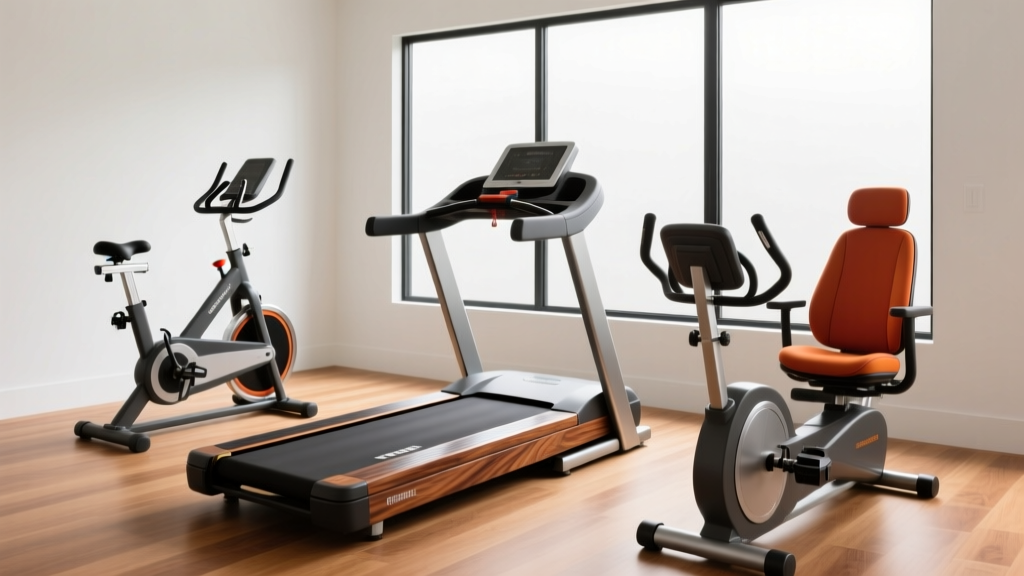
Spin bikes, such as the Schwinn IC4 or Peloton Bike+, are designed to mimic the geometry of a road bicycle. They feature a compact, aggressive footprint that makes them the ultimate space-saving companion for a bulky wood treadmill.
- Average Dimensions: 48" L x 20" W
- Operational Zone (with clearance): 88" L x 60" W
- Space Advantage: Their narrow width allows them to be tucked into tight alcoves or placed directly adjacent to the treadmill's lateral clearance zone without impeding traffic flow.
- Best For: High-Intensity Interval Training (HIIT), narrow galley-style rooms, and users seeking a high caloric burn to complement the steady-state cardio of a curved wood treadmill.
2. Upright Bikes
Upright bikes (e.g., Sole LCB, NordicTrack S22i) offer a more relaxed, traditional seating position with a slightly wider base to accommodate the console and magnetic resistance flywheel housing.
- Average Dimensions: 45" L x 25" W
- Operational Zone (with clearance): 85" L x 65" W
- Space Advantage: While slightly wider than spin bikes, upright bikes have a shorter overall length. They fit perfectly in corner layouts where the wood treadmill occupies the primary wall.
- Best For: Core engagement, moderate-intensity steady-state (MISS) cardio, and users who want a familiar, traditional cycling feel without the aggressive forward lean of a spin bike.
3. Recumbent Bikes
Recumbent bikes (e.g., Schwinn 270, Sole R92) feature a bucket seat with a backrest and extended pedal geometry. They are the most space-intensive bike type but offer unmatched lumbar support.
- Average Dimensions: 65" L x 28" W
- Operational Zone (with clearance): 105" L x 68" W
- Space Challenge: Their extended length rivals the wood treadmill itself. Placing them in the same room requires a wide, open-concept layout or a dedicated long-wall arrangement.
- Best For: Active recovery, rehabilitation, and users with lower back or knee issues who need to alternate between the high-impact nature of running and low-impact seated cycling.
Cardio Machine Footprint & Clearance Matrix
To visualize the spatial demands, refer to the comparison matrix below. All dimensions include the mandatory safety clearances recommended by physical therapy and fitness standards.
| Equipment Type | Physical Footprint (L x W) | Total Safety Zone (L x W) | Estimated 2026 Price Range |
|---|---|---|---|
| Wood Treadmill (Curved/Slat) | 68" x 33" | 108" x 73" | $4,500 - $8,000+ |
| Spin Bike | 48" x 20" | 88" x 60" | $1,000 - $2,500 |
| Upright Bike | 45" x 25" | 85" x 65" | $800 - $2,200 |
| Recumbent Bike | 65" x 28" | 105" x 68" | $1,200 - $3,500 |
3 Space-Optimized Floor Plans
Integrating a wood treadmill and a stationary bike requires treating your room as a functional grid. Here are three proven layouts for residential spaces.
Layout 1: The Narrow Galley (Spin Bike + Wood Treadmill)
Room Requirement: Minimum 10 ft x 12 ft.
Strategy: Place the wood treadmill parallel to the longest wall, leaving 30 inches of clearance at the rear. Position the spin bike directly beside the treadmill, separated by a 24-inch walkway. Because spin bikes are only 20 inches wide, this layout preserves a central traffic lane and prevents the room from feeling claustrophobic. This is the ideal setup for basement gyms or converted spare bedrooms.
Layout 2: The Corner L-Shape (Upright Bike + Wood Treadmill)
Room Requirement: Minimum 12 ft x 12 ft.
Strategy: Push the wood treadmill into the primary corner, facing outward into the room or toward a window. Place the upright bike on the adjacent perpendicular wall, creating an 'L' shape. This layout capitalizes on the upright bike's shorter length, allowing the user to easily pivot between machines during circuit training without crossing the treadmill's rear safety zone.
Layout 3: The Open Concept Zone (Recumbent Bike + Wood Treadmill)
Room Requirement: Minimum 14 ft x 16 ft (or open-concept living area).
Strategy: Because the recumbent bike is nearly as long as the wood treadmill, placing them end-to-end creates a massive 12-foot barrier. Instead, place them side-by-side with a 36-inch central walkway, facing the same direction (e.g., toward a television wall or large window). This requires significant width but creates a luxurious, commercial-gym-style cardio row that looks stunning in open-plan home designs.
Expert Insight on Flooring: Wood-slat treadmills generate significant kinetic energy and low-frequency vibration, especially during sprint intervals. When placing a stationary bike nearby, ensure both machines rest on a high-density EVA foam or vulcanized rubber mat system (minimum 8mm thick). This prevents the micro-vibrations from traveling across hard floors and destabilizing the bike's leveling feet, a critical safety factor noted in CDC physical activity environment guidelines for home exercise spaces.
Ergonomic and Safety Clearances
Beyond raw dimensions, human biomechanics dictate your layout. When mounting a recumbent bike, the user's legs extend fully forward. If placed too close to the rear of the wood treadmill, a user's feet could strike the treadmill's motor housing or rear stabilizer. Always measure the dynamic footprint—the space the machine occupies when a 6-foot-tall user is at their maximum range of motion.
Furthermore, consider the visual weight of the wood treadmill. The rich mahogany, oak, or walnut finishes draw the eye. Positioning a sleek, matte-black spin bike next to it creates a striking modern-industrial contrast, whereas a bulky recumbent bike might make the space feel cluttered. In 2026, interior design and fitness functionality are inseparable; choose the bike that satisfies both your spatial limits and your aesthetic vision.
Frequently Asked Questions
Can I fold a wood treadmill to save space?
Most genuine wood-slat curved manual treadmills do not fold due to their rigid, heavy-duty steel and wood frameworks. If space is an absolute premium, you must rely on the compact footprint of a spin bike to balance the room, as the wood treadmill will remain a permanent fixture.
What is the best stationary bike for active recovery after running?
A recumbent bike is widely considered the best for active recovery due to its back support and reduced core demand. However, if space prohibits a recumbent model, an upright bike with a low-resistance, high-cadence program will effectively flush lactic acid from the legs post-run.
How much weight can a typical second-floor bedroom support for this setup?
More gear to consider
All reviews
Stair Climber vs Treadmill with Handrails: Beginner Home Guide

Walking Pad Review: How to Lubricate Treadmill Without Lifting Belt

Air Bike vs Assault Bike Guide & Lubing Treadmill Maintenance
Bike Types vs Treadmill Workout with Dumbbells: Space Guide

Elliptical vs Treadmill: Space Layouts & Sunny SF-T7705 Treadmill